Staking

The Ethereum Foundation's steady staking cadence and shrinking ETH on exchanges are reshaping on-chain liquidity. Together they could create a durable staking floor and act as a catalytic supply shock for the next ETH run.
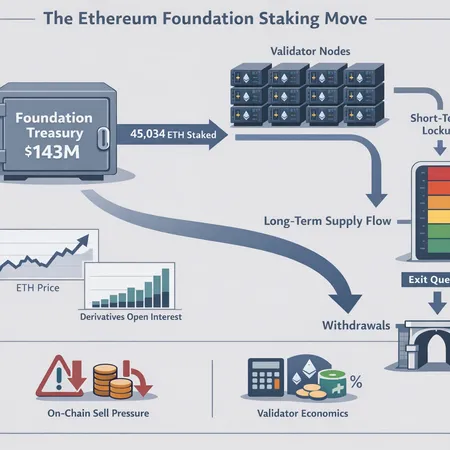
The Ethereum Foundation’s recent on‑chain staking of 45,034 ETH (part of a broader ~$143M deployment) is a clear vote of confidence from the treasury — but its market impact depends on validator economics, exit mechanics and existing on‑chain sell pressure. This article breaks down the mechanics, short‑ and long‑term supply effects, derivatives interactions, and the on‑chain metrics ETH holders should watch.

Solana staking yields are compressing due to protocol-driven supply dynamics, ecosystem revenue decline and validator competition. This analysis explains the drivers, compares emerging BTC reward models, and gives a risk-adjusted framework and practical steps for validators and delegated stakers.

Aster’s move to slash monthly token emissions by ~97% and pivot to staking-based rewards is a test case for radical tokenomics redesign in DeFi. This piece analyzes the mechanics, expected on-chain effects, comparisons with institutional designs like Aave v4, and practical strategies for token holders and product teams.

SOL’s on‑chain activity and new ETF staking distributions paint a mixed picture: strong throughput but weak price action. This article unpacks the drawdown, staking proceeds dynamics, and pragmatic trading scenarios for DeFi traders and on‑chain analysts.
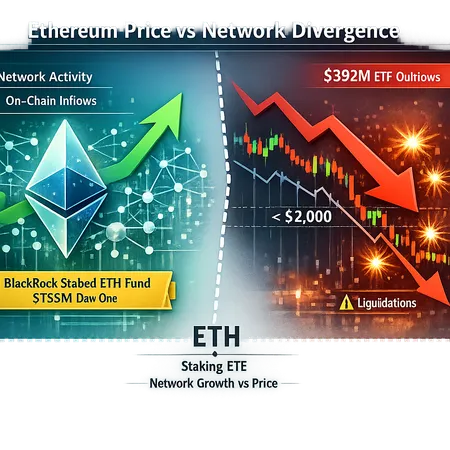
Ethereum’s network metrics show renewed activity and institutional staking demand even as ETH price slipped below $2,000. This article dissects the forces—BlackRock’s staking inflows, stablecoin and L1 activity, ETF outflows and liquidations—and the indicators that will decide whether price eventually follows fundamentals.

XRP's ecosystem shows renewed momentum: large-scale staking on Flare, rising derivatives interest, and a narrative shift toward payments and stablecoins are converging with PR wins to reshape adoption. This article breaks down what those signals mean for liquidity, protocol economics, and market risk.
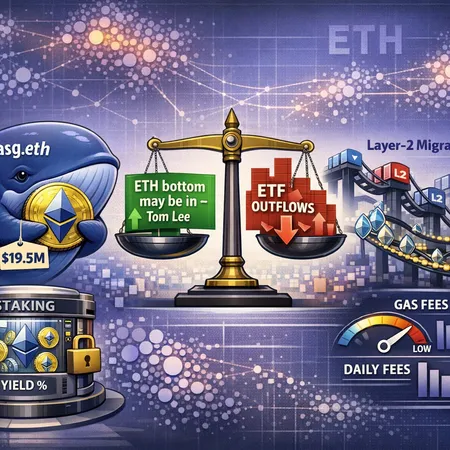
A close read of Ethereum’s recent on‑chain strength — highlighted by thomasg.eth’s $19.5M purchase and Tom Lee’s bullish note — versus structural signals like ETF outflows, falling fees and Layer‑2 migration. This piece weighs near‑term accumulation against long‑term revenue transition and staking implications.

Bittensor positions TAO as a token for an open AI marketplace that pays models and compute providers; its designers borrow Bitcoin-style scarcity to shape long-term token economics. This explainer walks through how the protocol works, why TAO’s scarcity matters, use cases and risks, and tactical entry considerations for investors and developers.

BlackRock’s iShares Staked Ethereum Trust (ETHB) launches a new channel for institutional staking demand. This article dissects ETHB’s structure, early inflows and whale buying, and how staked Ethereum ETFs may shift staking yield, liquidity and ETH/BTC dynamics.
DeFi
All DeFi postsBitcoin
All Bitcoin postsSecurity
All Security posts- Solana Risk Assessment After the Drift $285M Exploit: Price Damage, Supports, and Actionable Trading & Validator Controls
- Preparing for the Quantum Era: Post-Quantum Security for Stablecoin Rails — Arc & Naoris Case Studies
- Inside the April 1 Drift Protocol Hack: Reconstruction, North Korea Links, and a DeFi Security Playbook