Sei Network Staking in 2026: Why Fast Finality and EVM Compatibility Beat Headline APYs
Summary
Executive thesis
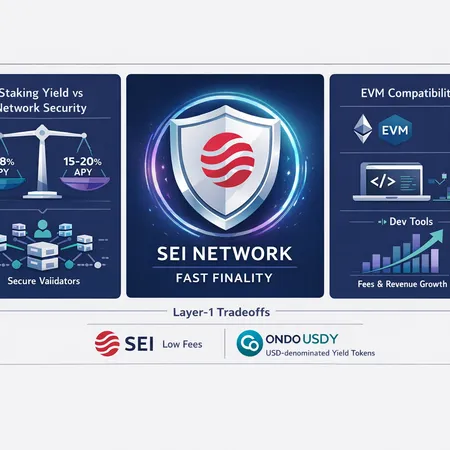
Short-term APYs are engaging, but they are only one axis of risk-adjusted return. For crypto-native yield investors in 2026, Sei Network presents a compelling practical case: fast finality reduces settlement and reorg risk, while EVM compatibility increases developer demand and fee-stack composability. Together these attributes can make a modest staking yield more valuable than a superficially higher APY on a slower or less composable chain. This article walks through how to evaluate staking yield versus network security/finality, the custody and liquid-staking landscape on Sei, the impact of EVM compatibility on developer demand and fees, and a comparison to other layer-1 staking tradeoffs.
Why finality matters more than headline APY
Finality is the economic guarantee that once a block is finalized, transactions are irreversible. For yield strategies that rely on fast execution, cross-chain settlement, or collateral rehypothecation, finality is not an academic point — it’s the backbone of risk budgeting. Fast finality reduces the chance of costly reorgs that can unwind staking rewards, liquid-stake positions, or lending collateral. When you calculate a portfolio-level expected return, the probability-weighted cost of a reorg should be subtracted from gross APY. That math often moves the needle against high-APY chains with slow or probabilistic finality.
Sei’s design priorities explicitly emphasize throughput and rapid finality, a fact discussed in recent protocol staking guides that stress how finality and compatibility often trump headline yields when you consider real-world operations and counterparty exposures (Sei Network staking guide). For traders and DeFi strategies that require deterministic settlement—market-makers cross-listing positions or strategies employing flash or near-flash settlements—this deterministic characteristic is an underappreciated source of alpha.
How to evaluate staking yields vs network security and finality
When comparing staking opportunities, use a checklist that goes beyond nominal APY:
- Effective staking yield: nominal APY minus expected dilution from inflation and commissions.
- Finality risk: probability and historical frequency of reorgs or consensus instability.
- Validator decentralization: concentration of stake among top validators and any slashing history.
- Fee regime and revenue sustainability: percentage of validator revenue from user fees vs token emissions.
- Liquidity and withdrawal friction: unbonding periods and cross-chain redemption routes.
A simple way to think about it: convert nonfinality risk into an expected annual cost and subtract that from headline APY. If Chain A offers 20% APY with a 5% annualized expected cost from reorgs/operational failures, while Chain B offers 10% APY with near-zero finality cost, Chain B might be the better risk-adjusted bet for capital that needs reliability. This is particularly true for multi-leg DeFi strategies where one failed settlement cascades into liquidation risk elsewhere.
Validator economics on Sei: practical points for stakers
Validator economics set the long-run sustainable yield. Key levers include commission rates, uptime and hardware costs, delegation concentration, and the share of revenue from fees vs emissions. On a growing L1 with healthy on-chain activity, fee revenue can replace inflationary rewards over time, reducing dilution for delegators and stabilizing staking yields.
For Sei, the interaction between fast finality and increasing EVM compatibility suggests two things: 1) as dApps and cross-rollup activity grows, protocol fee capture can become a larger portion of validator revenue, and 2) validator competition for performant infra will increase, pressuring commissions downwards but improving uptime—both good for delegators. These dynamics are why many professional stakers treat validator selection as an operational investment, not a passive checkbox.
Custody and liquid-staking options on Sei
Custody and liquid staking choices determine how flexible capital can be while still earning yield. The basic options are:
- Direct delegation to validators (highest control, longest unbonding friction).
- Native liquid staking derivatives (LSDs) that give a transferable token representing stake exposure.
- Custodial or institutional wrappers offering USD- or treasury-backed yield tokens.
Sei’s ecosystem is developing on both the LSD and institutional product fronts. A notable example is Ondo’s launch of a U.S. Dollar Yield Token (USDY) on Sei, which demonstrates real-world treasury-backed yield products arriving on the chain and gives stakers a USD-denominated route to transactable yield exposure (Ondo brings USDY to Sei). For investors focused on treasury-grade stability, USD-denominated yield tokens like ONDO’s USDY provide a hybrid: on-chain composability with an off-chain asset backing that changes the risk-return calculus.
When evaluating liquid-staking providers or custodial wrappers, ask: what collateral backs the product? Is there redemption certainty and who bears the liquidation risk? How does the provider handle slashing and downtime? Liquid staking improves capital efficiency but introduces counterparty and smart-contract risk that must be priced against the convenience of instant liquidity.
EVM compatibility: why it matters for fees, composability and demand
EVM compatibility is not just a developer convenience; it materially affects demand curves and fee dynamics. When an L1 supports EVM tooling, a large existing developer base can port contracts quickly, bringing immediate demand for blockspace and a more sophisticated set of applications (DEXs, automated market-makers, yield aggregators). This drives both short-term fee revenue and a longer-term network effects loop: better dApps attract users, which increases fee capture for validators and reduces reliance on inflationary rewards.
For Sei, adding EVM compatibility means traders and institutions who value existing tooling can build without a full rewrite. That lowers onboarding friction and can accelerate developer demand. Faster adoption increases transaction volume and fee stability—critical when assessing the sustainability of staking yields. In short: EVM compatibility is a lever that converts developer interest into measurable revenue for stakers.
Comparing Sei to other L1 staking tradeoffs
Put simply, observe three archetypes and where Sei fits:
- High-APY, probabilistic-finality chains: These offer mouthwatering yields but carry higher settlement and reorg risk; they also often depend heavily on token emissions that erode long-term value for delegators.
- Final but closed ecosystems: These provide stable finality and security but lack broad composability, limiting fee upside and developer-driven growth.
- Composable and final chains (Sei’s intended space): Aim to combine fast finality with EVM friendliness, arguably delivering better long-term, fee-supported staking economics even if nominal APYs are lower.
Compare to Ethereum (post-merge): its staking yield is lower but settlement finality and a strong fee market make staking an anchoring, low-friction proposition for long-term investors. Compare to certain high-throughput, less-decentralized L1s—those can offer higher short-term staking yield but with concentrated validator sets and centralization risk. Sei sits between those poles: promising better latency and finality than many high-APY chains, with greater composability than siloed ecosystems.
Practical playbook for yield-seeking investors and DeFi strategists
Define your settlement needs: if your strategy requires near-instant finality (arbitrage, market-making, cross-chain hedging), weight finality heavily. If you’re a long-term holder willing to bear unbonding windows, APY matters more.
Convert nonfinality risk into a dollars/year cost: historical reorg frequency * expected loss per event = annualized settlement cost. Subtract that from nominal APY to get a first-pass adjusted yield.
Evaluate revenue composition: chains where fees can grow to supplant inflation are preferable. Look at current fee share vs emissions and contractor/developer pipelines (EVM bridges, SDK adoption).
Choose custody with intent: direct delegation for maximal protocol exposure; liquid staking or products like USDY (ONDO) when you need USD-denominated stability or on-chain liquidity for leverage.
Monitor validator metrics: commissions, uptime, infra footprint and slashing history. Rebalance delegations periodically as margins compress or validator behavior changes.
Factor in composability: if you can use staked capital inside DeFi strategies without outsized risk, the effective ROI of staking rises materially.
Operational considerations and red flags
Watch for: sudden spikes in delegation concentration, repeated validator misbehavior, opaque custody terms from third-party product issuers, and anemic fee growth despite rising dApp counts. Institutional wrappers that advertise USD-denominated yields (like USDY) can be compelling but require scrutiny of custody arrangements, redemption mechanics and counterparty credit.
Also be mindful of ecosystem risk: EVM compatibility is an accelerator but also brings in cross-chain composability vectors (bridges, relayers) that introduce external attack surfaces. A disciplined risk assessment will treat these as separate modules: protocol finality risk, validator operational risk, and third-party counterparty risk.
Conclusion
In 2026, the decision of where to stake capital is less about chasing the highest APY and more about designing for real-world settlement needs, composability and sustainable revenue. Sei Network’s emphasis on fast finality and growing EVM compatibility changes the calculus: a modest staking yield on a chain where reorg risk is low and fee capture can grow is often a better long-term choice than a high APY on a less stable chain. Products such as ONDO’s USDY illustrate how USD-denominated, treasury-backed yield tokens are arriving on Sei and give investors more nuanced ways to capture yield while managing fiat risk.
For active DeFi strategists and yield allocators, the optimal approach mixes direct staking with selective use of liquid or custody-backed wrappers, aligned to strategy liquidity needs and settlement tolerances. Evaluating validator economics, fee regimes and the true cost of nonfinality will produce a far more robust, stress-tested yield book than chasing top-line APYs alone. Bitlet.app users and professional allocators alike should treat finality and composability as primary axes in their staking decision matrix.