Hyperliquid’s Washington Push: What Its Policy Center Means for Perpetuals and DeFi Regulation
Summary
Executive snapshot
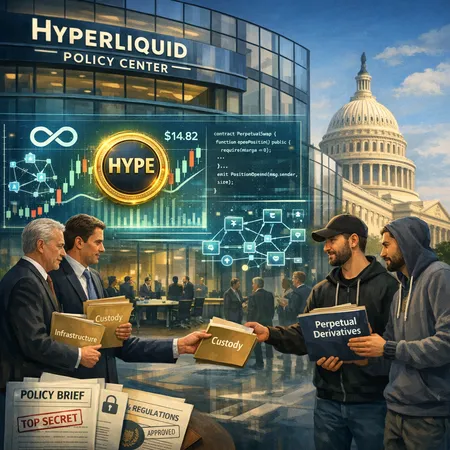
Hyperliquid’s decision to open a Washington Policy Center and to stand up a DeFi lobbying effort is more than PR: it’s a strategic bet that rule‑making cycles now reward organized, issue‑specific engagement. For industry insiders, this matters because the lobby’s priorities — perpetual derivatives, custody, and the infrastructure that underpins on‑chain trading — map directly onto the regulatory flashpoints most likely to shape capital flows, product design, and legal exposure over the next 12–24 months.
What launching a D.C. Policy Center signals about DeFi industry strategy
The move is a textbook example of professionalization. Early DeFi advocacy tended to be decentralized, ad hoc, and reactive: Twitter threads, GitHub governance proposals, occasional congressional testimony. Hyperliquid’s announcement reframes advocacy as an institutional activity requiring staff, policy research, and sustained proximity to lawmakers and regulators. That mirrors how legacy finance engages rule makers: persistent, technical, and focused on narrow asks rather than broad philosophical debates.
The timing also tells a story. Regulators and Congress increasingly ask for concrete guardrails around derivatives and trading infrastructure. By planting a flag in D.C., Hyperliquid aims to shape definitions and exemptions that could materially affect product legality and market access. For many traders, Bitcoin remains the primary bellwether, but derivatives and leverage markets are where much revenue and systemic risk reside — precisely the areas Hyperliquid’s policy shop highlights.
Industry playbook: targeted lobbying over broad messaging
Expect the Policy Center to push technical, narrowly scoped regulatory language: definitions of perpetual contracts, custody safe harbors for non‑custodial custodians, and standards for order‑matching and settlement providers. That approach increases the chances of winning discrete victories that preserve business models, instead of trying to fend off sweeping restrictions in one fight.
Regulatory targets: perpetual derivatives, custody, and infrastructure
Hyperliquid’s lobbying focus matches three converging regulatory themes. Each has different likely regulators, legal levers, and mitigation opportunities.
Perpetual derivatives
Perpetuals — the dominant margin product on many crypto venues — sit at the crossroads of CFTC and SEC jurisdictional debates. The CFTC treats many crypto derivatives as commodities, but questions about whether instruments or underlying tokens are securities complicate the picture. Hyperliquid’s prioritization of perpetuals suggests it will: argue for clear definitions that keep perpetuals within a derivatives framework; press for regulatory parity (so on‑chain perpetuals aren’t disadvantaged compared with centralized venues); and seek workable compliance templates for reporting, surveillance, and market‑integrity obligations.
Why this matters: rule changes that tighten registration, trade reporting, or capital requirements could either raise costs dramatically or force product redesigns. Hyperliquid is betting it can influence those rule contours before they harden.
Custody and custody‑adjacent rules
Custody is no longer a niche compliance checklist — it is a systemic focus for bank regulators, state money transmitter regimes, and securities law enforcement. DeFi players have long argued that true noncustodial architectures should sit outside traditional custody frameworks; regulators are skeptical and frequently look at economic control rather than technical custody models.
A successful policy push here would aim to create clear, tech‑aware custody definitions and safe harbors for noncustodial market makers, relayers, and settlement layers. That could reduce on‑chain friction (e.g., KYC/AML gating), but it will require technical proofs, auditability and remediation playbooks.
Infrastructure: matching, settlement, and node/network rules
Regulators increasingly see the “plumbing” — order books, matching engines, relayers, oracles, and settlement layers — as a place where operational risk aggregates. Hyperliquid’s lobbying is likely to advocate for proportional rules that recognize decentralized execution and settlement while addressing manipulation, front‑running, and resiliency concerns.
In short: expect arguments for tailored standards (operational, surveillance, and resilience) that recognize distributed architectures.
Market reaction and HYPE token risk as lobbying professionalizes
Hyperliquid’s story is not just policy — it’s a token story. HYPE’s earlier rally and subsequent cooling underline a broader market truth: regulatory activity is a double‑edged sword for native tokens.
Short term, announcements and perceived policy wins can attract speculative flows; longer term, professional lobbying raises a different set of risks. As Hyperliquid moves from grassroots to hired guns, tokenholders face:
- Reputation risk: lobbying can alienate segments of the community that prize decentralization. That friction can depress token utility or coordinated governance support.
- Execution risk: professional lobbyists cost money. If token-funded budgets are reprioritized toward DC staffing rather than product development, markets may reprice growth expectations.
- Concentration risk: centralizing political decision‑making into a policy center may expose leadership to targeted regulatory scrutiny or capture concerns.
Bitcoinist’s market note captured the initial dynamic: HYPE’s rally stalled after the announcement, underscoring short‑term momentum vulnerabilities even as the organization formalizes its policy efforts (see coverage of the rally cooling here). These dynamics create a path‑dependent risk profile — early speculation can flip to sustained discounting if token holders believe lobbying will dilute product or decentralization commitments.
How this compares with past DeFi industry advocacy
Past advocacy tended to split into two camps: independent think tanks and trade groups (e.g., Coin Center, industry coalitions) that focused on public goods and educational outreach, versus protocol‑led, transaction‑oriented lobbying. Hyperliquid’s model sits somewhere between: it’s a protocol actor creating a hybrid policy shop that combines technical expertise with business advocacy.
That hybrid differs from purely academic advocacy in one key way: it brings live commercial interests (perpetuals and market infrastructure) into the room. This can be powerful — regulators get practical, implementable policy proposals — but it also invites skepticism about whose interests are prioritized.
The new center resembles other modern efforts where market participants build in‑house policy capacity rather than relying solely on umbrella associations. Coverage of the initiative in industry outlets emphasized this practical orientation and the Washington strategy's focus on derivatives infrastructure (Hyperliquid launches a D.C.-based Policy Center and additional reporting on the lobby here).
Practical implications for DeFi teams and institutional investors
Whether you’re building perpetual engines, running an oracle network, or allocating capital to tokens like HYPE, Hyperliquid’s D.C. push changes planning assumptions. Practical steps to consider:
- Governance and documentation: publish clear risk frameworks, decision‑trees, and on‑chain governance logs. Regulators and policymakers respond to auditable processes as much as rhetoric.
- Compliance by design: start thinking in terms of modular, auditable controls for surveillance, trade reporting, and self‑executing AML guardrails. That lowers the cost of negotiation with regulators.
- Engage early: join or form coalitions. One protocol lobbying alone has less leverage than an industry coalition that can credibly argue for uniform standards.
- Token economics review: assess how policy spending is financed and whether token holders have meaningful say. Consider lockups, treasury governance, and transparency to reduce market overreaction.
- Scenario planning: model multiple outcomes — full clarity that preserves product models, stricter regimes that require product rewrites, and hostile outcomes where derivatives are limited. Each scenario should have capital, legal, and product contingencies.
Institutional investors should also pay close attention to on‑chain indicators (volumes, open interest, counterparty concentration) while recalibrating risk premiums for tokens whose issuing organizations concentrate political power.
Platforms like Bitlet.app that offer custody, earn, or P2P exchange services will watch these developments closely, as any definitional shifts around custody or derivatives could alter product offerings and compliance obligations.
What to watch next — practical milestones and regulatory theatre
A few near‑term markers will indicate whether Hyperliquid’s D.C. strategy gains traction:
- Rulemaking and guidance: watch statements, petitions, and concept releases from the CFTC and SEC related to derivatives and decentralized trading.
- Congressional hearings: invited testimony or hearings focused on crypto market structure — especially around leverage and consumer protection — will be flashpoints.
- Coalition formation: who joins Hyperliquid’s effort, and whether trade bodies or major exchanges publicly align, will signal whether this becomes an industry front.
- Market metrics: HYPE flows, on‑chain open interest in perpetuals, and centralized venue derivatives volumes will show whether policy noise undermines product demand.
Conclusion
Hyperliquid’s Policy Center and Washington lobbying push are a signal that DeFi is moving from ad hoc protest to strategic, technical advocacy. That shift can help create workable guardrails for perpetual derivatives and infrastructure — but it also creates new token and reputational risks as projects trade some elements of decentralization for regulatory influence.
For founders, policy analysts, and institutional investors, the right play is pragmatic engagement: document, prepare, and participate. Proactive policy work combined with transparent governance and risk controls gives projects the best chance to shape rules rather than be shaped by them — and that will matter for both product viability and token value.
Sources
- Hyperliquid launches a D.C.-based Policy Center to advocate for clearer federal DeFi rules: https://bitcoinist.com/hyperliquid-launches-d-c-policy-center/
- Coverage of Hyperliquid launching a DeFi lobby in Washington focused on perpetual derivatives and infrastructure: https://thenewscrypto.com/hyperliquid-launches-defi-lobby-in-washington/?utm_source=snapi
- Market note on HYPE token momentum cooling after an earlier rally: https://bitcoinist.com/hyperliquid-rally-stalls-near-30-will-hype-slide/