How Binance’s $9B Stablecoin Outflow Raises Liquidity, Margin, and Systemic Risks
Summary
Executive summary
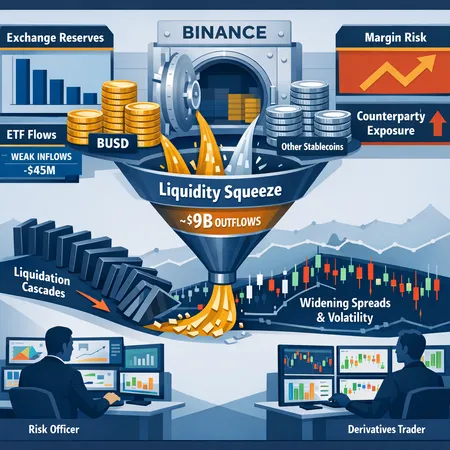
Binance reported a roughly $9 billion decline in exchange-backed stablecoin reserves over a three-month window — a meaningful contraction of on‑exchange dollar liquidity. That drop, concentrated in BUSD and other stablecoins, matters because exchange reserves are the plumbing for margin, redemptions, and arbitrage. When the plumbing tightens, price moves become deeper and more violent: liquidation cascades get larger, spreads widen, and funding/fair‑value dynamics shift. Professional traders and risk officers need to treat reserve outflows as a macro liquidity risk factor, complementing traditional market signals like funding rates and open interest.
What the on‑chain and exchange data show
Crypto.News reported the aggregate decline in Binance’s stablecoin reserves of about $9B over three months, a tangible reduction in exchange‑backed liquidity. The outflows were not limited to a single token; they affected BUSD and other large stablecoins that exchanges hold to support withdrawals, margin collateral, and internal settlement.
This is not merely an accounting footnote. Exchange stablecoin balances are a form of runnable short‑term funding: they sit on the balance sheet and are available immediately for users to withdraw or deploy into markets. When those balances fall, the exchange has less capacity to absorb withdrawals without selling assets or tightening margin conditions. See the reporting here for details: Crypto.News report on Binance reserve declines.
Why exchange‑backed stablecoin reserves matter for liquidity
There are three core channels by which exchange stablecoin reserves support market functioning:
- On‑exchange settlement and withdrawals: Stablecoins enable users to exit positions or move into funding vehicles quickly. Lower reserves mean slower or more expensive exits.
- Margin and collateralization: Exchanges accept stablecoins as collateral for futures and margin trading. Reduced stablecoin inventories force exchanges to increase haircuts or call margin earlier.
- Arbitrage and market‑making: Market makers and arbitrageurs rely on on‑exchange stablecoins to capture cross‑market spreads. Less available stablecoin liquidity impairs their ability to provide two‑sided liquidity, widening spreads.
When reserves contract, all three channels deteriorate. That manifests as wider bid/ask spreads, larger basis between spot and perpetuals, and higher realized slippage on large orders.
How dwindling reserves amplify liquidation cascades and margin risk
The mechanics of a liquidation cascade in a liquidity‑constrained environment are straightforward but brutal:
- A negative price shock reduces collateral values. Levered accounts hit margin thresholds.
- Exchanges need stablecoins or fiat to settle margin calls and to facilitate forced liquidations. If on‑exchange stablecoins are scarce, the exchange may execute larger market sales into an already weak market — increasing price impact.
- Larger forced sales push prices further down, triggering more liquidations in a feedback loop.
A smaller pool of exchange‑backed stablecoins intensifies steps 2 and 3. With fewer stablecoins available, exchanges and market makers may be forced to use spot BTC or other volatile assets to satisfy withdrawal and margin needs, producing deeper price moves and wider spreads. This is a classic liquidity‑driven margin spiral: the less buffer you have, the more likely a small shock cascades into a systemic event.
Two additional amplification mechanisms to watch:
- Funding rate and open interest feedbacks: When liquidity thins, funding rates can spike or invert, producing rapid deleveraging among funding‑sensitive positions.
- Cross‑market contagion: If stablecoin withdrawals occur on one major exchange, arbitrageurs that normally supply liquidity across venues lose capacity, widening spreads across the entire ecosystem (spot, perpetuals, ETFs).
Evidence from BTC derivatives and ETF flow weakness
Independent market data shows strains consistent with fading marginal demand. Recent coverage in CoinDesk highlights that Bitcoin remained under pressure near USD 68,000 with derivatives and ETF metrics pointing to weak demand, even as panic selling ebbed. That softness in derivatives/ETF flows implies fewer marginal buyers to absorb forced selling, which raises the probability of larger price moves for a given liquidation size. See the CoinDesk analysis here: Bitcoin under pressure; derivatives and ETF metrics weak.
Put simply: when on‑exchange stablecoin reserves fall at the same time that marginal demand (from ETF flows and futures buyers) weakens, the market loses both the dry powder and the buyers-of-last-resort. That combination increases the market impact of liquidations and makes funding and basis dynamics more volatile.
Practical warnings for traders and risk teams
Below are concrete, tactical controls and monitoring steps for risk officers, derivatives traders, and portfolio managers.
1) Monitor exchange reserves and on‑chain flows continuously
- Track exchange‑level stablecoin balances (not just circulating supply). Large outflows from major exchange reserves are a primary early‑warning indicator.
- Watch cross‑exchange balances: concentration on a single venue increases counterparty and liquidity risk.
- Set alerts for peg deviations and large stablecoin transfers to cold wallets or custodians.
2) Tighten collateral policy and dynamic haircuts
- Increase haircuts on stablecoin collateral when exchange reserves decline or peg stress grows.
- Require higher‑quality collateral (e.g., on‑chain fiat‑settled instruments, short‑dated liquid treasuries via tokenized products where available) for large counterparty exposures.
- Limit exposure to a single stablecoin and a single exchange; diversify redemption paths.
3) Stress‑test for liquidity squeezes, not just price shocks
- Run scenarios where exchange stablecoin liquidity drops 20–50% within a week while BTC falls 15–30% over 48 hours. Model the combined effect on liquidation rates, slippage, and margin utility.
- Simulate widening spreads and reduced market‑making capacity to estimate true liquidation costs (not just MPT‑style mark‑to‑market losses).
- Make stress tests forward‑looking: include reduced ETF inflows and lower market‑making participation as parameters.
4) Manage counterparty and settlement exposure
- Limit unsecured exposure to exchanges in proportion to their reserve buffers.
- Consider prefunding withdrawals or using multi‑custodial settlement for large redemptions.
- Reduce intraday concentration: avoid large intraday limit orders that depend on thin two‑sided liquidity.
5) Trading desk tactics during reserve stress
- Reduce aggressive limit order sizes; split executions and use TWAP/VWAP with liquidity‑sensitive slippage caps.
- Hedge delta using smaller, more granular trades across venues instead of single large fills.
- Use options and structured products to transfer tail risk rather than relying solely on spot liquidation.
Note: platforms like Bitlet.app provide portfolio and risk tooling that can feed into these stress‑test frameworks; treat them as inputs, not substitutes, for firm risk policy.
Key indicators and suggested thresholds (early warning dashboard)
Create a short dashboard for live monitoring. Suggested indicators and trigger thresholds:
- Exchange stablecoin reserves (absolute and 30‑/90‑day change): trigger at −10% monthly or >−20% over 90 days on a major exchange.
- BTC funding and basis spread: trigger when funding moves more than 50 bps intraday or basis widens beyond historical 2σ for more than 24 hours.
- Spot bid‑ask spread and depth at size: trigger when depth at $10M notional falls below a historical percentile (e.g., 10th percentile).
- ETF net flows and derivatives open interest: trigger on consecutive days of negative net ETF flows and >5% drop in open interest.
- Large stablecoin transfers off exchanges: trigger for single transfers >$100M or aggregated transfers >$500M in 24 hours.
These thresholds should be calibrated to desk size and risk appetite; the point is to marry on‑chain reserve metrics with market microstructure signals.
Policy implications and systemic risk pitch
From a systemic perspective, concentrated declines in exchange stablecoin reserves create a credible run scenario: users attempt to move into custody or fiat, exchanges must either sell volatile assets or slow redemptions, and arbitrage channels narrow. Regulators and large custodians have long worried about such dynamics — a stablecoin drain is functionally similar to a bank run when redemption rails are constrained.
Risk teams should therefore treat stablecoin reserve metrics as core prudential indicators, alongside leverage, margin utilization, and concentration risk. For firms underwriting leverage or operating principal trading, conservative limits on exchange counterparty exposure and higher capital buffers for margin trading are prudent.
Concluding notes
Binance’s roughly $9B decline in exchange-backed stablecoin reserves is not an isolated accounting item: it signals lower on‑exchange dollar liquidity at a time when marginal demand metrics for BTC look weak. The combination raises the odds of larger, liquidity‑driven price moves and increases systemic fragility. For derivatives traders and risk teams, the right response is not panic but disciplined risk management: monitor reserves and funding, raise haircuts dynamically, run combined liquidity‑plus‑price stress tests, and limit single‑exchange concentration.
Markets can absorb big moves when there are buyers with dry powder and market makers willing to commit capital. When both the dry powder (stablecoin reserves) and the buyers thin, the cost of being wrong on a levered position rises fast.
Sources
- Binance stablecoin reserve drop and analysis: https://crypto.news/binance-stablecoin-reserves-drop-9b-signal-fading-risk-appetite/
- BTC derivatives and ETF flow coverage: https://www.coindesk.com/markets/2026/02/17/bitcoin-remains-under-pressure-near-usd68-000-even-as-panic-ebbs
For many desk‑level decisions, combine these macro indicators with venue‑specific metrics and desk execution analytics. For context on how liquidity functions across protocols and market segments, consider cross‑checking on‑chain DeFi liquidity metrics and Bitcoin derivatives flows to form a complete picture.