Have Ethereum’s Upgrades Solved the Blockchain Trilemma? What It Means for ETH in 2026
Summary
Executive snapshot
Ethereum’s 2024–2025 upgrades and the concurrent growth in application activity have prompted a simple question among investors and builders: have we finally tamed the blockchain trilemma? Vitalik Buterin has publicly argued that the combination of protocol-level changes and an ecosystem of layer‑2s meaningfully addresses the trade-offs between security, scalability and decentralization. That’s a bold claim — and it matters for ETH as a macro asset because protocol-level assurances change risk, liquidity and yield dynamics for holders and institutions.
This article unpacks Buterin’s assertion, looks at 2025 DeFi and stablecoin data, examines institutional ETH staking behavior, and lays out the key risks and adoption catalysts that will shape market positioning into 2026. I reference protocol analysis and fresh on‑chain evidence, and I frame what this means for intermediate-to-advanced crypto investors and dev‑ops readers designing for production.
How the upgrades aim to address the blockchain trilemma
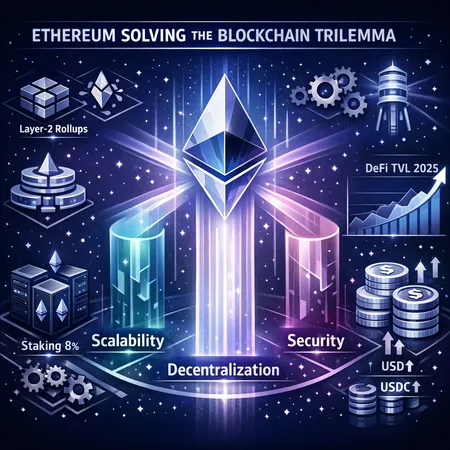
The classical blockchain trilemma posits an inverse relationship between security, scalability and decentralization: improving one or two often weakens the third. Ethereum’s strategy over the last several years has been to re-architect the stack so those trade-offs become less binary.
Vitalik Buterin has argued that recent upgrades — including execution/consensus separation, the merge-era security improvements, and the continued rollout of rollup-centric primitives — move the protocol beyond a simple trilemma framing. In his assessment he emphasizes that layering and richer client ecosystems allow the base layer to optimize for security and decentralization while Layer‑2s take on most execution load. See Buterin’s commentary for his full framing and reasoning: Vitalik Buterin on upgrades and the trilemma.
Concretely, the approach rests on three components:
- A secure and energy‑efficient consensus layer that anchors finality and stake-based security (post‑Merge and ongoing hardening). This preserves security and enables advanced cryptographic tooling.
- A lean base layer that deliberately avoids becoming the primary execution plane, boosting decentralization by keeping node requirements moderate and encouraging diverse client implementations.
- Layer‑2 execution environments (optimistic rollups, zk‑rollups) that deliver scalability without forcing the base layer to sacrifice security.
This is not magic — it’s architecture. The claim is not that every single trade-off disappears, but that the trade-off surface shrinks: you can now scale throughput dramatically without proportionally weakening security or forcing centralization at the base layer.
Evidence from 2025: DeFi TVL and stablecoin activity
If architecture is theory, on‑chain activity is evidence. Throughout 2025 Ethereum saw measurable growth in DeFi activity and stablecoin flows that suggest capacity and UX have improved enough to support higher economic throughput.
A recent data review noted that DeFi and stablecoin activity on Ethereum increased in 2025, driven by yield products, DEX volumes, and treasury deployments that used L2 rails to lower fees and latency. That analysis highlights rising Total Value Locked (DeFi TVL) and increased stablecoin turnover as practical indicators that upgrades plus Layer‑2 adoption are enabling more capital to flow on‑chain without overwhelming the base layer. See the 2025 review for the detailed TVL context: Ethereum reports growth in DeFi and stablecoin activity for 2025.
Why this matters:
- Rising DeFi TVL concentrated on L2s means demand for blockspace can be satisfied off‑chain, reducing fee spikes while preserving finality on the beacon chain.
- Stablecoin velocity and larger treasury operations on Ethereum signal that the network is being used for real settlement flows — not just speculation — which supports ETH’s case as an economic primitive.
The caveat: TVL and activity can be cyclical and sensitive to yield environments. But combined with lower effective fees on optimistic and zk rollups, the 2025 data says the network is being used more productively, which supports the notion that the trilemma is being mitigated in practice.
ETH staking: institutional dynamics and large staking entities
Security in a PoS system scales with stake concentration — but concentration carries both benefits and governance risks. 2025 continued to show large staking actors accumulating ETH, and operators expanding custodial and non‑custodial options.
One visible example is major staking operators adding significant amounts of ETH to their pools, a dynamic that both increases network security (more stake securing consensus) and centralizes effective voting power at scale. Reporting on institutional staking flows highlights episodes where large entities staked tens of thousands of ETH, changing the distribution curve of validators and locking up supply on long or indeterminate timelines. For a concrete example of large on‑chain staking accumulation: Bitmine stakes additional 86,400 ETH.
Key implications for investors and infra teams:
- Supply mechanics: As staking demand and institutional custody integrate, the fraction of circulating ETH that is liquid can decline, potentially compressing free float and affecting price discovery.
- Yield and deployability: Institutional staking increases the options for yield-bearing exposure to ETH but also introduces slashing and withdrawal risk considerations for custodians and treasury managers.
- Governance and decentralization: Large staking pools improve security but can concentrate proposer/attester influence. The risk profile depends on how widely custody and node operation are distributed across independent operators.
Services like Bitlet.app that facilitate staggered or custodial approaches to crypto holdings are part of this evolving operational landscape — they make yield and staking accessible but also shift how liquidity and governance risks are managed in practice.
Market sentiment and positioning heading into 2026
By late 2025 the narrative around Ethereum had shifted from an “experiment in scalability” to a plausible infrastructure for high‑throughput financial rails. Market sentiment reflected that transition, with more macro allocators and DeFi treasuries taking balanced positions: some gradually increasing ETH exposure for tactical appreciation and staking yield, others hedging via derivatives or maintaining allocations to L2-native assets.
Positioning signals to watch:
- Derivatives term structure: Steep contango or backwardation in ETH futures gives clues about short-term funding pressures and expected supply scarcity from staking inflows.
- Exchange inventories and OTC flows: Persistent withdrawals from exchanges into custody or staking suggest longer-term holder conviction.
- On‑chain staking ratios: A rising share of staked ETH reduces circulating supply; if unaccompanied by liquidity‑generating solutions, it can amplify volatility on flows.
Investors should consider that protocol upgrades have changed the calculus: Ethereum now resembles a hybrid macro asset that offers protocol-native yield (staking), settlement rails (stablecoins on L2s), and optional execution risk (choice of rollup). That combination can attract diversified capital, but it also leads to sophisticated strategies that exploit fee, yield and MEV differences across layers.
Remaining risks and open issues
Despite progress, several real risks and unresolved challenges mean the trilemma narrative should be viewed as mitigated, not conquered.
- Complexity and coordination risk: A layered ecosystem increases the number of interdependent moving parts. Cross‑layer bridges, sequencer economics, and upgrade coordination create vectors for systemic incidents.
- MEV and incentive alignment: As execution moves to rollups, MEV extraction patterns change. If MEV rewards concentrate, sequencer centralization or undue rent capture could alter economic fairness.
- Centralization via staking and infra: Large staking pools and dominant sequencer or node operators create single points of influence that could pressure decentralization goals.
- Regulatory uncertainty: Stablecoin regulation, custody rules, and securities classifications remain wildcards that can reshape capital flows and institutional willingness to hold ETH.
- UX and liquidity constraints: Even with cheaper L2 execution, cross‑layer liquidity fragmentation can hinder composability and increase slippage for large flows.
These are not theoretical quibbles — they’re practical issues dev‑ops teams, treasury managers, and protocol designers must account for when architecting resilient systems.
Adoption catalysts that would reinforce the bullish ETH macro story
Several developments would clearly strengthen the narrative that Ethereum’s upgrades are delivering durable macro value for ETH:
- Widespread zk‑rollup adoption: zk rollups offering native composability and cheaper finality would materially increase usable throughput while reducing reliance on optimistic fraud proofs.
- Mature fee markets and predictable sequencer economics: Stable, transparent fee models on L2s that reduce variance in user costs will encourage larger off‑chain settlement use cases.
- Institutional settlement flows: More treasuries and custodians settling in on‑chain stablecoins and routing payments over L2s would lock in real economic demand.
- Cross‑chain liquidity fabrics: Secure, permissionless bridges with proven safety would reduce fragmentation and enable large capital to move efficiently between L2s and other chains.
- Clear regulatory frameworks for staking and stablecoins: Reasonable rules that allow custodial staking and regulated stablecoin issuance could unlock more institutional balance sheet allocations to ETH.
If these catalysts align, ETH’s narrative as a macro asset — a scarce, yield‑bearing settlement layer for global digital value transfer — becomes harder to dispute.
Practical takeaways for investors and builders
- For macro investors: Treat ETH as a layered macro exposure where price appreciation, staking yield, and settlement demand all matter. Monitor staking ratios, exchange flows, and derivatives structure rather than relying on a single price indicator.
- For devs and infra teams: Design for cross‑layer observability, MEV-aware transaction flows, and sequencer failure modes. Testing bridge and withdraw patterns under stress scenarios will reduce systemic risk.
- For treasuries and custodians: Weigh liquidity needs against staking yields. Large locking operations materially affect float; staggered strategies or liquid staking derivatives can offer compromise but introduce counterparty and composability risks.
Conclusion
Ethereum’s recent protocol upgrades and stronger L2 adoption have materially reduced the friction that made the classic blockchain trilemma a tighter constraint. Vitalik Buterin’s framing — that a layered architecture can decouple security, scalability and decentralization — is supported by both design logic and growing 2025 on‑chain activity in DeFi and stablecoins. Nonetheless, significant execution, governance and regulatory risks remain.
For ETH as a macro asset, the net effect is that the risk‑return profile has evolved: there is now a clearer path for ETH to serve as both a settlement asset and a yield-bearing store of value. But this path depends on continued careful coordination across layers, the maturation of sequencer economics, and constructive regulatory outcomes.
If you’re positioning for 2026, focus on supply dynamics (staking share), cross‑layer liquidity, and the health of L2 fee markets — those variables will determine whether the mitigated trilemma turns into durable, real‑world adoption.
Sources
- Vitalik Buterin on the trilemma and upgrades: https://www.crypto-reporter.com/news/ethereum-charts-a-path-beyond-the-blockchain-trilemma-buterin-says-120545/
- Data review on Ethereum’s 2025 DeFi and stablecoin growth: https://thecurrencyanalytics.com/altcoins/ethereum-reports-growth-in-defi-and-stablecoin-activity-for-2025-235037
- Example of large-scale staking accumulation by a staking operator: https://www.cryptopolitan.com/bitmine-stakes-additional-86400-eth/