Dividends in Crypto: How Elemental Royalty's XAUt Payout Could Rewire Commodity Distributions
Summary
Why Elemental Royalty’s XAUT Dividend Matters
Elemental Royalty’s announcement that shareholders can receive dividends in Tether Gold (XAUt) is more than a novelty: it’s a practical experiment in tokenized commodity payouts. Rather than a cash transfer, shareholders can elect to take dividend value as a token that represents ownership of physical gold. For corporate finance teams and wealth managers, this raises immediate operational, regulatory and client‑reporting questions.
Tokenized commodity payouts combine two trends: investor demand for direct commodity exposure and the maturation of tokenised settlement rails. For context, tokenized gold has already grown into a multi‑billion‑dollar market, with XAUt among the leading tokens by market share and liquidity in that segment [per market coverage on the offering]. This is why the move is worth examining—not just as an isolated corporate action but as a model other resource companies could replicate.
Deal mechanics: how dividends paid in XAUT actually work
At a high level, paying dividends in XAUT is a dividend‑in‑kind. The company determines the cash-equivalent dividend amount (e.g., $0.10 per share) and offers shareholders the option to receive an equivalent value denominated in XAUT. Practical mechanics typically include:
- Board approval and shareholder communication specifying the conversion method and record/payment dates.
- Calculation of the dividend value in fiat and conversion to XAUT at a stated spot or average price over a defined window.
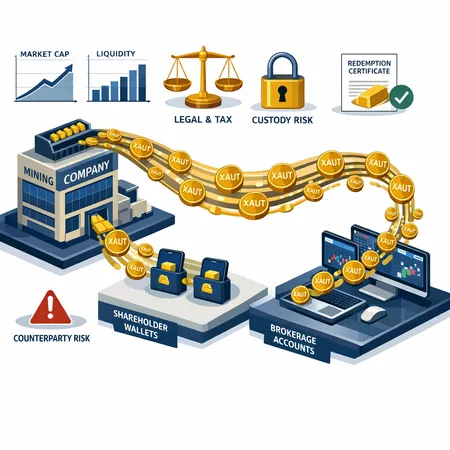
- Distribution route: the company (or an agent) transfers XAUT tokens to shareholders’ specified wallets—or to a custodian that holds tokens on behalf of beneficiaries.
- Election mechanism and fallback: shareholders usually must opt in; otherwise they receive fiat. If a shareholder can’t or won’t accept tokens (e.g., no compatible wallet), the company pays cash.
Operationally, this requires a payments agent or transfer agent that can interact with token rails, perform KYC and execute token transfers. Companies may choose to distribute to custodial addresses only, avoiding the complexity of sending tokens to unknown self‑custody addresses. That said, effective shareholder onboarding and clear KYC instructions are crucial.
What actually lands in the investor’s account
If an investor elects XAUT, they receive tokens representing allocated or pooled physical gold that the issuer (Tether, in this case) claims to hold in custody. The token balance sits in their ERC‑20 wallet (or on whichever chain XAUT is issued) and can be traded on exchanges, held for price exposure, or submitted for redemption where supported.
Market size and liquidity context for tokenized gold and XAUT
Tokenized gold is not fringe anymore. Coverage of the space notes a multi‑billion dollar market for tokenized gold instruments, with XAUT among the dominant players in terms of market share and secondary‑market liquidity. That matters because the viability of accepting dividends in XAUT depends heavily on:
- Secondary‑market liquidity (the ability to sell tokens quickly and at low spread).
- Depth across trading venues, which affects execution costs for investors who want fiat instead of tokens.
- Redemption rails and the minimums/fees charged by the issuer and authorized redeemers.
While XAUT tends to trade on multiple centralized and decentralized venues, spreads can widen in thin markets. For large shareholders—think fiduciary accounts or wealth management mandates—liquidity constraints and market impact should be modeled before electing tokenized payouts.
Legal and tax considerations: what corporate counsel and tax advisors must assess
Paying dividends in a token introduces several legal and tax questions that vary by jurisdiction. Below are the key issues corporate and tax teams should evaluate.
Tax characterization and valuation
- Taxable event: Most tax authorities will treat an in‑kind dividend as income to the recipient, taxable at the fair market value at the time of receipt. That means a shareholder who receives XAUT will likely recognize income equal to the fiat value of the XAUT received on the payment date.
- Basis and subsequent taxation: The shareholder’s cost basis in the token is typically the amount included as dividend income. Future sales or redemptions will trigger capital gains/losses measured from that basis. Wealth managers should be prepared to report dividend income and later capital events.
- Withholding: For cross‑border shareholders, withholding obligations may still apply in cash equivalents; paying in token does not negate cross‑border tax rules.
Tax treatment can differ for corporate recipients and pension funds; always confirm with local counsel and tax advisors.
Securities and corporate law
- Shareholder approval and disclosure: Changing the form of dividend payment often requires clear board resolution and shareholder communication. Some jurisdictions may require explicit shareholder consent for non‑cash dividends.
- Regulatory compliance: Distributing tokens intersects with securities, commodities and payments regulation. Companies must ensure compliance with anti‑money laundering (AML) and know‑your‑customer (KYC) rules when transferring tokens to shareholder wallets.
Contractual and operational rights
- Dividend mechanics should be reflected in dividend policies or shareholder circulars, explaining conversion rates, timelines, and how to elect a cash alternative.
- The company should define liability if the token issuer or network fails to deliver or if tokens are frozen.
In short: treating a token as a permitted dividend medium is feasible, but it’s not a paperwork‑free path. Legal and tax opinions are essential before implementation.
Institutional uptake and strategic implications for corporate dividend policy
Elemental Royalty’s move arrives as institutions show growing comfort with tokenized yields and regulated token products. Recent launches such as Grayscale’s staking ETF and institutional products tied to staking demonstrate that regulated vehicles can incorporate token economics into mainstream investment products. See the Grayscale Sui staking ETF for an example of regulated staking exposure gaining a formal structure, and BlackRock’s approach to aggressive staking for its Ethereum ETF highlights how large managers think about tokenized yield and custody tradeoffs.
These parallels matter because they indicate institutional frameworks are being built around custody, compliance and reporting for tokenized assets. For resource companies, the implications include:
- More flexible shareholder choice: Companies can expand dividend options, letting investors choose exposure to the commodity, fiat, or other assets.
- Balance sheet and payout strategy: Tokenized payouts could reduce cash outflows and preserve liquidity, especially for junior miners or royalty firms with thin cash positions.
- Market signaling: Offering tokenized commodity payouts may attract investors wanting direct commodity exposure (a new investor cohort) but could deter traditional income investors who prefer fiat.
Corporate finance teams should run scenario analysis to assess the reputational, liquidity and tax consequences before adopting tokenized payouts broadly.
Practical guide for investors: custody, redemption and counterparty risks
If a client asks whether to accept dividends in XAUT, here is a practical checklist wealth managers and custodians should follow.
1) Custody options and custody risk
- Self‑custody: The investor receives tokens in a personal wallet (private keys held by the investor). This option gives full control but exposes the investor to private key loss, user error, and limited institutional protections.
- Institutional/qualified custodians: Regulated custodians (crypto custodians or banks offering token custody) provide insurance, operational controls and custody segregation. For high‑net‑worth or fiduciary assets, custodial solutions reduce operational and compliance risk.
- Custody risk: Evaluate the custodian’s insurer, coverage limits, operational history, and whether they support XAUT specifically.
2) Redemption mechanics (token → gold or fiat)
- Redemption to physical gold: Some token issuers support redemption of tokens for allocated physical gold through authorized dealers, often subject to minimums, KYC, delivery fees and logistical delays.
- Redemption to fiat: Investors can sell XAUT on an exchange for fiat or a stablecoin, but execution costs depend on liquidity and venue. For large blocks, block trades or OTC desks may be necessary.
- Check minimums and timelines: Read issuer terms to know minimum redemption amounts, lead times and fees.
3) Counterparty risk and issuer transparency
- Issuer reserves and audits: Tokenized commodity tokens are only as good as their backing. Confirm the issuer’s transparency practices, independent audits, and clarity on whether the token is allocated (specific bars) or pooled.
- Operational resilience: Evaluate whether the token has been involved in custody disputes, freezes or regulatory action.
- Market representation: Some tokens trade more widely than others; XAUT enjoys better visibility, but investors should still assess concentration and navigability of order books.
4) Wallet compatibility and corporate administrative readiness
- Corporate share registers and transfer agents: Companies should coordinate with transfer agents to accept wallet addresses, record KYC, and handle fractional distributions.
- Wallet compatibility: Ensure clients have wallets that support the token’s chain (e.g., ERC‑20 environments) and understand gas fee implications for transfers.
5) Reporting and audit trail
- Maintain records: Dividend election confirmations, token receipt timestamps, FMV used for income reporting and subsequent trade/redemption records.
- Tax reporting needs: Be ready to report dividend income and capital gains/losses, and support clients during audits with clear documentation.
Risks and mitigants
- Liquidity risk: Large holders may face market impact when converting tokens to cash. Mitigate with staggered sales, OTC desks, or liquidity provision agreements.
- Custodial failure: Use reputable, insured custodians and avoid concentrated custody with a single unvetted provider.
- Regulatory risk: Ongoing legal changes could affect transferability or recognition of tokenized commodities—monitor developments and maintain contingency plans.
- Price volatility and basis risk: If the token’s market price diverges from spot physical gold due to spreads, sellers can experience execution slippage.
Practical steps for corporate finance teams considering tokenized payouts
- Obtain legal and tax opinions in relevant jurisdictions.
- Define clear shareholder election mechanics and fallback cash options.
- Partner with regulated custodians and transfer agents that support token rails and KYC obligations.
- Model liquidity scenarios and provide guidance for large shareholders on redemption pathways.
- Prepare reporting templates for tax and auditing purposes.
Companies that pilot tokenized dividends should run limited pilots, document operational lessons, and communicate transparently with investors.
Conclusion
Elemental Royalty’s XAUT dividend option is a timely case study in how tokenized commodities can be integrated into corporate distributions. The approach offers benefits—direct commodity exposure for shareholders, possible cash conservation for issuers—but it also brings new operational, tax and regulatory complexity. As institutional frameworks mature (illustrated by regulated staking ETFs and tokenized yield products), tokenized payouts become more feasible for mainstream issuers. That said, corporate finance teams and wealth managers must combine legal diligence, robust custody arrangements and clear client communication before treating tokenized dividends as a routine option.
For advisors and corporate teams assessing this model, the pragmatic path is a staged implementation: pilot small distributions, verify redemption rails and custodial controls, and translate technical operations into crisp tax and compliance guidance for clients. Platforms and services like Bitlet.app are part of a growing ecosystem that can help bridge tokenized rails and traditional investor needs—but the core requirement remains careful legal and operational design.
Sources
- Elemental Royalty becomes first public gold firm to offer dividends in Tether Gold (XAUt)
- Grayscale launches Sui staking ETF on NYSE Arca
- BlackRock's Ethereum ETF aims for aggressive staking
For further reading on how digital assets are reshaping corporate and institutional payout mechanics, see work on tokenized commodities and custody practices, and review issuer documentation when evaluating any tokenized dividend offer.
For many traders, Bitcoin remains the primary market bellwether; for institutional custody and yield conversations, research into DeFi protocols and regulated token products will also prove useful.