XRP’s Crossroads: Accumulation Signals, Whale Selling and What XRPL 3.1.1 Means for Traders
Summary
Executive snapshot
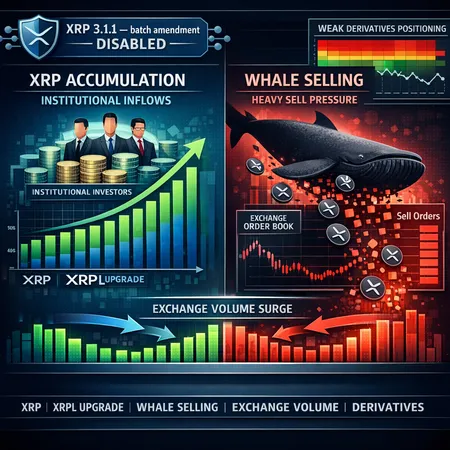
XRP is flashing mixed signals. On one hand, analysts and market reports point to institution-driven accumulation and explosive exchange volumes that look like renewed demand. On the other, visible whale transfers, active selling alerts and weak derivatives metrics warn that volatility and distribution remain very much possible. Add to that a recent protocol-level change — XRPL v3.1.1 disabling the Batch amendment — and you have a market where both price and protocol risks must be weighed before allocating capital.
Exchange flows and on-chain evidence of accumulation
Over the past weeks, public reporting has documented dramatic spikes in trading volume across major venues. Several outlets flagged outsized activity on platforms including Binance and Upbit, where trading surged in a way consistent with either intense retail participation or coordinated accumulation flows. CoinPaper captured the raw exchange-volume picture, noting record spikes across multiple orderbooks, which often precede broader price discovery when liquidity is being actively taken.
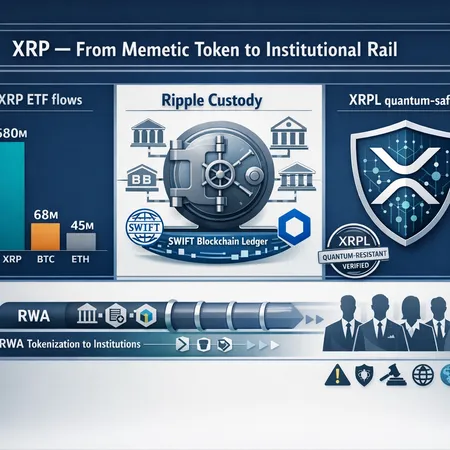
Complementing that, institutional-style capital appears to be trickling back into XRP-focused investment products. Cryptopolitan reported roughly $3.5 million in inflows into XRP investment products at a time when the broader crypto market saw outflows — a concrete capital flow that’s harder to fake than exchange volume alone. Meanwhile, an analyst piece assembled by CoinPedia argues that institutions are quietly building exposure on the XRPL despite spot prices under $1, advancing an accumulation thesis anchored in ledger-level use-cases and custody readiness.
These three signals — exchange volume spikes, product inflows, and analyst accounts of institutional interest — collectively create a plausible narrative that real demand is present. For traders, that means watching orderbook depth and time-and-sales: sustained buys that lift the spread are more convincing than isolated volume spikes.
For context, keep an eye on on-chain transfer patterns and exchange net flows rather than headline volume alone; the former differentiate a buy-side accumulation from wash or churn.
The counterweight: whale selling and fragile derivatives positioning
Nothing in crypto markets is binary. Counter to the accumulation narrative, reporting has also highlighted substantial whale intent to exit positions. Finbold tracked large wallets preparing to dump in excess of 30 million XRP — a sale size likely to pressure spot liquidity on narrower books. On-chain heuristics (big transfers to exchanges, large order placement) remain some of the fastest signals of impending supply shocks.
Derivatives markets amplify this risk. When futures open interest is light or skewed toward shorts, and perpetual funding rates are negative, sellers can exert outsized downward pressure without needing to liquidate long retail positions. Market commentary and charting of skewed derivatives flows have shown weakness around XRP, which increases the chance that apparent accumulation could be met with leveraged counterflows.
For traders, the practical consequence is straightforward but painful: visible accumulation on spot markets does not immunize a token from being sold into by large holders or being driven lower by leveraged shorts. Monitoring on-chain whale transfers, exchange inflows/outflows, and derivatives indicators (funding, open interest, and the basis) should be part of any allocation checklist.
Why XRPL v3.1.1 and the Batch amendment matter
Protocol-level stability is a less flashy but crucial component of institutional confidence. The recent XRPL software update v3.1.1 disables the Batch amendment, a change framed by developers as improving network safety and reducing upgrade-related risk. U.Today covered the technical note: disabling Batch removes a mechanism that previously bundled certain protocol changes together, which in theory can reduce the chance of accidental or poorly coordinated network behavior during upgrades.
Why does that affect capital flows? Institutions and custodians price not just market risk but protocol risk — the chance that a chain upgrade, bug, or governance snafu could interrupt operations, custody, or settlement. A more conservative upgrade pathway and explicit safety-focused changes reduce that category of risk, making XRPL more palatable for allocators who require operational robustness. That’s not an immediate price catalyst, but it tilts the incentive framework for longer-term accumulation.
However, protocol safety does not erase market mechanics. Even with XRPL’s improved upgrade policy, whales and derivatives sellers can still create downward price pressure in the short term. The two forces operate on different timelines: one structural and trust-based, the other liquidity-driven and immediate.
Reconciling the signals: a trader’s checklist
For intermediate-to-advanced retail traders and token allocators considering an XRP exposure, reconcile the contradictory data with a disciplined framework:
- Confirm flow quality: Distinguish between volume spikes caused by market orders that lift the book and volume churn from small retail trades. Use exchange-level net flows and time-and-sales to verify accumulation. Reference reports like CoinPaper and Cryptopolitan for macro context, but validate on-chain and orderbook data yourself.
- Monitor whale behavior continuously: Large transfers to exchange addresses often precede dumps. Alerts or manual scans of major wallet movements can provide early warning consistent with the Finbold reporting.
- Watch derivatives metadata: Funding rates, open interest, and the futures basis can show whether leverage is aligned with the accumulation thesis or stacked against it. Weak derivatives metrics raise the cost of being long.
- Factor in protocol risk reduction: XRPL v3.1.1 reduces an upgrade risk vector, which marginally improves the case for medium-to-long-term institutional allocation — an important nuance reported by U.Today and echoed by analysts discussing XRPL’s adoption prospects.
- Size and stage entries: Consider tranche-based buying, use limit orders or VWAP-style execution for sizable allocations, and set stop-losses appropriate to your time horizon and liquidity assumptions.
- Hedge when appropriate: If derivatives liquidity allows, use short-dated hedges (options or futures) to protect concentration risk during accumulation windows.
Bitlet.app users, and traders generally, should treat institutional inflows and exchange volume as signals to analyze — not as guarantees. The presence of both buying and selling flows increases execution risk and widens dispersion in outcomes.
Tactical scenarios and allocations
- Conservative allocator (protocol-focused, longer time horizon): allocate slowly, emphasize custody-grade products or regulated ETFs where available, and weigh XRPL’s safety improvements as supporting evidence for gradual accumulation.
- Active trader (short-to-medium horizon): trade price action, use protective hedges, and reduce size if derivatives skew negative or if large exchange inflows from whales appear.
- Opportunistic allocator (risk-on): set predefined entry grids below key liquidity bands and size for drawdowns, acknowledging that whale dumps can create attractive re-entry points if you have capital and risk controls.
Final thoughts
XRP’s current state is a study in contrasts. Exchange volume and investment-product inflows suggest real demand, while whales and derivatives dynamics preserve a clear path to downside. XRPL’s v3.1.1 update meaningfully lowers a class of protocol risk, which should matter more to allocators with multi-month horizons than to day traders. For anyone committing capital, the correct posture is neither blind optimism nor reflexive pessimism — it is measured, data-driven sizing with contingency plans for sudden liquidity shifts.
Sources
- Analyst: institutions already building on the XRP Ledger despite sub-$1 prices (CoinPedia)
- XRP buying frenzy and exploding trading volume across exchanges (CoinPaper)
- XRP sees $3.5M inflows even during broader outflows (Cryptopolitan)
- Whales preparing to dump over 30M XRP and derivatives weakness (Finbold)
- XRPL software v3.1.1 disables the Batch amendment for network safety (U.Today)
For wider context on how on-chain flows and exchange orderbooks drive price discovery, see commentary on related markets like DeFi and XRP in our archives.