Iran's Bitcoin Toll for Oil Tankers: Mechanics, Risks, and Market Consequences
Summary
What happened: Iran proposes Bitcoin tolls for tankers
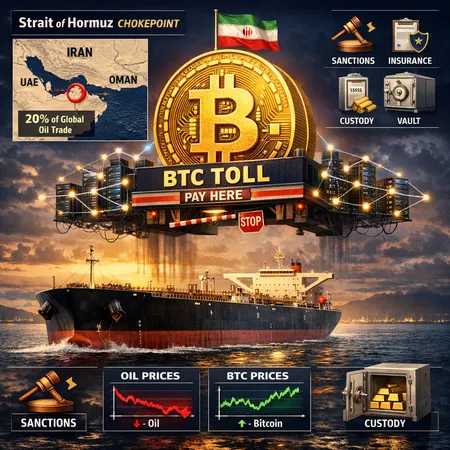
In recent reporting Iran said it may require oil tankers transiting the Strait of Hormuz to pay passage fees in Bitcoin. Multiple outlets captured the proposal and estimates for the toll: the Reuters-style coverage summarized the move as Tehran seeking crypto receipts, while deeper reporting suggested per‑barrel tolls and per‑voyage revenue figures that would make the plan material to state finances. See the initial coverage in Decrypt for a concise headline summary and the investigative piece in Unchained for the calculations and political framing.
The short version: Tehran appears to be testing whether accepting BTC for transit fees can reduce reliance on dollar rails, blunt the effects of sanctions, and monetize a strategic chokepoint in a way that complicates conventional enforcement. This is not simply a technical payment change — it is a geopolitical statement with operational and market consequences.
Why the Strait of Hormuz matters
The Strait of Hormuz is one of the world’s most consequential maritime chokepoints. Roughly 20–30% of global seaborne oil passes through it on any given day. A halt or partial disruption immediately elevates geopolitical risk premia in oil markets and snarls supply chains for Asia and Europe.
That concentration of flows is what gives any tolling scheme leverage. If Tehran enforces a transit bill denominated in a non‑fiat asset, it can exert pressure on shippers and on states dependent on uninterrupted flows — but doing so also risks escalation, legal retaliation, and disruptions that could damage its own revenue base.
The toll: price, estimated revenue, and examples
Published estimates for the toll vary. Investigative reporting modeled a per‑barrel charge and suggested that an effective levy could amount to several dollars per barrel; other coverage translated that into per‑voyage figures on the order of hundreds of thousands to a few million dollars per tanker depending on cargo. For instance, one quick brief priced potential tanker charges and revenue in those ranges, while Unchained laid out the $/barrel math and why the sums matter for Tehran’s budget calculus.
Putting numbers to it:
- A modest toll of $1–$3 per barrel on shipments that transit the strait would generate tens to hundreds of millions of dollars annually if fully collected.
- Some reports framed tolls as a per‑voyage Bitcoin charge reaching up to approximately $2M in nominal value for large crude carriers, depending on cargo and market prices.
Whether Iran can actually collect those sums depends on compliance by shipping firms, insurers, and flag states — and on how enforcement is structured (inspections, naval escorts, or threat of interdiction).
Operational mechanics: how a sovereign BTC toll would work
Collecting a sovereign BTC toll is straightforward in concept and complex in practice. The proposal forces attention on three operational domains: custody, on‑ramp/off‑ramp plumbing, and settlement risk.
Custody and wallet design
A state collecting meaningful BTC inflows needs secure custody that balances accessibility with sovereignty. Options include:
- Cold multi‑sig vaults controlled by Iranian authorities (high security, low liquidity).
- Hot wallets for day‑to‑day receipts (convenient but riskier).
- Federated custody arrangements where foreign or neutral custodians play a role (reduces seizure risk but invites compliance scrutiny).
Each arrangement creates tradeoffs: a highly secure cold setup reduces theft risk but complicates rapid conversion to local currency for state budgets; federated custody may ease conversion but raises legal exposure if custodians are subject to third‑country sanctions.
On‑ramps, off‑ramps, and settlement plumbing
A toll denominated and payable in BTC requires a path to convert crypto receipts into hard currency for state spending or reserves — unless Tehran chooses to hold BTC as a strategic asset. That path depends on liquidity venues and counterparty willingness:
- On‑ramps: Tankers or their operators must source BTC. If shippers refuse, intermediaries (brokers, maritime agents) might buy BTC on behalf of the ship — with KYC baggage.
- Off‑ramps: Iran needs exchanges or over‑the‑counter (OTC) desks to convert BTC to rials, euros, or other currencies. Those swaps are where sanctions exposure and banking counterparty risk concentrate.
- Peer‑to‑peer settlement: Direct wallet‑to‑wallet transfers are fast, but finality in BTC does not equal legal or banking finality in sanctioned jurisdictions.
A state can try to internalize conversion by incentivizing oil buyers to accept BTC, but widespread buyer cooperation would require price concessions or guarantees — unlikely in the short run.
Settlement risk and price volatility
Bitcoin’s price volatility creates immediate fiscal risk for a toll that is nominally pegged to oil flow rather than BTC. If Tehran sets a toll denominated in BTC quantity (for example, X sats per barrel), oil price swings translate into changing effective USD receipts. Conversely, if tolls are set as USD‑equivalents payable in BTC at spot, Tehran faces FX settlement risk tied to available conversion routes and liquidity.
Hedging solutions exist: forward sales, futures, or options can stabilize cashflows. But hedging requires counterparties willing to transact with Iranian entities and the legal right to settle those contracts — which sanctions can block.
Sanctions, legal exposure, and insurance implications
The proposal runs headlong into international legal and financial architecture designed to restrict sanctioned actors’ access to global markets.
Sanctions and compliance risk
Key questions for policy analysts and institutional investors: does accepting BTC circumvent sanctions, and if so, how will sanctioning states respond?
- Countries that have sanctioned Iran could interpret BTC receipts as an attempt to evade economic measures and respond with secondary sanctions on counterparties facilitating the transfers.
- Financial institutions and custodians that touch those flows risk de‑risking or exposure to sanction enforcement.
Reporting that Tehran plans BTC tolls has already raised these red flags in Western capitals — which implies that counterparties in Europe or Asia will tread carefully.
Insurance and P&I club reactions
Marine insurers and Protection & Indemnity (P&I) clubs underwrite political risk and war exclusions. If a ship transiting the strait takes on a BTC payment or adjusts routing to satisfy a Tehran toll, insurers must decide whether that conduct increases exposure to seizure, detention, or other hostile acts — and whether premiums should rise.
Insurers could react by:
- Raising premiums for transits through the strait.
- Excluding coverage for voyages that comply with an unrecognized sovereign toll scheme.
- Requiring enhanced disclosures about payment flows and compliance.
These reactions would make the operational cost of compliance higher for shipowners and charterers.
Flags, charterers and contractual liability
Charter parties and bills of lading often allocate commercial and legal risks. If a vessel pays a BTC toll under duress, disputes will arise over liability for delays, fines, or loss. Flag states might also push back, refusing to recognize enforced tolls as lawful — which would create conflicting legal obligations for shipmasters.
Market reaction: sensitivities for BTC and oil
The market impact will be driven by two channels: (1) immediate risk repricing of seaborne oil flows and (2) incremental demand/utility for BTC as a payment medium.
Oil: Any credible threat to throughput increases geopolitical risk premia. Short‑term oil volatility is likely to rise, and steep upside spikes are possible if shipping lanes are partially closed or if insurers restrict coverage. The magnitude depends on whether shippers comply or reroute (which is costly in time and fuel).
Bitcoin: If market participants believe the toll will generate sustained BTC demand, that could support prices in the near term — but the effect is likely to be modest relative to macro and macro‑liquidity drivers. The real impact lies in narrative: using BTC as a sovereign payment instrument elevates its geopolitical utility and could change how custodians and exchanges treat counterparty risk.
Sentiment and flows matter: institutional OTC desks, custodians, and exchanges will quickly price in increased compliance costs. If hawkish regulators threaten secondary sanctions, many venues may limit liquidity into accounts tied to Iranian counterparties, increasing the bid–ask spread and settlement friction.
For traders the actionable questions are: do you hedge oil exposure differently? Do you hedge BTC exposure until regulatory clarity emerges? In many cases the prudent answer is yes — diversify hedges and shorten tenor until counterparties and insurers clarify policy.
Does this set a precedent for other states using crypto as tolls or sanctions avoidance?
Iran’s move is a test case. If Iran can operationalize BTC receipts without triggering crippling countermeasures, other states with constrained access to global markets may consider crypto as a complement to existing channels.
But precedent is not automatic. Success depends on three variables:
- Compliance costs for shippers and insurers — if these rise too much, shippers will find alternatives.
- Willingness of counterparties to interact with sanctioned entities — secondary sanctions or banking de‑risking can block conversion.
- Technical plumbing and custodial safety — states need reliable custody and market partners to convert BTC receipts.
If other states copy the model, we could see a patchwork of crypto‑denominated fees (maritime, port, or transit tolls) that increase complexity for global trade. That would accelerate demand for neutral custodians, compliant OTC liquidity providers, and geopolitical hedging instruments priced into both crypto and commodity markets.
Practical steps for traders, custodians, and energy firms
Institutional actors should prepare for multiple scenarios. Practical measures include:
Traders: widen spreads on near‑term oil and BTC positions, shorten hedge tenors, and stress‑test portfolios for a correlated BTC‑oil shock. Scenario plan for both a compliance collapse (toll not collected) and successful collection.
Custodians and exchanges: review KYC/AML policies with a focus on secondary sanctions. Update risk scoring for counterparties tied to maritime services and consider temporary restrictions on flows from flagged on‑ramps.
Energy firms and shipping companies: consult P&I clubs and legal counsel on voyage planning. Decide in advance whether to refuse tolls, pay under protest, or reroute. Negotiate charterparty clauses that allocate risk for force majeure, detention, and fines tied to atypical toll demands.
Insurers: re‑price political‑risk and war‑risk premiums for the region; publish clear guidance on coverage for vessels that comply with ad‑hoc tolls.
Policy teams and sovereign wealth managers: analyze whether holding BTC as part of FX reserves is insurance or an exposure. Consider hedging strategies and diversification if receipt in BTC becomes a sustained revenue stream.
Bitlet.app institutional users and custodians should watch counterparty exposure closely and ensure settlement paths and custody policies are stress‑tested for these geopolitical payment scenarios.
What to watch next
Key indicators that will determine how consequential this development becomes:
- Official implementation details from Tehran (legal instrument, collection mechanism, and enforcement rules).
- Responses from major shipowners, insurance markets, and flag states — especially any blanket refusals or contractual adjustments.
- Regulatory or sanction responses from the EU, US, and other involved powers that could trigger secondary sanctions on intermediaries.
- Activity in OTC BTC markets and exchange order books that points to higher liquidity demands or widening spreads for flows tied to Iran.
If enforcement is half‑hearted and shippers resist, the episode may remain a geopolitical signal with limited market effect. If Tehran enforces the toll and finds reliable conversion partners, this could mark a structural shift in how crypto is used by states facing financial isolation.
Conclusion
Iran’s proposal to charge Bitcoin tolls for tankers in the Strait of Hormuz is more than a novel payment method — it is an experiment at the intersection of maritime geopolitics, sanctions policy, and crypto market structure. Operationally feasible, yes; legally and economically viable at scale, uncertain. For institutional investors and policy analysts the sensible posture is to prepare for volatility in both oil and BTC, tighten compliance and custody checks, and monitor how insurers and flag states respond. The larger question remains: will crypto become a practical tool of statecraft or a risky symbolic lever that invites stronger countermeasures?