CME Lists SUI and AVAX Futures: What Institutional Traders Should Know
Summary
Why the CME listing matters for mid‑cap layer‑1 tokens
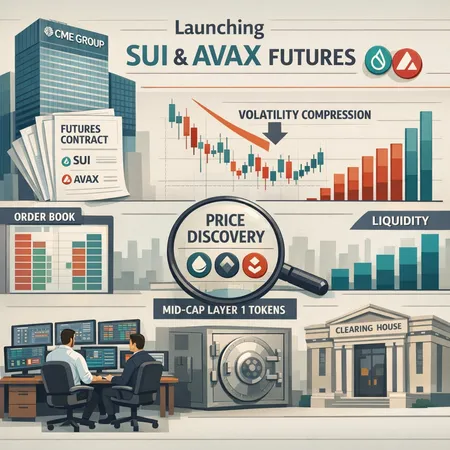
CME’s decision to offer futures on SUI and AVAX is not just another product launch — it signals that derivatives infrastructure is catching up with token market structure. For institutional desks, futures on SUI and AVAX deliver a regulated, centrally cleared instrument that can be used for directional exposure, portfolio hedging, or more complex relative‑value strategies. Market participants reacted immediately: coverage linked the CME listing to fresh bids in both tokens and a broader rally in altcoins, which is consistent with the pattern of “news‑driven” flows after major listings (Invezz).
Institutional adoption and derivatives availability tend to reinforce one another. Regulated futures allow asset allocators and prop desks to express views under familiar counterparty rules and margin frameworks, increasing the pool of potential counterparties and the depth of liquidity available during large tickets.
How futures listing typically affects spot liquidity and volatility
A futures listing changes market microstructure in several predictable ways:
Liquidity migration and expansion. Institutional order flow that previously sat on the sidelines (or traded via illiquid OTC) can now transact on a regulated venue. That flow often arrives through the futures first, then pushes into the spot order book as market makers hedge — deepening spot liquidity and narrowing spreads.
Volatility compression over time. With deeper order books and systematic market‑making around a liquid futures curve, realized volatility tends to fall gradually. Immediate volatility can spike, however, as the market reprices to incorporate the new marginal buyer/seller (short covering, funding arbitrage, or forced liquidations).
Improved price discovery. A professionally traded futures contract aggregates diverse views (hedgers, speculators, arb desks) and often becomes a primary reference for fair value. The spot market then tracks the futures price more closely, especially when futures are centrally cleared and highly visible to institutional desks.
Basis formation and new arbitrage channels. The spot‑futures basis (futures price minus spot) becomes a tradeable object — enabling cash‑and‑carry, reverse cash‑and‑carry, and basis compression trades that reduce persistent discrepancies between venues.
All of these effects are stronger when the futures are listed on a well‑regulated exchange with deep clearing — exactly the attribute the CME brings.
Historical analogues: what happened with Bitcoin and Ether futures
Past CME product launches provide useful analogies, though size and market structure matter.
Bitcoin (CME, Dec 2017): CME’s BTC futures gave professional traders a regulated instrument during the first big institutional turn toward crypto. Short‑term, the listing coincided with intense price moves and liquidity fragmentation across spot venues; longer term, the futures helped concentrate institutional flows and produced consistently traded markets for block trades and basis trades.
Ether (CME, Feb 2021): CME Ether futures showed a cleaner path to volatility compression. As more market‑making capital focused on ETH futures, the spot‑futures basis became tradable and hedged positions proliferated, which smoothed intraday swings and improved execution for larger market participants.
The lesson: listings on major derivatives venues generally produce an initial period of price discovery (and higher intraday volatility) followed by a multi‑month to multi‑quarter consolidation into tighter spreads and more predictable basis behavior. Mid‑cap L1 tokens like SUI and AVAX should expect the same qualitative pattern — scaled by market depth and liquidity provision.
Short‑term price targets and technical implications for SUI and AVAX
Technical frameworks and published forecasts can help set expectations for how much of the immediate price action is meaningful versus noise.
For SUI, recent technical commentary has placed near‑term targets in the roughly $105–$120 range by May 2026 based on momentum and breakout patterns after the listing announcement (Blockchain.News). Those forecasts reflect a scenario where futures-driven flows and spot hedging sustain the rally into the spring. Traders should treat those numbers as tactical targets — useful for sizing mean‑reversion and target‑based exits, but not as long‑term valuation anchors.
For AVAX, there’s no single consensus target published with the same specificity, but the same technical mechanics apply: listings often produce an initial “buy the allocation” episode as macro desks and relative‑value traders establish positions. Watch the futures basis, open interest, and volume on both regulated venues and major spot books as leading indicators of whether the move is durable.
Key things to monitor after listing:
- Open interest growth: rapid build suggests institutional participation; slow growth may indicate retail‑led rallies that can reverse.
- Futures‑spot basis: persistent premium/discount indicates funding or scarcity and creates arbitrage opportunities.
- Order book depth at the top of book vs. hidden liquidity: informs execution cost assumptions.
Remember: technical targets can be helpful for trade sizing and exits, but the microstructure shift from a listing often matters more for execution risk and expected slippage than for a pure price forecast.
Custody, clearing and operational considerations for institutions
One of the biggest barriers for institutional exposure to altcoins has been custody and counterparty risk. A CME listing helps but does not eliminate operational complexity.
Clearing and margin mechanics. CME contracts are centrally cleared through CME Clearing, which standardizes counterparty risk and margin frameworks. This lowers bilateral credit exposure, but margin requirements (initial and variation) represent real funding costs that must be modeled relative to spot financing and repo costs.
Custody of underlying assets. Many institutions will still prefer to hold spot allocations in regulated custodians (or rely on regulated prime brokers) for compliance and auditing. Institutions will compare the incremental cost of spot custody (vault fees, insurance, KYC/AML compliance) against futures margining to decide whether to hold spot or synthetic exposure.
Settlement format. CME historically lists cash‑settled crypto futures (e.g., BTC and ETH), which simplifies settlement for institutions uncomfortable with obtaining or transferring tokens. Expect SUI and AVAX contracts to follow that convention; cash settlement enables easier ledger‑level accounting but may create divergence from on‑chain supply dynamics when large flows occur.
Liquidity providers and clearing members. Execution guarantees for very large tickets still depend on clearing member capacity and the willingness of market makers to take principal risk. For true institutional scale, verify which FCMs (futures commission merchants) and custodians support the new contracts and their credit terms.
Naming one platform briefly, services like Bitlet.app sit in this evolving ecosystem by offering tools that bridge retail and institutional primitives — but for institutional desks the work is primarily about counterparty selection, margin optimization, and legal documentation.
Trade ideas for hedged exposure (institutional frame)
Below are practical, hedged trades that institutions commonly use when a futures contract emerges for a token they want exposure to. Each assumes robust execution and bank/FCM support.
- Cash‑and‑Carry (Long Spot, Short Futures)
- Rationale: Capture the basis if futures trade at a premium to spot while earning yield/benefits of holding the spot (staking if available and allowed).
- Mechanics: Buy spot SUI/AVAX; simultaneously sell CME futures of equivalent notional. Hedge funding costs vs. expected decay of basis. Close when basis compresses.
- Risks: Funding/custody fees, short squeeze if liquidity dries up, and counterparty margin calls.
- Basis Trade (Spread Capture)
- Rationale: Exploit predictable term structure between spot and futures maturities.
- Mechanics: If front‑month futures trade at a persistent premium, sell front month and buy back month (calendar) while maintaining a hedged spot position to isolate term premia.
- Risks: Roll volatility and changing carry dynamics as open interest and liquidity migrate.
- Delta‑Hedged Long Vol / Short Carry
- Rationale: If you want exposure to spikes in volatility around the listing event but don’t want directional exposure.
- Mechanics: Buy futures (or options if available) and hedge delta with spot or opposing futures. Alternatively, construct straddles on any options markets that appear.
- Risks: Theta decay and slippage; options markets for mid‑cap tokens may remain thin.
- Relative‑Value between SUI and AVAX
- Rationale: Capture dispersion between similar layer‑1 protocols when a listing reweights flows.
- Mechanics: Long the fundamentally cheaper token (spot) and short the more expensive one via futures. Size according to volatility parity.
- Risks: Idiosyncratic protocol events (governance, outages) that break correlation.
- Cheap Hedged Long (Scaled Accumulation)
- Rationale: For strategic accumulation without taking large directional risk.
- Mechanics: Ladder buys in spot while selling short‑dated futures to earn carry if the basis is favorable. This can function like a financed accumulation program with built‑in downside protection.
- Risks: Persistent adverse basis, margin calls during drawdowns.
Execution note: For any of the above, monitor the evolution of open interest, tick‑by‑tick basis, and depth on both CME order books and major spot venues. Execution desks should simulate worst‑case margin and slippage scenarios before committing.
Risks and things that can go wrong
- Liquidity mismatch: If CME futures attract notional flows far larger than available spot liquidity, the resulting basis can be volatile and create execution headaches for hedgers.
- Regulatory shifts: Changes in crypto regulation or guidance can rapidly change institutional appetite and margining requirements.
- Event risk for mid‑cap protocols: Smart contract exploits, token unlock schedules, or network outages can produce asymmetric tail risk that standard futures hedges may not fully cover.
- Clearing stress: Extreme moves can cause rapid margining and forced deleveraging across the cleared ecosystem, amplifying intraday volatility.
Practical checklist for institutional traders
- Confirm contract specs (tick size, margining, settlement mechanism) with CME and your FCM.
- Assess custodial options and compare custody fees vs. futures margin cost.
- Model basis compression scenarios and run stress tests on marginal funding costs.
- Establish WFM/ops playbooks for exercise, settlement, and distressed unwind.
- Monitor on‑chain signals alongside order‑book metrics: token unlocks, large transfers, or concentrated staking distributions.
Conclusion
CME’s SUI and AVAX futures are a watershed for mid‑cap layer‑1 institutional access: they create regulated, cleared instruments that improve liquidity, foster price discovery, and enable a range of hedged strategies. Expect an initial burst of volatility and repricing as market participants rebalance, then gradual compression of realized volatility as market‑making capital and basis trades take hold — an arc familiar from prior CME launches. Traders should combine technical targets (for example, published SUI near‑term forecasts) with microstructure monitoring (open interest, basis, depth) and solid custody/clearing due diligence before sizing large positions.
Sources
- SUI and Avalanche surge as CME futures launch boosts crypto rally — Invezz
- Price prediction: SUI targets $105–$120 by May 2026 — Blockchain.News
For institutional desks evaluating these instruments, treat CME futures as a structural improvement in market access — but one that still requires active liquidity and risk management. For further practical tooling on execution and hedging, consider how platforms such as Bitlet.app and your prime brokers can integrate these new contracts into your workflow. Also, for broad market context, remember that Bitcoin and DeFi dynamics continue to influence capital flows into mid‑cap L1s.