Why the Ethereum Foundation Sold 5,000 ETH via CoWSwap TWAP — Market Impact and What Comes Next
Summary
Executive summary
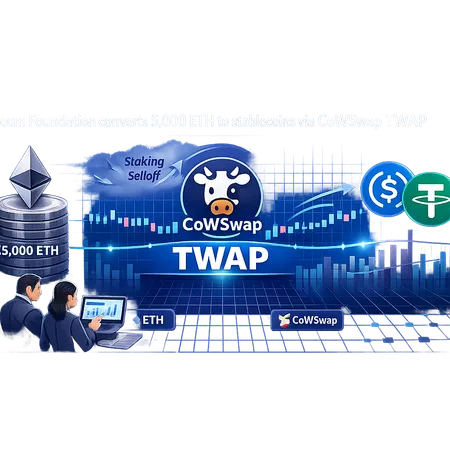
The Ethereum Foundation announced it converted 5,000 ETH to stablecoins via a CoWSwap TWAP to fund grants, research, and operational expenses. The move was executed to limit market impact and provide a predictable USD-denominated runway for the Foundation’s work. Rather than a flash panic sale, the mechanics and public explanations point to methodical treasury management — yet the trade still feeds into broader market narratives about post-merge staking flows and ETH liquidity. For DeFi analysts and portfolio managers, the important questions are: how much did this sale actually move price, does it weaken the "staking selloff" thesis, and what should traders and grant recipients plan for going forward?
The 5,000 ETH conversion: facts and stated purpose
The Foundation converted 5,000 ETH using a time-weighted strategy on CoWSwap, explicitly to fund operations and grants. News coverage documented that the Foundation routed the conversion through CoWSwap’s TWAP tooling, a detail that underscores intent to manage execution quality rather than immediately unlock USD exposure. Reporting summarized the transaction mechanics and the Foundation’s stated aims of funding grants and research News.Bitcoin.com.
This was not a novel accusation of distress; the Foundation framed it as routine treasury management. Still, 5,000 ETH is material in dollar terms and therefore merits scrutiny: it is large enough to matter to liquidity curves on major AMMs and to be noticed by algos watching whale behavior.
How TWAP on CoWSwap works (and why it reduces market impact)
A TWAP — time-weighted average price — slices a large order into smaller tranches executed across a time window so the average execution price tracks the market price over that period, instead of pushing the market at a single instant. CoWSwap’s implementation combines off-chain matching with on-chain settlement and can route orders through liquidity-efficient paths, including batch auctions and ring-matching, to minimize slippage.
Practically this means the Foundation’s 5,000 ETH was not dumped at once into a single liquidity pool. Instead, smaller swaps executed over time and across venues. That reduces visible footprint and front-running risk. CryptoSlate’s analysis argued that the Foundation’s use of CoWSwap undermines simplistic narratives that every large ETH outflow equals an immediate sell-off, since CoWSwap TWAPs are explicitly designed to limit impact and information leakage CryptoSlate analysis.
Why choose TWAP and stablecoins now? Treasury management logic
There are three connected reasons: budgeting certainty, inflation/expense matching, and liquidity hygiene. First, many foundation expenses (grants, payroll, vendor payments) are denominated or benchmarked to fiat-stable assets, so converting some ETH to stablecoins secures purchasing power and reduces FX risk. Second, moving with TWAP reduces execution cost and reputational risk versus straight market sales. Third, steady, transparent conversions give the Foundation predictable runway without triggering knee-jerk market reactions.
Timing matters too: post-merge, the staking rewards regime and on-chain yield dynamics changed investor narratives about how and when ETH supply might surface. Converting to stablecoins now can be read as a cautious hedging step to ensure grant payments are insulated from ETH volatility, rather than a capitulation. Coverage framed this specific conversion as operational rather than a change in long-term conviction News.Bitcoin.com.
The 'staking selloff' thesis — does this transaction undercut it?
The so-called staking selloff thesis holds that newly unlocked or withdrawable staked ETH will flood exchanges as stakers cash out, creating persistent downward pressure. The Foundation’s conversion complicates that dogma in two ways.
First, structure matters: this was not a single exchange-listing dump but a managed TWAP executed to limit slippage and leakage. That points to controlled, predictable liquidity management rather than an emotional sell. CryptoSlate argued that the Foundation’s behaviour weakens the simple narrative that large ETH disposals equal immediate bearish supply shocks because the execution method is explicitly market-impact conscious CryptoSlate analysis.
Second, the Foundation is a special-case treasury actor. Its motivations (funding open-source development, grants) differ from retail or yield-chasing stakers. But even controlled sales add to net realized supply and, if repeated, can act like a slowly dripping sell-pressure — subtle, cumulative, and sometimes overlooked by simplistic supply-shock models. Analysts offering bearish scenarios highlighted the psychological effect of institutional conversions and modeled potential price outcomes if such actions became recurring CryptoNews price context.
Liquidity and price dynamics: short, medium, and long term
Short term: because CoWSwap TWAP minimizes slippage, the immediate price impact of this single 5,000 ETH conversion was likely muted relative to a market dump. Market makers and AMM liquidity curves absorb smaller, time-sliced flows more efficiently; therefore intraday volatility from this event should be limited.
Medium term: if the Foundation establishes a cadence of periodic conversions to stablecoins to fund consistent outflows, that predictable supply could be priced in. Markets dislike surprises; predictable, scheduled selling is easier to hedge against. Persistent conversions, however, expand the float available to marginal sellers and can lower the equilibrium price if demand doesn't absorb them.
Long term: the fundamentals of ETH — network usage, L2 growth, developer activity — will continue to dominate price beyond single treasury moves. That said, large, recurring treasury conversions tilt the balance between cash and token supply and should be considered in forward-looking risk models for ETH exposure.
Possible market responses and price forecasts
Analysts are split. Some view a one-off, well-executed TWAP as neutral to mildly bearish because it increases realized supply without immediate dumping. Others caution that institutional conversions validate the idea that realized supply can grow, pressuring price in downside scenarios. CryptoNews discussed interpretations that place the Foundation sale within potential bearish contexts and modeled downside risk if similar sales persist CryptoNews price context.
Quantitatively, a single 5,000 ETH sell executed optimally may register as small percentage moves on major venues, but a sequence of such conversions (monthly/quarterly) could equal high-single-digit to low-double-digit percent increases in circulating tradable supply over a year — a non-trivial factor in volatile markets. Scenario planning is the right tool: stress-test portfolios for repeated conversion cadence and use liquidity metrics (depth at +/-1% and +/-2% slippage) to estimate execution cost.
Guidance for traders, market makers, and grant recipients
Traders/portfolio managers: treat this conversion as a signal that treasury liquidity management occurs and may recur, but do not over-interpret a single event as systemic capitulation. Adjust sizing to account for the potential of scheduled conversions; consider using limit orders and liquidity-aware execution strategies when trading ETH.
Market makers and AMMs: incorporate predictable TWAP flows into quotes. Because large treasuries increasingly prefer TWAP or OTC-like routes, front-running risk is lower but sticky supply — the additional circulating ETH available over time — should be hedged via delta management.
Grantors and projects depending on EF funding: stablecoin receipts reduce budget volatility. However, if your burn model assumed ETH-denominated grants, re-run budgets assuming grants arrive in USD or USDC; hedging policy and stablecoin custody should be clarified. Grant recipients also should monitor treasury disclosures and cadence to forecast cashflow timing.
Bitlet.app users building DeFi hedges or liquidity provision strategies should note that foundation conversions executed via TWAP change the shape of onchain flows; they are easier to absorb intraday but matter to end-of-quarter sizing.
Practical execution lessons from the transaction
Use of CoWSwap suggests the Foundation prioritized market-impact minimization and routing efficiency. CoWSwap’s architecture (off-chain matching, on-chain settlement, smart routing) helps compress execution cost and obscure the trade footprint.
TWAP is not a magic shield: poorly sized time windows or predictable schedules can still leak information. The combination of randomized timing and venue diversity is best practice for large treasuries.
Communication matters. Publicly framing the conversion as operational (funding grants and research) reduces panic and aligns counterparties on intent; transparency can dampen volatility by reducing speculative misinterpretation.
Conclusion
The Ethereum Foundation’s conversion of 5,000 ETH to stablecoins via a CoWSwap TWAP was a measured treasury action aimed at funding grants and operations while reducing market impact. The transaction weakens simplistic spin that every large onchain ETH outflow equals an imminent staking selloff — structure and execution methodology are critical to causal interpretation. Still, repeated or scheduled foundations conversions do increase realized supply and therefore merit inclusion in liquidity and risk models for ETH.
For DeFi analysts and portfolio managers, the call to action is clear: model recurring treasury flows, stress-test portfolios for steady conversion scenarios, and respect the difference between one-off controlled sales and sustained sell-pressure. The market will continue pricing ETH based on onchain fundamentals and macro flows, but treasury behaviors — when predictable — become another variable to manage.