Cosmos Migration Playbook: How to Move Assets Safely After the Leap Wallet Shutdown
Summary
Why this matters now
Leap Wallet’s announced shutdown — with a formal wind‑down timeline through May 28, 2026 — puts many Cosmos users in a race against the calendar to secure on‑chain assets, staking positions, and live IBC flows. The closure is a reminder that custody and operational continuity are not the same thing: you need a clear, auditable migration plan that protects both principal and ongoing staking returns (ATOM holders in particular). For the announcement and the explicit wind‑down date see the Crowdfundinsider report linked below.
This playbook is focused, practical, and prioritized for immediate action: inventory, safe key export, migrate assets, handle staking/IBC, and prepare contingencies if things go wrong. It’s written for both everyday Cosmos users and validators who must preserve uptime and rewards. You’ll also find a short comparison with projects that are investing in infrastructure (for contrast, see HTX DAO’s spring rollout) so you can frame the closing of a service alongside ecosystem resiliency moves.
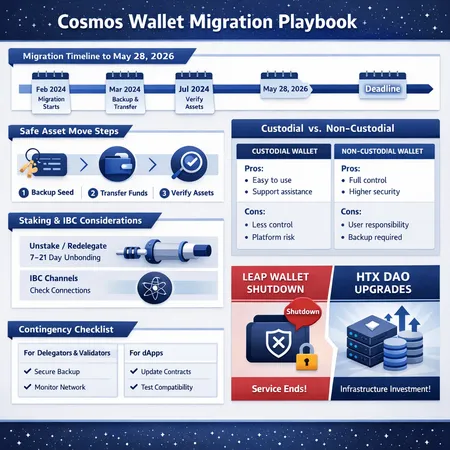
Timeline: the clock to May 28, 2026
- Immediately (Days 0–7): Freeze new interactions with Leap Wallet — stop approving transactions, revoke dApp permissions if possible, and create a full inventory of addresses and assets.
- Short term (Days 7–21): Export keys / mnemonics securely, set up and test a replacement wallet, and begin staged migrations (especially for less liquid assets).
- Medium term (Days 21–45): Complete redelegations or start undelegations with an awareness of the 21‑day ATOM unbonding window where applicable; confirm IBC channels are clean and relayers are operating.
- Deadline (May 28, 2026): Finish the wind‑down by having critical assets and active delegations moved to a secure environment; maintain evidence of on‑chain ownership and delegation changes.
Note: the exact day counts above are operational guidance. Your priority list may differ if you hold large delegations, run a validator, or use complex cross‑chain flows.
Step 1 — Inventory and risk triage (first 24–72 hours)
- Export a full list of addresses used by Leap Wallet and the assets held on each chain (ATOM, any IBC tokens, LP positions, tokenized assets).
- Identify which assets are: (a) actively delegated, (b) in transit via IBC, (c) controlled by smart‑contract approvals, and (d) custodial features (if Leap acted as custodian for any keys).
- Prioritize by risk: large ATOM delegations and tokens in transit should be top priorities because they impact staking yields and can be vulnerable if the provider shutters relayer services.
Practical tip: create a single spreadsheet with columns for chain, address, token, delegation status, and notes about approvals or pending IBC transfers.
Step 2 — Secure key export and wallet setup
Exporting secrets safely
- If Leap provides a mnemonic/key export, do it offline if possible. Prefer using an air‑gapped device or a separate, clean computer.
- Never paste mnemonics into web forms or public tools. Assume any exported key is high‑risk and handle it like cash.
- If you cannot export keys (some custodial setups won’t allow it), immediately plan to transfer assets on‑chain to a new address you control.
Choosing your replacement: custodial vs noncustodial
- Custodial (exchange or custodial service): Pros — simple UX, rapid transfers, potentially insured custody; Cons — counterparty risk, withdrawal limits, KYC, and not suitable if you want to preserve non‑custodial staking strategies. Use only if you trust the counterparty and need speed.
- Noncustodial (software + hardware wallets): Pros — self‑custody, full control over delegations and IBC, compatible with validator tools; Cons — more operational complexity and responsibility for key backups.
Decision factors: supported chains and IBC, Ledger/hardware compatibility, delegation tools (redelegate/undelegate UI), multisig options for large funds, reputation and audits, and community adoption. Popular noncustodial options in the Cosmos ecosystem include Keplr and Cosmostation (pair them with hardware wallets like Ledger for high‑value holdings).
If you want a hybrid approach: move only operational funds to a custodial service for speed while preserving long‑term stakes in hardware + Keplr/Cosmostation.
Step 3 — Migration mechanics: assets, delegations, and IBC
Moving tokens (safe transfer process)
- Test with a small transfer: send a tiny amount to the new address to confirm signing and receive functionality.
- For each token, confirm denoms and receiver addresses across chains (IBC denoms differ from native denoms).
- Pause any recurring auto‑deposits or contract approvals before moving funds.
Staking migration: redelegate vs undelegate
- Redelegation: Redelegating ATOM from one validator to another typically avoids the 21‑day unbonding period and helps preserve continuous staking rewards, but it can be subject to redelegation limits (network/validator rules) and cooldowns. Use redelegation when you can and when the destination validator is trusted.
- Undelegation: If redelegation is not possible or if you want to move tokens off‑chain, undelegate and start the 21‑day unbonding process — plan for this delay and the temporary loss of liquid staking.
- Withdraw rewards first: If you have pending rewards, withdraw them before redelegating/undelegating where possible to avoid accounting confusion.
Validator note: coordinate with your validator(s) before delegations change. Sudden mass undelegations can be treated as negative events by the community and may affect your relationship with validators who provide operator support.
IBC considerations
- If you have assets in transit or bridged via ICS‑20, check channel states and relayer health. A wallet shutdown can coincide with relayer disruptions; verify that packets are not stuck.
- Avoid initiating new cross‑chain transfers from Leap close to the wind‑down deadline. Instead, route transfers from new wallet addresses using healthy relayers.
- If you rely on a dApp that uses IBC channels managed by Leap, pause or reconfigure the dApp to point to new addresses and relayers.
For users unfamiliar with channel states, ask your validator or relayer operator for a state check — they can confirm whether packets are pending or completed.
Step 4 — dApp, contract approvals, and access revocation
- Revoke legacy approvals: go through any dApp approvals granted via Leap and revoke allowances where possible. This limits the attack surface if keys were compromised during a wind‑down.
- Update dApp addresses: if you moved addresses, reconnect dApps to the new address and re‑authorize minimal necessary allowances.
- Multisig and delegated keys: if Leap was part of a multisig or operator access, update your multisig policy immediately and reconfigure signer sets.
Contingency checklist (for urgent or failed migrations)
- If keys cannot be exported: transfer assets on‑chain immediately to a new wallet you control. Prioritize ATOM delegations and IBC assets.
- If redelegation fails: start undelegation and accept the 21‑day delay; stagger undelegations to avoid simultaneous liquidity crunches.
- If IBC transfers are stuck: contact relayer operators and validators; escalate via community channels and provide tx hashes.
- If you detect suspicious activity: move unaffected funds to cold storage and notify the community/validators; gather on‑chain evidence (tx IDs, timestamps).
Emergency action flow (simple):
- Identify affected asset → 2. Test wallet control with micro‑tx → 3a. If you control keys: move to hardware/Keplr and redelegate where possible. 3b. If you don’t control keys: withdraw via custodial route to exchange or request support from Leap (before wind‑down). 4. Revoke approvals and inform validators.
Validator operator checklist
- Maintain validator uptime: ensure signing nodes are not using Leap for key signing. Replace any operator keys that were stored with Leap.
- Communicate: post your migration plan and expected changes to your delegators. Transparency preserves trust and prevents panic undelegations.
- Monitor slashing risks: avoid double‑signing when updating operator keys; schedule rotations carefully and during low‑traffic windows.
Ecosystem responses: shutdowns vs infrastructure investment
The Leap Wallet shutdown is an example of a service exiting during a stressed market window. By contrast, some projects are doubling down on infrastructure — rolling out upgrades and relayer investments to strengthen long‑term resilience. HTX DAO’s spring rollout is one such example of a project investing in core infrastructure even when others cut back; Coincu covers that effort as a counterpoint to exits.
These different responses matter: when wallets or services fold, custody risk and operational friction increase; when projects invest in relayers, validators, and tooling, the network becomes more robust. For Cosmos users, that means you should favor solutions backed by active infrastructure investment when choosing where to migrate (look for teams committed to relayer uptime, multisig security, and hardware wallet support).
Practical migration checklist (quick reference)
- Create an asset inventory (addresses, tokens, delegations, IBC).
- Export mnemonic securely or plan on‑chain transfers if export is not possible.
- Test a micro‑transfer to a new wallet (hardware + Keplr/Cosmostation recommended).
- Withdraw staking rewards, then redelegate when possible; if not, undelegate with 21‑day lead time.
- Check IBC channel health and coordinate with relayers.
- Revoke dApp approvals and reconfigure multisig settings.
- Keep a migration log (tx hashes, timestamps, and screenshots) for auditability.
Tools and resources
- Keplr and Cosmostation are widely used noncustodial wallets that support Cosmos and IBC chains; pair them with a Ledger for cold‑key security.
- For relayer and IBC status, consult your validator or relayer operator and use chain explorers to trace ICS‑20 transfers.
- If you need a custodial bridge in a hurry, use a reputable exchange, but move critical stakes out afterward to avoid long‑term custody risk.
Bitlet.app users who rely on our ecosystem tools should check integration docs and ensure addresses are updated in any Bitlet.app workflows.
Final notes and best practices
- Act early: the May 28, 2026 wind‑down date is a hard external deadline for Leap Wallet customers. Don’t wait until the final week to begin complex operations like undelegations and IBC reconciliations.
- Prioritize security over speed: rushing with poor operational security (copying mnemonics into web browsers, skipping hardware wallet tests) creates new risks.
- Communicate: if you run a validator or manage large delegations, tell your delegators what you plan to do and why. Clear communication reduces panic and helps preserve overall network stability.
Sources
- Leap Wallet shutdown announcement and May 28, 2026 wind‑down timeline: Crowdfundinsider
- HTX DAO spring rollout and infrastructure investment contrast: Coincu
For additional background on Cosmos, IBC, and staking mechanics, see community documentation and your validator’s recommendations. If you need tailored operational help, consider reaching out to your validator or an infrastructure provider — and always verify contact channels through official community pages.
For broader context about cross‑chain asset movement and how public infrastructure affects strategies, check material on Cosmos and on DeFi.