Inside the WLFI Collateral Crisis: World Liberty, Dolomite and What Comes Next
Summary
Executive summary
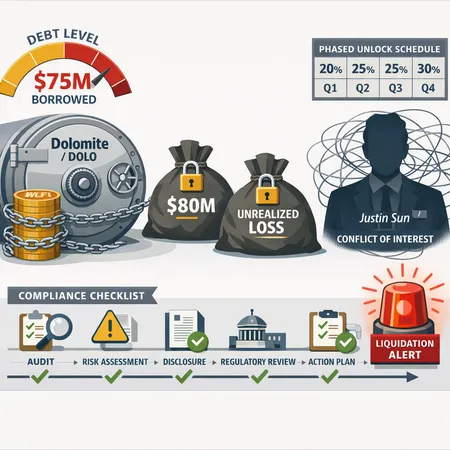
World Liberty Financial’s native token, WLFI, was used as collateral in large quantities on the Dolomite money‑market, enabling the project to borrow roughly $75 million. Independent reporting exposed concentrated pledged holdings and highlighted that some large locked WLFI positions tied to high‑profile accounts have seen material unrealized losses after the collateral usage became public. Analysts and DeFi risk teams are now grappling with two intertwined problems: concentrated collateral exposure and potential conflicts of interest because of advisor ties to the borrowing integration.
This investigation compiles public reporting, on‑chain signals you can check yourself, the project’s rebuttal and unlock plan, and practical steps for depositors, lenders and risk managers evaluating similar events. For teams monitoring liquidations and collateral health across platforms, thinking like both a lender and a forensic auditor is essential—this piece gives an operational checklist to do that.
How WLFI ended up as Dolomite collateral
A short narrative
At scale, token issuers sometimes borrow against their own tokens to raise liquidity for operations, market‑making, or strategic spending. World Liberty Financial used WLFI in precisely that way: it pledged WLFI as collateral on Dolomite and drew a sizable loan. Public reporting shows the borrowing amount at approximately $75 million on the Dolomite integration, which triggered scrutiny because a meaningful share of pledged collateral appears to be held or controlled by insiders and linked parties.
Unchained’s reporting lays out the key claim that World Liberty pledged WLFI to borrow against that platform, showing how the interaction took place at an institutional level and flagging the scale of the exposures involved. You should also view these developments in the context of broader market behaviors: similar events have amplified liquidations in prior cycles when collateral values fell and leverage was high.
Timeline of material events (sequence)
- WLFI issuance and initial distribution to investors, team and advisors.
- Integration of WLFI as allowed collateral on the Dolomite money‑market (DOLO rails and collateral configuration).
- Large on‑chain transfers and approvals enabling WLFI to be posted as collateral; borrowing activity reported at roughly $75M against those collateral pools (reported by Unchained).
- Public analyses and data aggregators highlighted that some locked WLFI bags tied to known accounts (including Justin Sun–linked holdings) experienced material unrealized drawdowns once the collateralization was revealed (APED.ai reporting).
- Independent commentary raised questions about the lending model and whether lenders, not the borrower, would ultimately carry bad‑debt risk (CryptoSlate explainer).
- Project response and proposed phased token unlocks to shore up liquidity and calm the market (Ambcrypto coverage).
- Platform rebuttals and explanations of safeguards from Dolomite or related parties summarized by Blockonomi.
This sequence is assembled from public reporting and the project and platform responses; the exact block‑level timestamps and transaction hashes are available on chain for those who want to verify each step.
On‑chain evidence: what to look for and how to verify claims
There are several on‑chain artifacts that help you independently verify the story without relying on press alone. If you perform these checks you can move from anecdote to verifiable positions.
- Token approvals and collateral allowances: check WLFI token contract approvals for the Dolomite smart contracts. Large approvals from project‑controlled wallets are a red flag for self‑sourced collateral.
- Collateralized positions and borrowing events: inspect the Dolomite money‑market contracts (DOLO‑listed pools) for borrow entries that show the borrower address, the collateral amount, loan principal and the current collateral ratio.
- Transfer and lock patterns: locked token contracts or vesting schedules are visible on‑chain or through token‑vesting contracts; verify the addresses listed in tokenomics docs against on‑chain owners to identify insider concentrations.
- Oracle and price feeds: validate which price oracles Dolomite used for WLFI valuation at the time of borrowing; misaligned or manipulable oracles increase liquidation risk.
- Lender exposure: inspect the pool’s debt and liquidity composition to see whether lenders are exposed to concentrated collateral or if the loan is an isolated position.
Practical tools: Etherscan/BSCScan (or the chain explorer for WLFI’s chain), Dune dashboards or custom queries, and Dolomite’s own contract ABI allow a competent risk team to reconstruct positions and calculate current LTVs and liquidation thresholds.
What the reporting says (and what to infer)
- Unchained documented the $75M borrowing against WLFI and emphasized the counterparty structure surrounding that borrow. Their report is the clearest public account tying World Liberty’s own token pledges to significant leverage on Dolomite.
- APED.ai drew attention to notable unrealized losses tied to locked WLFI holdings associated with Justin Sun–linked wallets after the collateralization became public, estimating roughly an $80M mark‑to‑market impact for these locked bags.
- CryptoSlate’s explainer warns of a structural problem in the lending model: when a borrower posts native tokens as collateral in a way that centralizes risk, the broader lender base may pick up bad‑debt if the collateral plunges and liquidation mechanics are imperfect.
Taken together, these accounts indicate a classic concentrated‑collateral problem: the issuer’s financing activity increases systemic exposure for lenders on the platform while reducing market confidence in token liquidity.
Conflict of interest and Dolomite advisor ties
Two structural concerns stand out: first, the advisory link between the project and players involved in the Dolomite integration; second, whether Dolomite’s governance or risk parameters were configured in a way that favored the borrower.
Unchained highlighted advisor ties that suggest potential conflicts of interest. Blockonomi summarized platform perspectives and rebuttals but also shows the appearance problem: when an advisor has a hand in both the borrower and the protocol where borrowing occurs, it raises questions about preferential treatment, parameter settings, and whether special liquidity windows or oracle configurations were employed.
This matters because conflict of interest is not only about intent — it’s about contagion mechanics. If an insider can influence collateral acceptance or oracle cadence, lenders may be unknowingly exposed to a counterparty that has asymmetric control over the liquidation environment.
Project response: denial, context and phased unlocks
World Liberty’s public pushback emphasizes that the project is not near liquidation and that the reported figures overstate immediate systemic risk. Ambcrypto covers the project’s defense, which centers on liquidity assurances and a plan to roll out phased token unlocks intended to relieve pressure on locked positions.
A phased unlock can be a reasonable remedial step if implemented transparently: it may increase available float, reduce short‑term price pressure, and provide time for negotiated debt restructuring. But the effectiveness depends on three things: clarity on the unlocking schedule, concrete liquidity commitments (not just promises), and lender protections (e.g., overcollateralization or DCEs) during the unlocking window.
Blockonomi relays Dolomite or platform commentary that seeks to reassure users regarding risk controls; however, platform statements cannot substitute for concrete on‑chain evidence that collateral ratios and liquidation mechanics are robust.
Practical implications for depositors, lenders and compliance teams
Depositors (lenders)
- Lenders may be unknowingly exposed to a single token’s collapse because liquidity providers in money‑markets often cannot choose which collateral backs which borrows; check pool architecture.
- Expect heightened volatility and potential temporary freezes or unusual slippage during any phased unlock. If WLFI liquidity is low, lending pools can experience sudden asset‑price shocks and partial value recovery may take months.
Borrowers and token holders
- Token holders should expect increased scrutiny, potential lock‑ups, and a reputational cost which may depress secondary market activity.
- For project teams considering similar moves, transparency and independent audits of lending integrations are necessary to avoid the appearance of self‑dealing.
Compliance and counterparty risk teams
- Counterparty risk assessment must expand to include tokenomics risk: who holds concentrated stakes, who is borrowing against those stakes, and whether the platform’s governance or advisors have ties to those parties.
- Document potential regulatory exposures: borrowing your own token at scale can create questions about market manipulation, investor disclosure, and solvency that regulatory teams will want to evaluate.
For market participants who track broader systemic risk, remember that this is not just a single‑token story: similar mechanics can play out with memecoins or governance tokens—monitoring concentration and collateralization across DeFi matters everywhere.
Risk mitigation checklist (operational steps for teams and individual lenders)
- Concentration limits: cap exposure to any single collateral token (for instance, set a 5–10% maximum pool share per non‑stable collateral).
- Active on‑chain monitoring: create alerts for large approvals, transfers from vesting contracts, sudden increases in borrow size, or declines in collateral price beyond thresholds.
- Oracle hardening: require multi‑source price oracles and time‑weighted averages (TWAPs) to avoid flash‑price liquidations.
- Stress testing and liquidation drills: run realistic deleveraging simulations with slippage assumptions and order‑book depth estimates.
- Governance and conflict checks: document any advisory or governance overlap between token issuers and protocols where tokens are allowed as collateral; require recusal rules or cooling‑off periods.
- Legal and disclosure reviews: ensure public disclosures on collateralization practices and any insider pledges are documented and easily accessible to lenders.
- Insurance and backstops: where possible, purchase or provide insurance/debt‑recovery mechanisms to protect lender capital from concentrated issuer collapses.
- Phased unwind playbooks: if a borrower announces an unlock or restructuring, require explicit timelines, escrowed liquidity amounts, and incremental unlocking tied to milestones.
These steps are actionable for internal risk teams and can be operationalized in monitoring dashboards, lending contracts, and governance requirements.
Counterarguments and uncertainties
The project’s defenders make several reasonable points: they say the situation is not near liquidation, that the borrowed funds support legitimate operational needs, and that a phased unlock can reduce short‑term price pressure. Blockonomi reports platform rebuttals that the integration followed standard protocols and risk parameters.
Two important uncertainties remain:
- Liquidity resilience: if WLFI markets are thin, a phased unlock might still depress prices and trigger lender losses, even if total supply increases gradually.
- Oracle and execution risk: if oracles lag or if the market moves faster than liquidation engines can act, lenders may still bear losses.
Both uncertainties are testable with on‑chain checks and stress tests; absent those, market participants must price in additional risk premia.
How to verify the specifics yourself (quick operational guide)
- Find WLFI token contract and check total supply, vesting contracts and allocations.
- Query Dolomite’s lending contract for WLFI collateral positions; look up borrow principal, collateral amount and LTV ratio.
- Pull transfer histories for wallets flagged in reporting and compare to addresses mentioned in tokenomics or vesting docs.
- Validate the oracle sources Dolomite used for WLFI pricing during the borrowing window.
- Build a simple liquidation simulation using the pool’s available liquidity, oracle cadence and a realistic slippage curve.
If you need automated feeds or dashboards for ongoing monitoring, integrate Dune/Labeled queries or on‑chain watchers tied to your risk thresholds. Bitlet.app and similar portfolio platforms can be used to alert users to unusual collateral events, though for deep forensic work you'll want raw chain data and independent tooling.
Conclusion
The WLFI–Dolomite episode is a reminder that token‑issuer financing using native tokens creates second‑order risks for lenders and depositors. The combination of concentrated holdings, advisor ties and large borrow amounts can amplify liquidation risk and reputational fallout. The project’s phased unlock and public denials are important steps, but they must be paired with transparent, on‑chain evidence and creditor protections to restore market confidence.
For risk managers and compliance teams: treat tokenomics as a first‑class element of counterparty assessment. Lenders should demand clarity around concentration, oracles, and governance overlaps before allowing native tokens to underwrite sizable borrows.
Sources
- Unchained: World Liberty Financial borrows $75 million against its own token on a protocol its advisor co‑founded
- APED.ai: Justin Sun’s locked WLFI bags sink ~$80M after collateral usage became public
- CryptoSlate: How Trump‑linked WLFI set up a lending model where lenders will pay the price of failure
- Ambcrypto: World Liberty Financial says we are nowhere near liquidation but fears remain
- Blockonomi: World Liberty Financial pushes back against WLFI risk concerns on Dolomite platform