Is XRP Graduating from Meme Token to Institutional Rail? An Evidence-Based Evaluation
Summary
Introduction: a contested narrative
XRP has long worn two hats: internet meme and experimental ledger token. Over the last 12–18 months the narrative is shifting. A sudden spike in ETF inflows, growing custodial relationships with banks and SWIFT pilots, bold claims about XRPL’s quantum-resistant posture, and an explicit push into Real-World Assets (RWA) all suggest Ripple wants XRP to function as institutional rail rather than community meme.
This piece evaluates those data points and places them in an allocator’s playbook: what’s signal, what’s noise, and what operational due diligence matters before moving capital.
ETF flows: a short-term burst or meaningful re-rating?
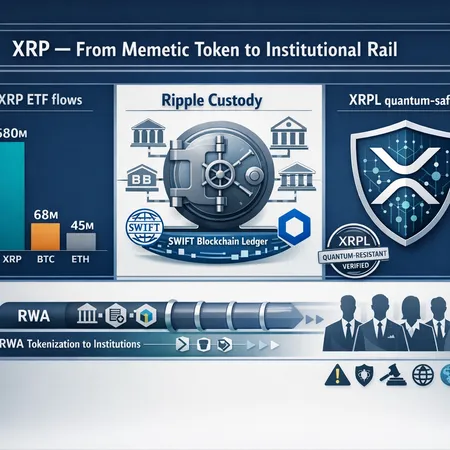
In late trading windows XRP registered outsized 24‑hour ETF inflows that topped flows into BTC, ETH and even DOGE, according to market reports. That kind of inflow data is a noisy but actionable indicator — it shows that capital can and will rotate into lesser-cap assets when product structures, liquidity and narratives align. See the reporting that highlights how XRP beat major assets in a 24-hour ETF flows snapshot.
A few interpretive points:
- ETF flows are a liquidity signal, not a durable demand guarantee. Short-term flows can be momentum-driven and speculative. Allocators should parse whether flows are retail-focused ETF products or institutional-sized placements. The one‑day snapshot is important, but it needs to sustain into weekly/monthly windows to imply structural demand.
- Product design matters. Shifts in product availability, fee structures, or market‑making incentives can cause flow distortions. Understand whether flows are into spot-style wrappers, derivative ETFs, or synthetic exposures.
- Relative market cap and liquidity amplify flow volatility; smaller-cap assets can eclipse larger ones in percentage terms even on modest absolute dollars.
For institutional strategists this means ETF flows are an early-warning — or early-opportunity — signal. They merit follow-up, not immediate reallocation on their own. (Source: U.Today on 24‑hour ETF flows.)
Custody and bank integrations: plumbing that legitimizes rails
One of the clearest signs of institutionalization is when global banks start to pilot and rely on the ecosystem’s plumbing. Recent reporting shows major banks including BBVA, BNP Paribas and Citi backing SWIFT’s blockchain ledger while integrating or leveraging Ripple Custody in pilots and product designs. That’s important because custody and settlement are the operational gates that determine whether a token becomes usable in bank workflows.
Why this matters for allocators:
- Custody reduces counterparty and operational risk if providers meet bank-grade standards (segregation, insurance, proven KYC/AML flows).
- Bank pilots with SWIFT’s ledger lower the integration cost for cross-border payment rails; institutional demand tends to follow interoperability and predictable settlement windows.
- Use of Ripple Custody by banks signals not only technical integration but also an acceptance of risk models and compliance postures — though pilots are not full production rollouts.
Put differently: custody and SWIFT ties move XRP from speculative point-to-point trading toward being a component in institutional settlement stacks. But pilots need to convert into SLAs, insurance, and multi‑jurisdictional legal frameworks before allocators should assume bank-grade resilience. (Source: Coinpaper reporting.)
XRPL quantum-safe claims: what’s proven and what’s speculative
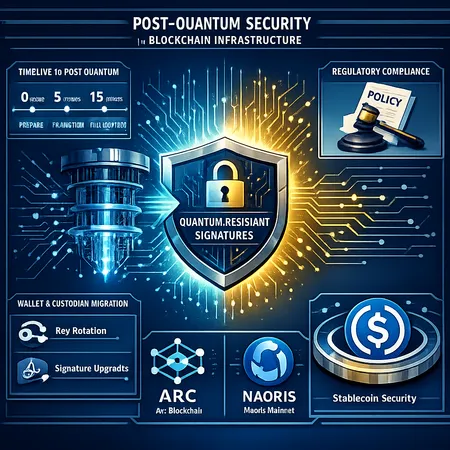
Security is foundational for any settlement rail. Recent technical breakdowns by an XRPL contributor concluded the ledger is among the most secure networks today, with architecture elements that are described as quantum-resistant for portions of the ledger. The claim centers on cryptographic choices and upgrade paths that would mitigate future quantum-computing threats.
A few technical notes and caveats:
- "Quantum-safe" is not binary. It refers to design choices that reduce exposure to known quantum attack vectors today, and to pathways for cryptographic transition. No current public ledger is invulnerable to all future threats.
- Operational security (key management, validators, multisig and guardianship) often matters more in practice than the underlying signature algorithm. If custody and validator governance are weak, cryptographic resistance is an academic win only.
- Audits and contributor analyses are helpful; third‑party, adversarial testing and public peer review are necessary to convert claims into institutional acceptance.
For allocators, XRPL’s claims lower a theoretical tail risk — but they do not eliminate legal, governance or operational attack surfaces. Treat quantum-resistance as one factor among many in security due diligence. (Source: U.Today audit breakdown.)
Ripple’s RWA push: turning on-chain utility into token demand
Ripple has publicly positioned itself to participate in Real-World Asset tokenization — a market many expect to unlock new settlement flows, collateralized credit lines, and cross-border liquidity. Reporting has connected recognizable names and concrete RWA use cases to Ripple’s strategy, arguing the token could gain utility if it becomes part of settlement/remittance and RWA lifecycle events.
How RWA could create sustainable demand for XRP:
- Settlement velocity: If XRP becomes the preferred on‑chain bridge for RWA token transfers, natural utility-driven demand emerges from payment, conversion and liquidity provisioning activity.
- Network effects: Institutional counterparties prefer rails with broad connectivity; as banks and custodians adopt Ripple Custody and SWIFT-ledger interoperability, usage could compound.
- Fee capture and burn mechanics (if implemented) can create deflationary pressures tied to usage, aligning token economics with real activity.
But the bridge between narrative and demand is long. Token utility only translates into durable demand if a) legal frameworks allow tokenized contracts to enforceably represent off‑chain assets, b) institutions trust custody and settlement workflows, and c) onboarding friction (KYC, reconciliation) is reduced. The broader RWA discussion and specific examples of how Ripple fits into real asset flows are covered in recent industry coverage. (Source: Bitcoinist on RWA.)
Investment implications and risks for institutional allocators
For allocators evaluating XRP as part of a settlement-rail or token allocation strategy, the evidence offers both opportunity and caution.
Key upside case
- Increasing institutional plumbing (SWIFT integrations, custodial pilots) and the RWA narrative suggest use-case-driven demand could grow beyond speculative trading.
- Technical security claims (quantum resistance) reduce a class of existential tech risk and make long-term custody planning easier.
- ETF flows indicate capital can rotate quickly into the token when product structures align.
Primary risks and frictions
- Regulatory uncertainty: Ongoing or future legal actions in major jurisdictions can disrupt liquidity and institutional participation.
- Execution risk: Pilots do not guarantee production SLAs, insurance, or cross-border legal certainty needed for bank deployments.
- Market structure: XRP’s free float, distribution, and market depth affect how much large allocators can move in or out without market impact.
- Counterparty/custody risk: Reliance on single custody providers or poorly scoped contracts can introduce unexpected exposures.
A short operational checklist before allocating capital
- Custody validation: Obtain custodian SLAs, insurance schedules, and proof of segregation. Prefer custodians with bank-grade audits.
- Legal opinions: Seek legal clarity on whether on‑chain tokenized contracts map to enforceable rights in relevant jurisdictions.
- Stress testing: Run settlement simulations using projected flows; measure slippage, settlement times, and reconciliation pain points.
- Concentration limits: Cap initial exposure to a small percentage of digital assets or a wider institutional alpha bucket until flows prove persistent.
- Monitor telemetry: Track ETF flows, custody signings, validator decentralization metrics, and on‑chain RWA issuance.
Quick allocation framework (not investment advice)
- Exploratory tranche: 0.1–0.5% of digital asset envelope to test custody and settlement.
- Operational tranche: 0.5–2% once custody and legal frameworks verify.
- Strategic tranche: 2–5% only if RWA flows and bank production rollouts are demonstrably live and auditable.
Practical signals to watch next
- Sustained ETF inflows and the composition of those inflows (institutional vs retail).
- Contracts and production SLAs from custodians and banks using Ripple Custody.
- On-chain RWA issuance volumes and whether settlement uses XRP as a native bridge or remains off‑chain.
- Independent cryptanalysis and third‑party audits validating XRPL’s quantum-resistance claims.
For context, many institutional allocators still treat Bitcoin as a reserve/complementary asset and look for rails that reduce settlement friction. Likewise, RWA narratives frequently intersect with broader DeFi composability and custody requirements — keep that cross-market view when sizing positions.
Conclusion: signs of maturation, but not a done deal
XRP is no longer only a meme. ETF flow episodes, bank-level custody pilots, SWIFT ledger collaborations, XRPL security claims and a deliberate RWA push all point toward institutionalization. Yet pilots, audits and headline flows must convert into production-grade SLAs, legal certainty and sustained transaction volumes before XRP truly becomes a primary institutional rail.
Allocators should view current developments as a transitional opportunity: enough infrastructure is forming to warrant structured experiments, but not yet enough to justify large, permanent allocations without rigorous operational and legal due diligence. Platforms and services such as Bitlet.app illustrate how consumer and institutional product sets diverge — institutional adoption requires a higher bar of custody, compliance and SLA assurances.
Sources
- U.Today — XRP beats Bitcoin, Ethereum, Solana and even Dogecoin in 24-hour ETF flows: https://u.today/xrp-beats-bitcoin-ethereum-solana-and-even-dogecoin-in-24-hour-etf-flows?utm_source=snapi
- U.Today — How much XRP is quantum safe as of April 2026?: https://u.today/how-much-xrp-is-quantum-safe-as-of-april-2026-top-xrpl-contributor-breaks-it-down?utm_source=snapi
- Coinpaper — BBVA, BNP Paribas and Citi back SWIFT’s blockchain ledger as Ripple Custody link adds intrigue: https://coinpaper.com/16070/bbva-bnp-paribas-and-citi-back-swift-s-blockchain-ledger-as-ripple-custody-link-adds-intrigue?utm_source=snapi
- Bitcoinist — XRP, recognizable names and RWA: https://bitcoinist.com/xrp-recognizable-names-rwa/