How the US–Iran Ceasefire Ignited a Rapid Risk-On Crypto Rally: Signals & Trade Playbook
Summary
Executive snapshot
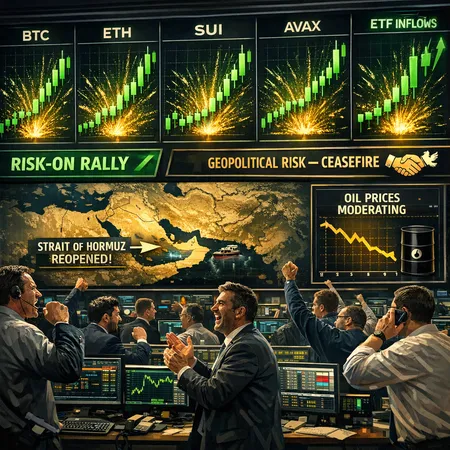
A conditional two-week US–Iran ceasefire produced an immediate market pivot: volatility dropped, oil prices fell, and risk assets rallied — crypto among them. Within hours traders saw Bitcoin shoot past prior resistance, while Ethereum, SUI and AVAX posted outsized percentage gains as liquidity rotated from safe havens into riskier tokens. This piece parses how that geopolitical event translated into macro flows, ETF and liquidity signals, and practical trade ideas for momentum and mean-reversion players.
Immediate price reactions and liquidity shifts
Within the first trading session after the announcement, Bitcoin jumped decisively. Major crypto outlets reported BTC pushing north of $72k in the first wave of the rally — a move contemporaneous with headlines about the ceasefire and easing regional tensions (see coverage from Cointelegraph and Decrypt). The swift BTC uptick had the classic characteristics of a sentiment-driven breakout: elevated volume on spot venues, widening bid-ask spreads during the first leg, and rapid delta in derivatives funding rates.
Altcoins outperformed on a percentage basis. ETH retraced much of the earlier risk-off losses as traders rotated capital; smaller-cap protocols like SUI and AVAX spiked sharply, aided in part by fresh institutional interest (in SUI/AVAX futures on CME) which served as an additional demand conduit for those tickers. Invezz captured the SUI/AVAX lift tied to the new CME futures listings, a clear example of how news + product availability can turbocharge altcoin moves.
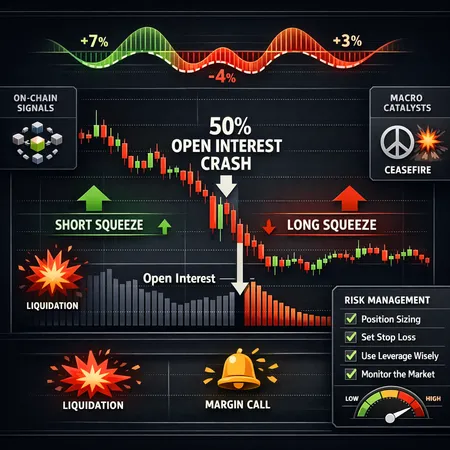
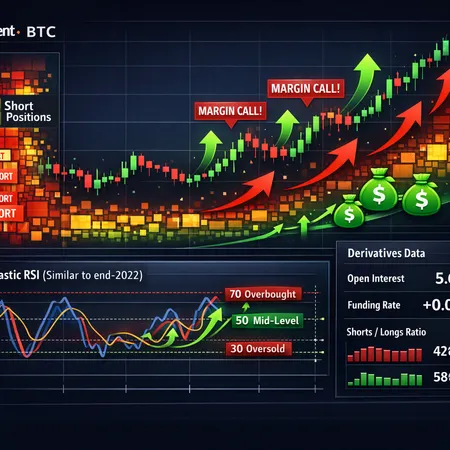
Liquidity cues to watched in real time included: funding rate flips (from negative to positive), concentrated inflows into spot ETF-like wrappers or custody products, and a contraction of implied volatility on BTC/ETH options markets. CryptoNews and other outlets noted large short-covering and repositioning as institutional desks and algo funds reduced geopolitical hedges, further accelerating the up-leg.
Macro transmission: oil, Strait of Hormuz, and the pivot from risk-off to risk-on
Geopolitical risk in the Middle East has a direct macro channel into markets via oil prices and trade-route risk. The ceasefire reduced the probability of chokepoint disruptions through the Strait of Hormuz, sending oil prices lower; Cointelegraph linked falling crude with Bitcoin’s jump, underlining an inter-market connection: when oil drops, equity and risk-asset risk premia tend to compress, freeing liquidity for risk-on positions.
That liquidity can flow in two distinct routes into crypto: (1) direct reallocation from traditional risk assets and commodities—hedge funds trimming oil/energy exposure and redeploying capital—and (2) the reduction of cross-asset volatility hedges (fewer tail-risk positions), which lowers the cost of carry for leveraged crypto exposure. The net effect: risk budgets expand, ETF and custody products see inflows, and altcoin beta revives.
ETF flows and institutional signals
Even absent immediate ETF approvals for every token, ETF-like demand shows up through custody flows, Greyscale conversions, and new futures products. The market reaction around SUI and AVAX highlights how institutional product launches (CME futures) can provide a durable on-ramp for capital previously sidelined.
Early signs of institutional participation during this rally were: spot custody inflows, increasing OI in regulated futures, and options skews compressing as implied volatility fell. Those are the same signals momentum traders watch to confirm a shift from a retail-driven pop to a broader structural reallocation.
Is this persistent or a short-term sentiment bounce?
Short answer: it can be both — durability depends on whether macro tailwinds hold and whether capital permanence increases.
Factors that argue for persistence: sustained decline in oil prices (reducing risk premia), institutional product rollouts (CME futures for altcoins), and confirmed ETF/custody flows into BTC and ETH. When those boxes check, reallocations look less like a headline bounce and more like portfolio reweighting.
Factors that argue for a fade: the move began as a sentiment shock with a compressed timeline; markets often overshoot after sudden geopolitical relief, creating setups for pullbacks. Liquidity might be shallow at extreme levels, and any re-escalation of geopolitical risk or a reversal in macro rates could snap positions quickly.
Use objective cues to decide: is open interest increasing alongside spot flows? Are funding rates sustainably positive, or are they forced higher only by short-squeeze dynamics? Are ETF/custody inflows steady across multiple days (suggesting allocation) or spiky and one-off? These signals will tell you whether to treat the rally as persistent or as a mean-reversion candidate.
Trading playbook: momentum players
Validate with multi-venue flow: momentum traders should look for confirmation across spot inflows, CME futures OI growth, and options IV compression. If BTC and ETH show coordinated demand with rising OI, bias favors trend-following.
Time entries with pullbacks to structural levels: use higher timeframe support (EMA bands, prior breakouts) as entries rather than chasing the initial spike. For BTC this means watching the breakout retest; for SUI/AVAX, track the development of institutional orderbooks post-futures launch.
Use scaled exposure and time-based stops: add on confirmed continuation (e.g., fresh higher highs on daily with volume above 20-day average), and use trailing stops keyed to ATR or shorter EMAs to protect gains.
Hedge tail risk selectively: for large momentum exposure, hold small options protection rather than full cash hedges — it’s cheaper and preserves upside while guarding against headline reversals.
Trading playbook: mean-reversion players
Identify exhaustion signals: rapid price moves accompanied by divergence in on-chain transfer volumes or falling exchange balances often mark short-term tops. Look for sudden spikes in funding rates and intraday RSI extremes as mean-reversion triggers.
Short the hot hand tactically: consider selling into strength for names that benefited primarily from sentiment (small caps, low-liquidity alts). Use tight, defined stops above local micro-structure highs because momentum can remain elevated.
Reversion into liquidity: if BTC rallies on headlines and derivatives show squeezed shorts, fade with a plan to buy back into liquidity zones — construct trades that convert instant P&L to a buy-and-hold if the market stabilizes.
Size conservatively and watch macro overlays: mean-reversion is risky when macro flows are structurally changing; ensure position sizes account for potential extension driven by institutional buckets.
Risk management, execution and operational points
- News risk is binary. Use limit orders near structural levels and avoid market orders on first reaction candles which often see slippage.
- Watch cross-asset hedges: a bounce in equities and a drop in oil that accompanies the ceasefire may create correlated squeezes; cross-hedges in equities or options can reduce portfolio drawdown.
- Monitor on-chain indicators (exchange inflows/outflows, large whale transfers) together with derivatives metrics (funding, OI) — the combination is more predictive than any single data point.
For practical execution, traders on platforms like Bitlet.app should ensure custody and settlement speed align with their trade duration — intraday momentum trades need different operational readiness than position trades.
What to watch next (signals that matter)
- Sustained oil price trajectory: if oil stabilizes lower, the risk-on impulse has a plausible macro bedrock.
- ETF/custody flow persistence: multi-day inflows into BTC/ETH custody products mean capital is sticking.
- Institutional product adoption: growing OI in CME-listed altcoin futures (SUI/AVAX) suggests deeper institutional participation.
- Geopolitical headlines: any reversal or extension of the ceasefire will remain the dominant exogenous variable.
Conclusion
The two-week US–Iran ceasefire was the kind of binary geopolitical event that can flip market psychology almost overnight. The immediate crypto reaction combined short-covering, fresh institutional on-ramps, and a macro backdrop of falling oil that freed risk budgets — a textbook recipe for a risk-on rally. Whether the move becomes a durable regime shift or a sharp, tradable bounce depends on persistent macro flows, ETF/custody adoption, and the behavior of institutional order flow. Active traders should convert this event into disciplined setups: momentum players need multi-venue confirmation and dynamic stops; mean-reversion traders must respect the possibility of extended trends and size accordingly.
Sources