Uncovering XRP’s Hidden Bull Case: Futures Surge, Ichimoku Flip, Reserve Decline and Institutional Signals
Summary
Why these “hidden” signals matter for active traders
The price chart alone often hides the market’s pressure cooker. Derivatives desks and whales move first; on-chain flows and custody decisions follow — and only later does the spot price catch up. For XRP this week, several relatively quiet data points line up: an 83% surge in futures balance, an Ichimoku cloud flip, a measurable decline in exchange reserves, and increased institutional signaling around Ripple. Together these create a non-obvious but coherent narrative that can precede a larger spot impulse. Bitlet.app users who track both derivatives and chain-level data will recognize this pattern: concentrated derivative demand plus shrinking exchange float often equals kinetic price moves once liquidity thins or leverage is repriced.
The derivatives jolt: dissecting the 83% futures-balance spike
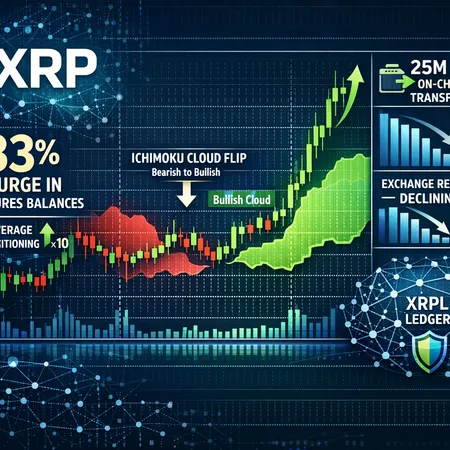
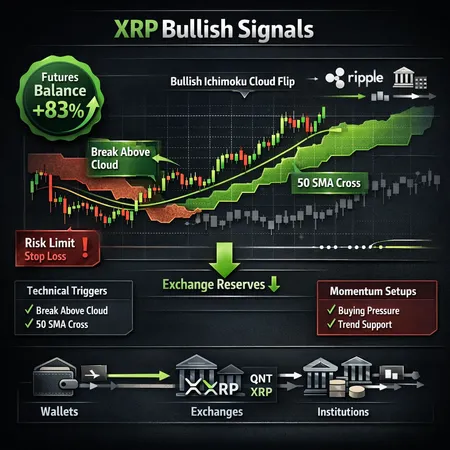
An 83% increase in XRP futures balance over 24 hours is not a rounding error — it's a major reallocation of market exposure. The report highlights a sudden accumulation of futures positions that can mean one of two things in practice: either a rapid build of directional risk (likely more longs) or heavy hedging activity that temporarily distorts the balance sheet of exchanges and liquidity providers. Either way, that magnitude of change is a derivatives signal worth watching because leverage and open interest amplify eventual spot moves.
Why this can lead price, not follow it: derivatives desks can create a cascade. If a large cohort pushes leverage into long bias, funding rates can flip positive, encouraging more longs and setting up a short-squeeze dynamic if liquidity thins. Conversely, if the spike was short-side positioning, a cover can produce an equally fast rally. Traders should watch the evolution of open interest and real-time funding rates immediately after such a spike to determine whether the market is building sustainable demand or simply oscillating.
(Data point: the 83% figure was reported in a short note on the surge in XRP futures balance.) (U.Today link)
Technical context: what the Ichimoku flip actually signals
An Ichimoku cloud flip — where price moves above the cloud and Tenkan (conversion) crosses above Kijun (base) with a bullish Senkou Span ahead — is a multi-dimensional trend signal, not just a moving-average crossover. For XRP the reported Ichimoku flip shows that shorter-term momentum has started to outpace the intermediate trend; combined with price clearing the cloud it implies a shift from neutral to structurally bullish, provided the components confirm each other over the next sessions.
Important caveats: the Ichimoku is lagged and works best with volume/flow confirmation. A flip paired with rising on-chain accumulation and increasing open interest is a far stronger read than a flip in isolation. The same report that noted the Ichimoku flip also documented a large on-chain transfer by Ripple — a 25 million XRP move — which could be liquidity rotation rather than distribution, depending on destination (exchange vs cold wallet). (CoinPaper link)
Exchange reserves and on-chain flows: the supply side is shifting
A persistent decline in exchange reserves is one of the most underappreciated bullish signals. When coins leave exchange wallets — especially to custodial cold storage or institutional addresses — the available float for immediate selling shrinks. That squeezes markets when demand reappears. Recent coverage shows XRP exchange reserves falling, a metric that historically correlates with supply tightening and subsequent upward pressure on spot price if demand holds or grows.
Pair that with large, purposeful transfers: Ripple’s movement of tens of millions of XRP can be either liquidity management or redistribution for strategic partnerships. The context matters: transfers to cold custody or to OTC partners often point to accumulation; transfers into exchange hot wallets point to potential distribution. Monitoring the receiving addresses and follow-up on-chain behavior turns these raw transfers into actionable signals. (U.Today reserves decline link; the 25M transfer was noted by CoinPaper).
Institutional layer: Ripple, Quant and the narrative behind the scenes
Institutional interest can change market structure because it brings large, non-leveraged capital and custody demands that reduce circulating supply. Recent cooperative appearances from Ripple and projects like Quant (QNT) signal that the “Internet of Value” narrative is getting renewed institutional play. Public-facing stage time and partnership pilots are not immediate price catalysts by themselves, but they alter the probability distribution of longer-term demand — and they often precede notable accumulation phases as enterprises prepare rails and custody.
Coinpedia summed the increased institutional choreography between Ripple and Quant as evidence of the narrative maturing, which helps explain why large transfers and reserve declines may be strategically timed rather than random. Institutional engagement tends to favor off-exchange custody and customized settlement flows, both of which reduce exchange float and increase the effect of concentrated derivative positioning. (Coinpedia link)
Why derivatives and on-chain metrics often lead spot moves
Combine the mechanics: derivatives position building concentrates risk and creates potential for short squeezes or forced deleveraging; exchange reserve outflows reduce available sell-side liquidity; large transfers set new settlement and custody baselines; and institutional moves change distribution dynamics. Spot price is simply the visible layer where these factors eventually reconcile. Because derivatives desks and institutions can move quickly and in large blocks — sometimes off-exchange — their actions show up earlier in open interest, futures balance and on-chain transfer records.
Practical example: a rapid increase in futures balance plus falling exchange reserves means there are more leveraged bets on price direction while fewer tokens are immediately available to satisfy a rush of buy or sell orders. If demand surprises (e.g., a positive institutional announcement or an off-exchange buy), the market can gap rapidly as leveraged shorts cover or liquidity providers widen spreads. That’s why active traders track both the derivatives sheet and the ledger.
Confirmation checklist: what would convince me this is a sustained rally?
Below are concrete triggers — both technical and fundamental — that together reduce false-positives and increase the odds of a multi-week rally:
Technical
- Price consistently above the Ichimoku cloud with Tenkan > Kijun and Chikou Span above price for multiple daily candles.
- Rising open interest alongside rising price (OI up + price up) without funding blowing out extremely positive (which can signal an overheating squeeze).
- Volume-backed breakout through multi-week resistance levels; confirmed retest and hold on shorter timeframes.
On-chain / fundamental
- Continued decline in exchange reserves across several days rather than a one-off move.
- Large transfers into cold custody or known institutional wallets, not exchange hot wallets.
- Public institutional announcements or confirmed pilot deployments (e.g., partnerships or custody rollouts) that materially increase on-net demand.
Derivatives nuance
- Funding rates that normalize or only slowly rise (shows balanced participation), not parabolic funding that risks blow-off tops.
- Futures balance spike followed by sustained open interest growth rather than a quick reversal.
When a majority of these checkboxes are ticked, the probability of a sustained rally meaningfully increases.
Practical trade setups and risk limits for momentum traders
Below are three pragmatic setups with entry logic, targets, stop methodology and risk controls. Use position-sizing so that any single trade risks no more than 1–2% of your total equity (or per your own risk tolerance).
- Momentum breakout long (conservative)
- Trigger: Daily close above the recent multi-week horizontal resistance and the Ichimoku cloud with Tenkan > Kijun.
- Entry: Enter on a confirmed break candle close or on a 1–2% pullback to the breakout level.
- Target: First target = 15–30% move (take partial profits); second target = measured-move resistance based on the breakout range.
- Stop: Below the breakout level or below Kijun (base line) on the daily chart; typically 6–10% depending on volatility.
- Risk controls: Position size so that stop loss equals 1–2% portfolio risk. Monitor funding rates and be ready to trim if funding spikes.
- Pullback long to Ichimoku support (moderate)
- Trigger: Price retraces to Tenkan or Kijun after Ichimoku flip and shows bullish reversal pattern (hammer, bullish engulfing) on 4H/1D.
- Entry: On bullish reversal confirmation candle.
- Target: 10–25% initial, trail with Tenkan or a fixed ATR-based trailing stop.
- Stop: Below Kijun or below the low of the reversal candle; typical stop 4–8%.
- Risk controls: Lower leverage, prioritize spot or low-leverage futures (≤3x). Reduce size if exchange reserves suddenly rise.
- Aggressive derivatives play (high risk)
- Trigger: Rapid momentum confirmed by rising open interest and moderate funding (not parabolic), plus exchange reserve decline continuing.
- Entry: Leveraged long in futures with tight tactical stop.
- Target: Short-term squeeze target (20–50% depending on volatility); exit in timed stages as funding costs accumulate.
- Stop: Strict hard-stop (e.g., 3–5% absolute) and a time stop (if not achieving 50% of target in X days, exit or reduce exposure).
- Risk controls: Max leverage 3–5x for responsible retail traders; institutional players may use more sophisticated hedges. Use size limits such that a margin call or liquidation would not exceed your pre-defined loss threshold.
Extra rules for all setups
- Never hold highly leveraged positions over major macro events or high-impact news windows.
- Watch funding rates: if funding becomes extremely positive (longs paying shorts), treat as an overheating signal and scale out.
- Use position-sizing rules (Kelly-lite or fixed-fraction) and diversify trade durations (some short, some swing) to mitigate single-event risk.
Monitoring dashboard: what to watch in real-time
Create alerts and a small dashboard that includes:
- Futures balance (the 24h spike metric) and open interest change.
- Funding rates across major venues — watch for sudden flips.
- Exchange reserves change (net flow per 24–72h) and large transfer alerts (e.g., >1M XRP moves to known custodial addresses).
- Ichimoku component status on daily and 4H (price vs cloud, Tenkan/Kijun cross, Chikou Span).
- News/partnership feeds (e.g., Ripple & Quant developments) and on-chain counterparties tied to OTC desks.
Automate alerts for: large exchange inflows (potential distribution), continued reserve declines (accumulation), open interest + price divergence, and sudden change in funding rates.
Closing thoughts and caution
The convergence of an 83% futures-balance spike, an Ichimoku cloud flip, declining exchange reserves and renewed institutional choreography forms a compelling, conditional bullish case for XRP. But remember: no single metric is a guarantee. Derivatives can amplify both directions, on-chain transfers require contextual decoding, and partnerships take time to convert into liquidity-demanding flows. Treat these signals as a probabilistic edge — a faster way to prioritize trades and size positions — not as certainties.
For active traders and on-chain analysts, the profitable path is to combine these signals into a checklist-driven workflow, stick to disciplined risk limits, and keep a compact dashboard for rapid decision-making. If the confirmation checklist above begins to tick en masse (price above cloud, rising OI with balanced funding, continued reserve decline, and institutional news), the odds favor a sustained rally that momentum traders can exploit.
Sources
- U.Today — 83% in XRP futures balance: https://u.today/83-in-xrp-futures-balance-is-important-easy-to-miss-signal?utm_source=snapi
- CoinPaper — Ichimoku flip and 25M XRP on-chain transfer: https://coinpaper.com/16157/xrp-price-prediction-ichimoku-cloud-flips-bullish-as-ripple-moves-25-m-coins-on-chain?utm_source=snapi
- U.Today — Exchange reserves decline: https://u.today/xrp-eyes-another-rally-as-exchange-reserves-decline-to-274-billion?utm_source=snapi
- Coinpedia — Ripple and Quant institutional context: https://coinpedia.org/news/ripple-and-quant-team-up-on-stage-is-xrp-the-real-internet-of-value-behind-the-scenes/
For an on-chain, derivatives-aware approach to trade execution and portfolio monitoring, consider integrating these signals into your existing workflow on platforms that support both spot and derivatives analytics. And if you follow the XRP narrative closely, keep an eye on the XRP tag for related write-ups and comparisons.