Privacy‑Coin Resurgence: Why ZEC, XMR, DASH and DCR Ripped Higher in April 2026 — Risks & Trade Rules
Summary
Executive snapshot — what happened in April 2026
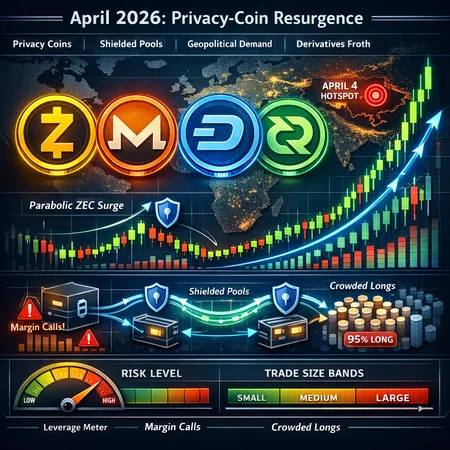
Privacy coins ripped higher in early April, with ZEC, XMR, DASH and DCR posting some of the strongest short‑term moves in crypto. The immediate spark was a geopolitical episode on April 4 that accelerated demand for transactional privacy and cross‑border capital mobility. That narrative combined with technical liquidity squeezes, concentrated flows into shielded pools (ZEC), and elevated derivatives activity — a classic cocktail for a sharp, fast rally that can unwind just as quickly.
This guide is written for risk‑aware traders and allocators evaluating speculative positions in privacy tokens. It explains the macro and geopolitical drivers, the on‑chain evidence of demand, the mechanics that helped the run, where derivatives froth introduces extra risk, and practical trade sizing and exit rules you can apply today. I also reference market commentary and data reporting that tracked ZEC’s parabolic move and the corresponding indicators.
The April 4 geopolitical catalyst and the narrative shift
On April 4, a geopolitical development—heightened sanctions talk and renewed concerns around cross‑border capital controls in several regions—prompted a reevaluation of on‑chain privacy demand. Media and market intelligence outlets noted that actors seeking to move value discreetly shifted their flow mix toward privacy‑centric rails.
Coinpedia’s analysis frames the broader context behind the breakout: geopolitics can act as a direct catalyst for privacy‑coin demand when capital mobility becomes a priority for individuals and institutions alike. That type of demand is blunt and rapid: once a narrative anchors in the market, counterparties who control liquidity (OTC desks, market makers, some exchanges) must rebalance, and that rebalancing shows up quickly in price and on‑chain flows.
Why this matters: the privacy narrative is not purely speculative derivative chasing. It can be fundamental when a real geopolitical incentive exists to avoid traceable value transfer. That said, narrative fuel attracts speculators, and that’s where derivatives froth comes in.
Solid move mechanics across privacy coins: supply, liquidity and flow dynamics
Privacy tokens share a few structural features that amplify moves:
- Limited on‑chain liquidity pools on major venues combined with uneven exchange distribution create concentration risk. When demand hits, order books thin quickly.
- Increased use of native privacy features—shielded pools for ZEC, stealth addresses for Monero—reduces available spendable supply in visible liquidity channels. The effective tradable float contracts smaller.
- OTC desks and private flows can accelerate price discovery off‑exchange before retail bids chase on centralized venues.
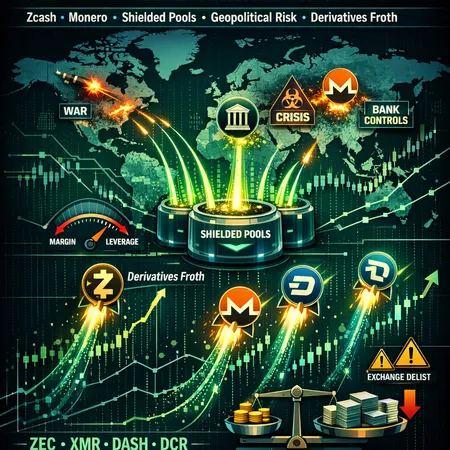
These mechanics played out in April. For ZEC, increased transfers into shielded pools removed coins from visible liquidity, contributing to tighter on‑book supply and larger price moves. For Monero (XMR), DASH and DCR, similar flows toward privacy‑preserving usage and custodial solutions tightened visible balances and widened the bid‑ask gap during fast rallies.
On‑chain evidence: shielded pools, flows and what to watch
The clearest on‑chain signal in this episode was rising shielded pool activity for ZEC. Analysts and reporting noted significant inflows into shielded addresses at the same time price appreciation accelerated, which is a direct signal that users prioritized privacy over immediate liquidity.
FXEmpire highlighted rising inflows to ZEC’s shielded pools as a driver pushing some analysts to model a $500 target for ZEC — the thesis being that reduced visible supply plus heightened demand can support much higher prices. See the reporting on growing shielded‑pool demand and the bullish projection.
Coinpedia placed the rally in a geopolitical context and tracked the breakout narrative across privacy coins, reinforcing the idea that some flows were demand‑driven rather than purely momentum chasing.
On‑chain indicators to monitor in real time if you trade privacy tokens:
- Shielded‑pool inflows and outflows (ZEC): persistent net inflows are a supply sink; sudden outflows can presage selling. FXEmpire’s coverage suggests inflows were material during the run.
- Exchange visible supply and withdrawal spikes: rising withdrawals to non‑custodial wallets or OTC addresses signal supply tightening. Watch for spikes in CEX withdrawals.
- Concentration of holdings: increasing share of supply in a small number of addresses can be dangerous if those holders decide to sell.
- Fee and priority behavior on Monero: unusual increases in stealth address creation or ring‑size changes may indicate heavier privacy usage.
ZEC’s parabolic surge: the bull case and the $500 thesis
Zcash captured headlines due to a steep, parabolic rally within a compressed time frame. Traders and analysts quickly floated range targets: some technical and narrative models argued for ZEC reaching or exceeding $420–$500 if conditions persisted. Decrypt and FXEmpire summarized optimistic trader scenarios after large weekly spikes, while contextualizing how momentum and supply compression could justify aggressive targets.
The bull case is straightforward:
- Geopolitical demand raises the baseline demand curve for privacy features.
- Shielded‑pool inflows materially reduce visible tradable supply, increasing scarcity premiums.
- Momentum attracts speculators and allocators, generating a feedback loop on margin and derivatives platforms.
FXEmpire explicitly cited inflows to shielded pools as part of the reasoning for a $500 target, while Decrypt documented traders positioning for upside after a steep weekly advance. These are legitimate components of a bullish model — but they rely on persistent demand and a slow, orderly release of coins back into liquidity markets. If that expectation breaks, prices can reverse fast.
Derivatives froth and the risk of blow‑offs
When parabolic price action aligns with heavy derivative activity, risk multiplies. Crypto.news and other coverage warned that ZEC’s run exhibited classic derivatives froth: rising open interest, aggressive buying of perpetuals, jammed funding rates and concentrated options positioning. Those elements create a brittle structure vulnerable to rapid deleveraging.
Key derivatives danger signs to monitor:
- Elevated open interest relative to spot liquidity: if open interest grows faster than exchange order‑book depth, liquidation cascades are more likely.
- Positive and spiking funding rates: sustained expensive longs indicate short squeezes are fueling the move and that mean reversion pressure is brewing.
- Large bilateral OTC option trades or concentrated long call positions: asymmetric exposures mean a few counterparties can create directional pressure near strike clusters.
- Basis blowouts between spot and futures: large backwardation or contango shifts can trigger funding adjustments and margin calls.
Crypto.news reported that after ZEC’s parabolic run, derivatives metrics flashed risk. That’s not a prediction that prices must collapse, but it is a structural warning: high leverage magnifies both upside and downside and tends to amplify volatility during news events or liquidity shocks.
Scenario planning: forward price paths for ZEC (and generalizable lessons for XMR, DASH, DCR)
No one can predict exact prices. But scenario analysis helps set probabilities and trade rules.
Base case (40% probability): demand persists, shielded‑pool inflows continue but slow; liquidity normalizes as market makers add depth. Result: consolidation above recent highs with measured retracements — ZEC drifts toward $300–$420 over weeks. This is the path where the $500 thesis remains possible but not immediate.
Bull case (20% probability): continued geopolitical escalation plus low exchange releases and persistent speculative flows. Open interest grows but does not cascade; ZEC tests $420 and pushes toward $500 as the market re‑rates scarcity. This is the scenario FXEmpire outlined for the $500 target.
Derivatives blow‑off / unwind (30% probability): a short‑term headline, a sudden liquidity withdrawal, or funding‑rate collapse sparks liquidations. Rapid waterfall ensues and ZEC retraces sharply to pre‑rally levels (potentially 40–70% down), with $400 becoming a volatile range rather than a floor — echoing the warnings in Crypto.news about derivatives risk.
Reversal and regime change (10% probability): regulatory or exchange delistings that materially affect market access for privacy coins — a structural negative that forces prolonged pressure across XMR, ZEC, DASH and DCR.
These probabilities should be updated continually with fresh on‑chain and derivatives data. The point: treat upside targets like $500 as conditional, not inevitable.
Practical trade sizing and risk rules for volatile privacy assets
Trading privacy coins in a speculative rally demands tight risk controls. Here is a pragmatic framework for position sizing and exits tailored to risk‑aware traders and allocators.
Position sizing (suggested framework):
- Maximum portfolio allocation (speculative sleeve): 0.25–1.5% per single privacy token for conservative allocators; up to 3–5% for speculative traders with dedicated risk capital. Privacy tokens should live in the high‑volatility, high‑risk part of a portfolio.
- Volatility‑adjusted sizing: use ATR or realized volatility to scale. Example: target risk per trade = 0.5% of portfolio; trade size = (portfolio value × 0.005) / (entry price − stop price). Larger realized volatility should reduce nominal position size.
- Kelly‑light approach: if you use Kelly, apply 10–25% of the Kelly fraction to balance growth with ruin protection in highly uncertain markets.
Entry principles:
- Avoid buying the parabolic run top. If momentum is already extreme and funding rates are high, prefer to wait for a consolidation or a pullback into a support band before establishing a new position. For allocators, dollar‑cost average into a thesis over weeks rather than a single big ticket entry.
- Use staggered scaling: enter 25–40% of intended exposure on initial signal, add on disciplined pullbacks or confirmed retests of structural support.
Stops and exits:
- Hard stop (capital preservation): set a stop aligned to technical support or a fixed volatility multiple (e.g., 2–3 ATR). If your stop is hit, exit and reassess; do not “move the stop” in most cases.
- Profit targets & scale‑outs: identify primary and secondary targets (e.g., near‑term range top, $420, $500). Scale out 25–50% at the first target and trail the remainder with a volatility‑based trailing stop (1.5–2 ATR).
- Emergency exit triggers: sudden spike in funding rates + rapid open interest growth + large off‑market sales (e.g., whale withdrawals) should ratchet up your discipline to reduce exposure or hedge.
Leverage guidance:
- Avoid excessive leverage: with derivatives froth present, long perpetuals and isolated margin positions can vaporize equity quickly. If you use leverage, keep it conservative (≤2–3x) and reduce as funding rates rise.
- Prefer option structures for directional exposure with defined downside (buy calls, buy call spreads) instead of naked leverage when possible.
Hedging and portfolio protection:
- Consider shorting a correlated asset or buying puts/call spreads to limit downside in a portfolio context. Hedging cost can be justified for larger allocations.
- Size hedges objectively: hedge the dollar value at risk you estimate from a worst‑case scenario (e.g., expected drawdown × position size).
Record‑keeping and review:
- Log each trade’s rationale, entry, stop, and exit plan before execution. Review performance weekly and update scenario probabilities based on on‑chain and derivatives signals.
Red flags: what forces me to cut exposure fast
- Sudden, synchronized outflows from shielded pools back to exchanges.
- A spike in open interest accompanied by large funding‑rate divergence and visible liquidation events elsewhere in crypto markets.
- Exchange or regulatory headlines that curtail access for privacy tokens.
- Concentrated selling from a small number of addresses or custodians.
When two or more of these red flags appear, treat the position as at high risk and reduce size quickly.
Monitoring checklist — data to watch in real time
- ZEC shielded‑pool net inflow/outflow trends (daily and weekly).
- Exchange visible supply and withdrawal spikes across major CEXs.
- Open interest and funding rates on perpetuals and futures venues.
- Options positioning and notable block trades (if reported).
- Concentration of large addresses and OTC flow reports.
- Relevant geopolitics and sanctions developments that could materially shift demand.
If you have access to on‑chain analytics or provider feeds, set alerts for material divergences in these metrics.
Practical example trade (hypothetical)
- Thesis: ZEC benefits from continued geopolitical demand and reduced visible supply. Target: $420 initial, $500 stretch. Stop: 25% below entry. Risk per trade: 0.75% of portfolio.
- Execution: enter 40% of intended allocation at $X on a confirmed consolidation; add 30% on a pullback to first support; leave remainder to scale out at the $420 target.
- Manage: if funding rates exceed a threshold and open interest grows 50% in 72 hours, reduce size by 25%. If shielded pools begin net outflows to exchanges, reduce to zero and hedge remaining exposure.
This plan converts scenario thinking into simple, executable rules that match a risk‑aware profile.
Final takeaways: marry on‑chain nuance with strict risk controls
April’s privacy‑coin resurgence combined real geopolitical drivers with classic market mechanics: supply compression via shielded pools, concentrated liquidity, and speculative derivatives flows. ZEC’s parabolic run illustrated both the upside potential (the $420–$500 range argued by some analysts) and the structural fragility when leverage stacks up.
For traders and allocators: respect the narrative but never ignore the markets’ structural indicators. Use shielded‑pool and exchange supply data as primary inputs, treat derivatives froth as a risk multiplier, and size positions with volatility and scenario probabilities in mind. Bitlet.app users evaluating token exposure should apply conservative sizing rules and keep contingency exits ready.
Sources
- Can privacy coins sustain their breakout rally? (Coinpedia)
- Zcash price news — ZEC eyes rally to $500 as inflows to shielded pools rise (FXEmpire)
- Zcash price cools after parabolic run as derivatives froth flashes risk (Crypto.news)
- Zcash could rise 420 after 62% weekly spike — traders predict (Decrypt)
Internal context: for many traders, Bitcoin still sets broader liquidity conditions, and activity in DeFi markets can change funding and volatility regimes relevant to privacy token flows.