XRP's Derivatives Heat vs. Quiet Spot: 83% Futures Surge, Exchange Drain, Ichimoku Flip
Summary
Executive snapshot
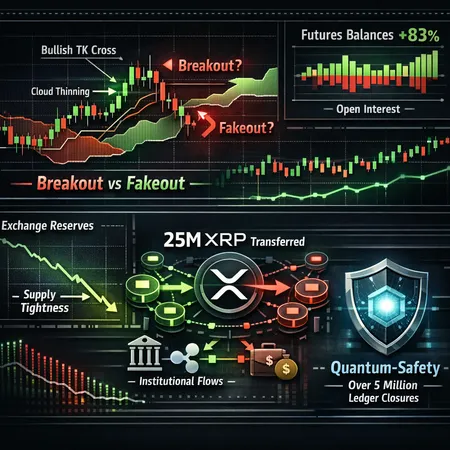
A recent analysis of XRP’s derivatives and on‑chain activity found two seemingly contradictory signals: a reported 83% jump in futures balances — a sign of growing derivatives aggression — while the spot market appears relatively quiet. At the same time, exchange reserves have declined, Ripple moved a large chunk of XRP on‑chain, and technical indicators like the Ichimoku cloud are flipping bullish. For traders and on‑chain analysts these mixed signals matter: they can foreshadow a powerful breakout, or they can precede a derivatives‑driven fakeout.
For many traders, XRP remains a liquid bellwether on the XRPL and beyond. Below we unpack what the futures balance spike means compared with open interest, why declining exchange reserves tighten supply, how a 25M XRP transfer and Ichimoku flips act as co‑catalysts, and why quantum‑safety stats can influence institutional flows.
Futures balance spike vs. open interest: what's actually heating up?
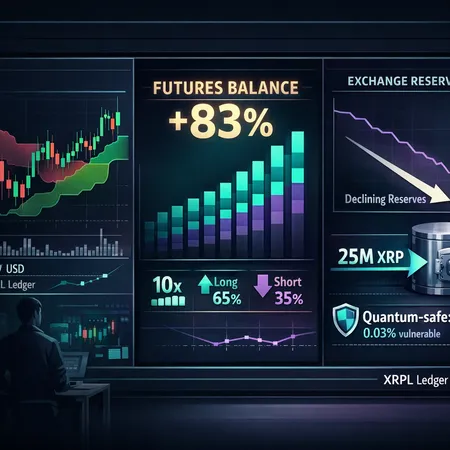
Two numbers get conflated in market commentary: the futures balance (the amount held in futures-related balances or segregated accounts that imply leverage exposure) and open interest (the total number of outstanding derivative contracts). The recent report of an 83% increase in XRP futures balance is best read as a rise in derivatives positioning intensity rather than a one‑to‑one increase in open interest; it suggests that counterparties are moving capital into futures stacks more aggressively beneath the surface of the spot market (source: U.Today — 83% piece).
Why the distinction matters:
- Open interest rising usually means more new contracts — direct evidence of fresh bets. It’s easy to track on exchanges.
- A spike in futures balance can reflect larger notional exposure or concentration inside certain custody/clearing flows, hinting at leverage buildup or hedging flows that won’t show up immediately in spot orderbooks.
Operationally, that means markets can look calm (low visible spot volume, thin orderbook) while systemic leverage quietly increases. For traders that is both an opportunity and a risk: increased leverage amplifies moves, but it also increases the chance of violent reversals if a catalyst triggers liquidations.
Practical reconciliation for analysts
- Watch open interest and margin utilization on major derivatives venues alongside the balance metric. If all three trend up, the probability of a leveraged move grows.
- Track funding rates and basis between spot and futures. Positive, rising funding tends to accompany bullish leverage accumulation.
Exchange reserves falling: evidence of supply tightening
Exchange reserves for XRP have been reported to decline toward ~274 billion, a classic on‑chain indicator of reduced immediate selling supply (source: U.Today — reserves decline). Lower reserves do not automatically mean price spikes, but historically declining exchange balances correlate with less available product for spot sellers and greater price sensitivity to buy pressure.
Key interpretations:
- Persistent withdrawals to cold wallets or custodial vaults usually indicate accumulation by long‑term holders or institutions preparing to custody rather than trade.
- Short‑term traders should interpret fast declines as lower liquidity; even small orderbooks can move sharply against leveraged positions.
Put together with rising futures balance, the narrative becomes clearer: demand (or at least custody demand) is increasing while visible supply tightens, creating fertile ground for leveraged squeezes.
Ripple moves 25M XRP on‑chain and Ichimoku flips: a mixed technical + on‑chain catalyst
On the same cadence as derivatives and reserves, Ripple reportedly moved 25 million XRP on‑chain, and technical overlays like the Ichimoku cloud have shown bullish flips — both are cited as catalysts in recent reporting (source: Coinpaper).
Why the transfer matters:
- Large transfers from custodial addresses to exchanges can presage selling pressure; transfers away from exchanges to cold storage imply accumulation. The direction of the 25M transfer and the receiving address type matters as much as the raw amount.
- Transfers associated with known Ripple treasury movements tend to get especially close scrutiny: they can be operational (escrow management) or strategic (distribution, partnerships).
Why the Ichimoku flip matters:
- Ichimoku combines trend, momentum and support/resistance context in one overlay. A bullish cloud flip (conversion line crossing and cloud turning positive) signals a shift in medium‑term bias for many technical traders.
- Because Ichimoku is widely used among swing traders in crypto, a clear flip can attract fresh buy-side appetite and shorten reaction times to on‑chain catalysts.
Combine the two and you have technical conviction meeting an on‑chain heartbeat: if the transfer was accumulation and Ichimoku shows bullish structure, algorithmic and discretionary buying can compound quickly.
Quantum‑safety resiliency: why it matters for institutional flows
A less obvious but growing factor for large capital is quantum safety. Recent analysis argues only 0.03% of XRP supply is vulnerable to known quantum threats — a statistic that underpins security confidence for large custodians and institutions considering exposure (source: Finbold).
Why that matters:
- Institutions evaluate custody and long‑term security risk. If a protocol is perceived resilient against plausible future quantum threats, more institutional capital is likely to consider allocation.
- Combined with lower exchange reserves, higher derivatives exposure and clean technicals, a credible quantum‑safety story can be the psychological nudge that converts passive holders into active buyers or custodians into allocators.
Note: quantum risk is a long‑term factor; it won’t move the market intraday, but it influences the willingness of large counterparties to hold and scale positions.
Scenarios traders should be ready for (actionable)
Below are scenario frameworks — not trade advice — to help reconcile the derivatives heat with spot calm. Each includes triggers, likely market mechanics, and risk checkpoints.
Scenario A — Bullish breakout (high probability if catalysts align)
Triggers:
- Continued decline in exchange reserves and on‑chain accumulation flows.
- Sustained rise in futures balance accompanied by increasing open interest and positive funding rates.
- Ichimoku retains bullish structure and price closes above the cloud on higher timeframe.
Mechanics:
- Reduced sell liquidity + concentrated leverage causes buyers to pay up, creating a short squeeze. Options skew may steepen.
Action points:
- Consider pyramiding or option directional exposure with fixed risk (defined risk options or spreads).
- Use multi‑timeframe confirmation: daily Ichimoku cloud hold + rising OI.
- Stops below a recent key Ichimoku support (e.g., conversion/Kijun area) to manage capped downside.
Scenario B — Derivatives‑led fakeout/liquidation cascade (medium risk)
Triggers:
- Futures balance surge not matched by OI or funding divergence (indicating concentrated, possibly synthetic positions).
- A single large exchange deposit or Ripple transfer to an exchange precedes selling.
- Funding rates flip from positive to sharply negative as longs are flushed.
Mechanics:
- Aggressive shorting against a thin spot market can trigger rapid long liquidations; price spikes higher briefly then collapses as margin calls unwind.
Action points:
- Avoid over‑leveraging; prefer options or tight stops. Monitor exchange inflows in real time.
- Watch for abrupt funding rate moves and large orderbook imbalances as immediate red flags.
Scenario C — Chop and consolidation (most likely baseline)
Triggers:
- On‑chain flows and derivatives metrics diverge with no single confirming catalyst.
- Ichimoku shows whipsaw signals across short timeframes but remains neutral on daily.
Mechanics:
- Volatility remains contained; bad fills and stop hunting increase risk for momentum plays.
Action points:
- Trade range or use neutral options strategies (iron condors, calendar spreads) with clearly defined breakpoints.
- Keep position sizes small and respect liquidity layers.
Monitoring checklist and indicators
For traders and on‑chain analysts wanting to reconcile the mosaic of signals, keep a compact dashboard:
- Futures balance (sources reporting the metric) and open interest on major exchanges.
- Exchange reserve trends and net flows for XRPL wallets.
- Funding rates and perpetual basis curves.
- Large transfers and address tagging (custody vs exchange vs Ripple treasury).
- Ichimoku structure across 4h, daily and weekly charts.
- Quantum‑safety / protocol security narratives for institutional appetite.
Pro tip: pair on‑chain alerts (large transfer or exchange deposit) with live funding rate moves. The combination often precedes the fastest volatility bursts.
Risk framing and why Bitlet.app users should care
Higher derivatives exposure beneath a muted spot market means a smaller shock can produce a large move. Whether you’re executing over multiple legs, hedging a custody allocation, or managing a leveraged position, plan for asymmetric outcomes: a tight supply picture (falling reserves) can suddenly validate speculative derivatives positions — and when that happens, liquidity evaporates fast.
Bitlet.app clients monitoring XRPL flows and derivatives metrics should pay special attention to custody signals and maintain disciplined sizing — institutional interest driven by perceived quantum safety can accelerate accumulation, but it doesn’t eliminate tail risk.
Final takeaways
- An 83% jump in futures balance is a loud derivatives signal; read it as rising notional leverage and attention beneath a quiet spot market rather than as the sole truth.
- Falling exchange reserves tighten available supply and make the market more responsive to buying pressure; combined with leverage, that raises breakout probability.
- Ripple’s 25M XRP transfer plus an Ichimoku cloud flip provide technical and on‑chain fuel that can turn latent pressure into a move — but they can also be part of a manufactured fakeout if derivatives liquidity is concentrated.
- Quantum‑safety statistics, while longer‑term, strengthen institutional willingness to hold XRPL exposures and can be the marginal factor for large allocations.
Plan scenarios, watch confirmatory metrics (OI, funding, exchange inflows), and size positions for the amplified moves that a leveraged, low‑reserve market can produce.
Sources
- https://u.today/83-in-xrp-futures-balance-is-important-easy-to-miss-signal?utm_source=snapi
- https://u.today/xrp-eyes-another-rally-as-exchange-reserves-decline-to-274-billion?utm_source=snapi
- https://coinpaper.com/16157/xrp-price-prediction-ichimoku-cloud-flips-bullish-as-ripple-moves-25-m-coins-on-chain?utm_source=snapi
- https://finbold.com/only-0-03-of-xrp-supply-is-vulnerable-to-quantum-threats/?utm_source=snapi