Why Bitcoin Broke $72–73K on April 10, 2026 — Catalysts, Durability, and Trader Playbook
Summary
Quick snapshot: the April 10 move in context
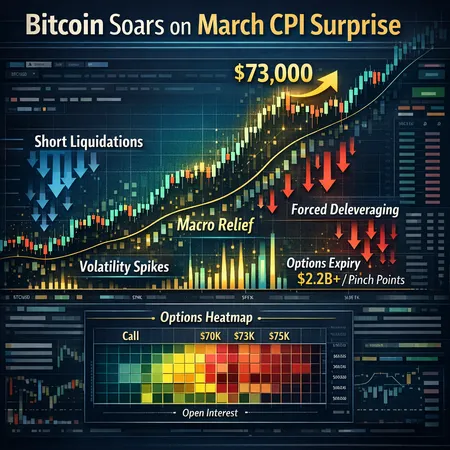
On April 10, 2026 Bitcoin vaulted through the $72–73k band in a matter of hours. The move wasn’t a single cause but the intersection of macro relief — a cooler March CPI print — and concentrated market structure effects: short liquidations, large derivatives flows, and the timing of an important options expiry. Macro headlines lowered the perceived odds of faster Fed tightening, while leverage in the futures and options market turned that narrative into price action. For many traders, Bitcoin remains the primary macro-playable crypto asset, so these cross-asset signals carry oversized weight.
Macro catalyst: March CPI and a 3.3% print
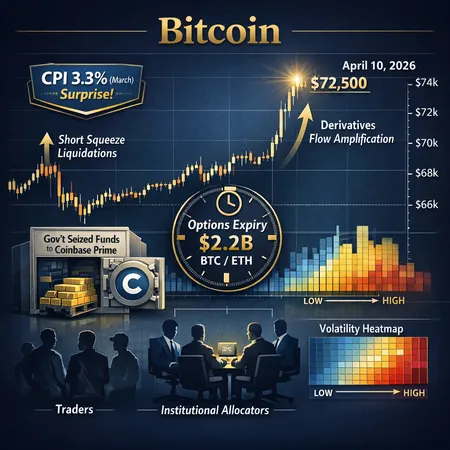
The proximate macro trigger was March’s Consumer Price Index coming in cooler than expectations. Markets interpreted the 3.3% headline as evidence that disinflation was persisting, which re-priced the short end of rate-expectation curves and restored some risk appetite. Several outlets connected the CPI surprise to the spike: CoinPaper summarized how the CPI outcome reshaped the narrative and helped fuel the rally, and other macro writers noted that the figure lowered the near-term probability of additional Fed hikes.
Why that matters for Bitcoin: lower expected terminal rates reduce the opportunity cost of holding non-yielding assets and make leveraged long positioning cheaper to finance. The CPI print did not guarantee a multi-quarter bull-run, but it was the spark that allowed existing balance-sheet and derivatives mechanics to ignite a rapid move.
How short liquidations and derivatives flows amplified the rebound
The pace of the April 10 advance was driven as much by market structure as by sentiment. When a macro surprise pushes price into a crowded short zone, the mechanical effects of futures margin calls and cascading liquidations can create reflexive momentum. Reports of large short liquidations and concentrated leverage suggested that many participants were short into the print — a setup that created asymmetric upside when the print was dovish.
At the same time, OTC desks and exchanges saw quick re-leveraging from buyers who used futures, perpetuals and delta-hedged options to express bullish views. Short squeezes are painful to be on the wrong side of, and they tend to exaggerate moves in a thin-liquidity environment. Crypto options and perpetual markets are still shallower than traditional equity or FX markets at these levels, so the same input shock produces a larger price response.
The $2.2B options expiry: why expiry days still move markets
A concentrated options expiry can compress gamma and skew dynamics into a tight window, magnifying moves either way. On April expiry dates, market participants roll or close positions; if a large chunk of activity is concentrated in a narrow strike range, hedging flows from market-makers (buying or selling spot or futures to remain delta-neutral) can materially push BTC and ETH prices. News outlets flagged roughly a $2.2 billion expiry for BTC and ETH around the same period, highlighting the potential for short-term directional pressure and elevated implied vol.
Options expiries don't create macro demand per se, but they shape the path: delta-hedging and gamma risk transfer can feed momentum and then reverse if positions are rebalanced. Traders should expect higher realized volatility around expiry windows and consider that hedging flows may exacerbate both the initial leg and the retracement.
Institutional flows and the seized-Bitcoin deposit to Coinbase Prime
Separately, the US government deposited a block of seized Bitcoin into Coinbase Prime in April 2026 — an important institutional-supply signal. The deposit matters because Coinbase Prime is a bulwark for institutional access: custody, block trades, and venue routing for large sellers or buyers often go through that rail. CryptoBriefing covered the deposit and discussed how such flows feed into institutional liquidity calculations.
Two simple scenarios explain the deposit’s effect. If the coins remain in custody and are allocated to long-term government holdings, the deposit effectively removes floating supply, tightening market liquidity. If the government elects to liquidate into the market (via auction or brokered sales), supply pressure could emerge, especially if done quickly. Market participants and allocators must assume a non-zero chance of eventual selling; the timing and execution method will determine whether it’s a long-term supply removal or a short-term shock to available float.
Bringing the pieces together: why the rally ran to $73k
Put together: a dovish CPI prints lowered rate-forcing fears, re-pricing the risk-free curve; large short exposures in futures/perpetuals created a ripe short-squeeze environment; market-makers in options were forced to hedge a heavy expiry cluster that concentrated flows into a narrow timeframe; and institutional rails like Coinbase Prime amplified the narrative when a seized deposit hit headlines. Each element alone is notable; together they created a feedback loop that pushed BTC through prior resistance bands to test fresh highs.
The rally therefore had the feel of a classic macro + market-structure move: a fundamental news shock multiplied by leverage and liquidity mechanics.
Scenario-based outlooks for traders and allocators
Below are succinct, actionable scenarios — with suggested posture for intermediate traders and crypto allocators on position sizing, hedging, and monitoring.
Base case (probability: 45%): consolidation with higher realized volatility
- Narrative: CPI remains disinflationary or stable; no major geopolitical shock; the seized-deposit is managed without immediate large sales. Options expiry-related volatility cools after the event as positions are rebalanced.
- Market action: BTC drifts in a higher range (e.g., $62–78k) with episodic spikes tied to macro prints and news.
- Trade/allocator posture: trim smaller, tactical long positions as realized vol reverts; use collars or selling calls to fund downside protection; keep sizing moderate (3–5% of liquid portfolio for strategic holders, larger for tactical sleeves) and set clear stop-placement relative to volatility.
Bull case (probability: 25%): continued risk-on and structural tightening
- Narrative: CPI trend continues to cool, money flows rotate into risk assets, and institutional onramps buy more than they sell. The seized coins are mothballed or used in a controlled auction that minimizes market impact.
- Market action: BTC extends to new highs with pullbacks bought aggressively; realized vol compresses gradually.
- Trade/allocator posture: add to core positions on volatility pullbacks, consider longer-dated LEAP-style options for leverage with defined risk, and layer systematic DCA for larger allocations. Institutional allocators might scale into 5–10% exposures depending on mandate and liquidity needs.
Bear case (probability: 30%): mean reversion and supply shock
- Narrative: geopolitical shocks or a surprise hawkish Fed response (or a decision to liquidate seized coins) triggers a flight from risk. The concentrated options expiry reverses as market-makers unwind and push price lower.
- Market action: sharp retracement to prior support zones; realized vol spikes; liquidity dries in stops and liquidations cascade on the way down.
- Trade/allocator posture: tighten sizing, use put protection (verticals or outright puts) and reduce leverage; prefer cash reserves to redeploy on capitulation. For allocators, consider trimming to policy weights and set a re-entry ladder rather than trying to time the bottom.
Risk management: sizing, hedges, and execution
- Position sizing: treat BTC as a high-volatility sleeve. For intermediate traders, a guide is sizing positions such that a 25–35% move against you does not breach portfolio-level risk limits. For allocators, cap strategic crypto exposure to policy bands and use tactical sleeves for higher conviction ideas.
- Hedges: use options where available — collars to monetize upside while capping downside, or selling call spreads to finance puts. For those without options access, staggered stop-limits and tranche-based DCA reduce tail risk.
- Execution: on potential supply events (e.g., seized-coin auctions), favor block liquidity and dark pools if executing large trades. Smaller retail-sized orders should avoid market orders in thin books; use TWAP/VWAP algos when possible.
One practical tip: monitor derivatives open interest, funding rates and concentrated strike exposures in options — these are early warning signals that a macro print can move price far beyond what spot liquidity would suggest.
Watch-list: the data and dates that matter next
- Next CPI and core inflation prints — they remain the dominant macro handle that can change market discounting of rates.
- Option expiry calendars and concentrated strike clusters — expiries can create outsized gamma and skew flows.
- Any update on the custody or disposition plans for the seized Bitcoin in Coinbase Prime — auction or auction-like sales will be headline events.
- Geopolitical developments that can suddenly re-risk or de-risk global portfolios.
Practical takeaways
- The April 10 surge was less a single bullish confirmation and more a technical reflex amplified by macro relief. Treat the move as volatility, not a binary validation of perpetual uptrend.
- Use options where possible to define risk; collar strategies and vertical spreads are efficient for intermediate traders who want exposure without open-ended downside.
- Keep position sizing disciplined: allow for 25–35% intra-period swings and plan execution around known liquidity events (expiries, auctions).
- Institutional signals (like seized-coin deposits) can tighten or loosen effective supply — monitor custody announcements and exchange flows, not just price.
Bitlet.app users and allocators should integrate these structural checks into their portfolio dashboards: macro calendar alerts, options expiry heatmaps, and exchange inflow/outflow trackers can materially improve timing and risk control.
Conclusion
April 10’s push above $72–73k was a textbook intersection of macro and market-structure forces. Cooler-than-expected CPI lowered the cost-of-carry for risk assets, and that macro breath of air met a highly leveraged, thinly liquid crypto market with a clustered options expiry and meaningful institutional signals. Whether the rally sustains depends on follow-through in macro data, the handling of seized institutional supply, and how options and futures flows re-price hedges. For intermediate traders and allocators the sensible posture is conditional: size conservatively, hedge explicitly, and watch the data and expiry windows that will determine the next directional leg.
Sources
- Bitcoin climbs above $73,000 as inflation cools and risk appetite returns
- XRP price prediction — Ichimoku cloud flips bullish as Ripple moves 25M coins on chain (context on March CPI)
- Crypto options alert — Bitcoin and Ethereum set for $2.2 billion expiry event
- US government deposits seized Bitcoin to Coinbase Prime (April 2026)