Inside Bitcoin’s Rally Above $73K: CPI, Short Squeezes, Options Expiry and Custody Flows
Summary
Quick take
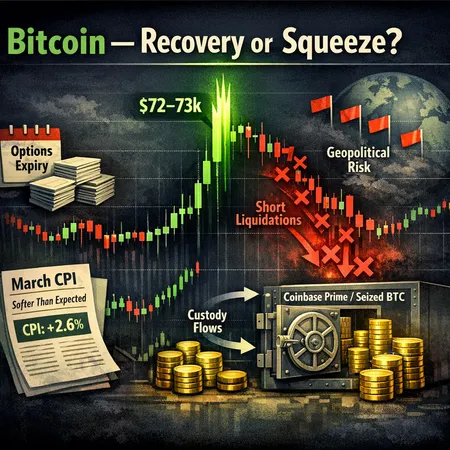
The market’s knee-jerk rally above $72–73k after the US March CPI release was a classic collision of macro relief and leveraged positioning. Cooler-than-expected inflation gave risk assets fresh oxygen; at the same time, crowded short positions and a major options expiry magnified spot moves through forced deleveraging and gamma flows. That mix can look like a recovery on charts, but underneath it’s often a liquidity story — one that custodial deposits and government flows can materially change.
For context, many market participants still treat Bitcoin as both a macro hedge and a liquid risk asset. The question for intermediate traders and portfolio managers is practical: are you watching a durable re-accumulation or a squeeze-driven snapback? This article breaks down the drivers, explains the plumbing (derivatives + custody), and gives an actionable checklist of signals to monitor.
What drove the move
CPI surprise: immediate macro relief
The immediate catalyst was the US CPI print. Several outlets reported that core CPI surprised to the downside, easing near-term inflation concerns and prompting a quick re-pricing of rate expectations. Coinpedia explains how the core CPI surprise fed into the move higher in BTC by lowering the perceived terminal rate and nudging risk appetite back up. Lower-than-expected inflation reduces the urgency for hawkish tightening, which historically helps risk assets — and Bitcoin benefits when liquidity chases into equities and crypto.
That macro relief is the foundation of the bounce: it turns off one of the main narrative headwinds for BTC — rapid, ongoing rate hikes — and frees marginal buyers to step in.
Short liquidations and the mechanics of a squeeze
Once the macro trigger hit, the market’s structure did the rest. Short positions in perpetual futures and concentrated spot short offers were vulnerable. As prices rose, short liquidations cascade: exchanges and derivatives platforms auto-close leveraged short positions, buying spot or perp contracts into the market and mechanically fueling more upside. Invezz flagged that Bitcoin moved above $73,000 as short liquidations and renewed risk appetite accelerated the rally.
This is not merely theoretical: NewsBTC documented a high‑profile trader liquidation that illustrates how leverage can blow up in minutes when volatility spikes. Short squeezes tend to produce sharp, headline-grabbing rallies that can retrace when the forced-deleveraging impulse fades.
Options expiry and gamma dynamics
Derivatives add a second-order amplification. The market faced a large options expiry around the same time — U.Today reported a significant Bitcoin and Ethereum options expiry (reported in some tallies as roughly $2.2 billion in notional). When big expiries cluster near key strikes, dealers who are short options adjust hedges dynamically: if spot moves higher they buy spot/perpetuals to remain delta-neutral, a feedback loop called gamma squeeze. Conversely, if spot falls they sell. Close-to-expiry hedging can thus dramatically increase realized volatility.
Put together: CPI -> re-priced rates -> spot uptick -> short liquidations -> option-seller hedging -> more spot buying. That chain explains both the speed and ferocity of the move.
Why custody and seized‑BTC deposits matter for liquidity
On-chain supply and custody movements are the quieter part of the story but they have outsized market impact when liquidity is tight. Cryptobriefing reported that the US government deposited seized Bitcoin into Coinbase Prime. Institutional-grade custody flows like that matter for a few reasons:
- Exchanges and custodians are the immediate conduits for liquidity. A sizable deposit to an institutional custody venue increases the supply that can be sold quickly, or alternatively signals incoming sell-side inventory.
- Custodial flows change counterparty balance sheets. Big deposits to Coinbase Prime shift where liquidity sits; large sellers concentrated on one custodian can create idiosyncratic microstructure effects if that custodian’s order books and OTC desks absorb or release positions unevenly.
- Psychological impact: government custody actions are visible, signalling that meaningful Bitcoin volumes have moved from private hands to institutions or the state — a change in available supply dynamics.
In short, during a squeeze, what looks like tight order books on spot venues can be tightened further by concentrated custodial holdings. That makes the market more reactive to forced flows from liquidations and options hedging.
Risk scenarios that could reverse or re-amplify the move
1) Recurring liquidation churn
If the rally was predominantly squeeze-driven, expect churn: price pops followed by pullbacks as forced positions exhaust themselves. Watch futures funding rates and open interest: sustained positive funding and rising open interest with widening basis suggests buyers are adding conviction; collapsing open interest after the move suggests a relief rally that will fade.
2) Trader blow‑ups and concentrated leverage
High-profile liquidations (the NewsBTC example) are not one-offs. A few large, levered desks getting knocked out in succession can create snap retracements. That risk is magnified when options gamma exposure is concentrated at particular strikes — dealers scramble to rebalance and that rebalance can overshoot.
3) Geopolitical shocks
Geopolitics can cut both ways. An escalation in major geopolitical risk can push BTC either up (as a flight to crypto in certain narratives) or down (if liquidity globally is withdrawn and fiat credit lines tighten). For portfolio managers, the lesson is to not treat the CPI move in isolation: geopolitical headlines can rapidly shift the macro correlation regime.
4) Custodial & institutional reserve shocks
A large overnight sell program from custodians or an institutional offloading event (or conversely, rapid withdrawals from exchanges into cold custody) can flip the market. The Cryptobriefing note about seized BTC on Coinbase Prime underscores that institutional movements are not academic — they move balances where liquidity is effectively sourced or sinked.
Signals and metrics to decide: recovery or squeeze?
Here’s a practical checklist for intermediate traders and PMs to judge durability:
- On-chain exchange reserves: falling reserves over weeks suggest genuine accumulation; a one-day drop or intra-day spike can be squeeze-driven.
- Futures open interest and funding: rising OI + sustained positive funding supports a structural rally; OI falling sharply after a move indicates washout.
- Options skew & OI by strike: dealers building heavy short-delta (or gamma) exposure around expiry can presage transient volatility. Monitor changes and the calendar of expiries.
- Spot liquidity and order book depth: thin depth at large venues means a handful of market-sized orders can move price significantly — check Coinbase Prime OTC prints if available.
- Custodian reports and large transfers: large deposits to exchange custody (or a government seizure deposit) can change supply dynamics in ways not visible in price alone.
- Macro flow context: CPI and rates are the backdrop. If rate expectations re-accelerate higher again, the case for a durable BTC risk-on rally weakens.
If most of the above point to sustained structural demand (ex: falling exchange reserves, rising OI, persistent positive funding anchored by organic buyers), the rebound has legs. If the signals show one-off derivatives unwinds and static reserves, treat the move as a squeeze.
Positioning and risk management suggestions
For intermediate traders:
- Avoid full-size entries into a move driven by forced liquidation. Scale in with limit orders and size your entries so you can absorb volatility.
- Use options to hedge tail risk if you want exposure: buying puts or structures like put spreads can cap downside without killing upside.
- Monitor intraday funding and OI; if funding spikes and OI collapses after a rally, reduce long exposure.
For portfolio managers:
- Treat recent gains as a rebalancing opportunity. Consider trimming into strength unless on-chain/derivatives signals confirm accumulation.
- Allocate a stress-test buffer for geopolitical shocks and custody-related liquidity squeezes — assume worst-case execution for large blocks.
- If using custody platforms (including Coinbase Prime), maintain visibility on institutional flows and the custodian’s OTC/prime desk liquidity; Bitlet.app users and allocators should also map execution risk into P&L assumptions.
Bottom line
The post‑CPI surge above $72–73k combined macro relief with structural plumbing: short liquidations and options hedging amplified price moves, and custody flows can make tight markets tighter. That recipe produces fast rallies that can translate into sustainable recoveries — but they require confirmation from on-chain reserve trends, derivatives open interest, and continued macro calm.
For traders and PMs the pragmatic stance is measured: respect the move, but demand confirmation. Use the checklist above as your litmus test — if exchange reserves fall, OI rises and funding normalizes, accumulation is credible. If the rally is dominated by sudden liquidations, clustered expiries and unchanged reserve metrics, treat it as a squeeze and size positions accordingly.
Sources
- Bitcoin climbs above $73,000 as inflation cools and risk appetite returns (Invezz)
- Bitcoin breaks $73,000 as core CPI surprises — will the rally last? (Coinpedia)
- Crypto options alert: Bitcoin and Ethereum set for $2.2 billion expiry event (U.Today)
- A Bitcoin cautionary tale: high-profile liquidation coverage (NewsBTC)
- US government deposits seized Bitcoin to Coinbase Prime (CryptoBriefing)