Quantum‑Resistant Blockchains: Practical Paths for BTC, DOGE and TON
Summary
Why quantum resistance matters now
Quantum‑resistant upgrades are moving from academic curiosity to engineering priority. Most blockchains rely on elliptic curve cryptography (ECDSA/Ed25519) for keys and signatures; sufficiently large quantum computers would make those primitives vulnerable. For engineers and protocol investors the question is not just “if” but how to migrate without crippling network UX or fracturing communities.
The conversation has practical urgency: NIST standardized post‑quantum primitives in 2022, and projects are already testing hybrids and prototypes. For many traders and node operators, including platforms like Bitlet.app, watching which chains adopt cryptographic agility and workable migration paths will be a governance and technical bellwether.
Two high‑level upgrade paths: soft‑fork vs replacement
There are basically two architectural choices when a protocol needs new cryptography:
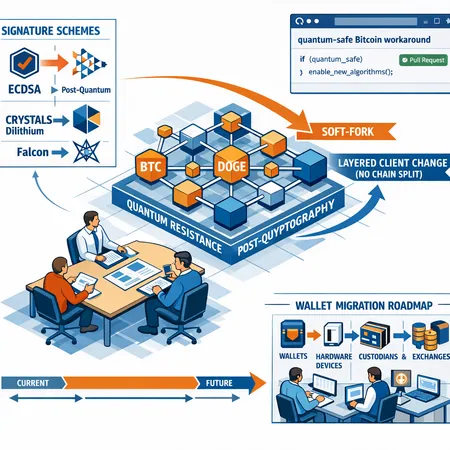
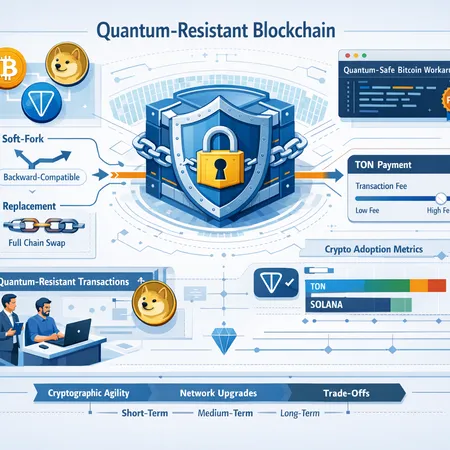
Soft‑fork / backward‑compatible additions. Add new script ops or rules that allow post‑quantum schemes while old keys continue to work. This minimizes churn for existing addresses but often requires broad consensus and careful scripting to avoid enabling new attack surface. Soft‑forks preserve history and let old coins move under old rules.
Replacement (hard‑fork / migration). Require all new keys to use different algorithms or alter core transaction validation in ways that make old signatures invalid. This can be cleaner long‑term but is disruptive: it forces wallet, exchange and hardware updates and risks chain splits if adoption falters.
Each has trade‑offs: soft‑forks reduce immediate disruption but can become messy long‑term (supporting multiple signature families forever). Replacements simplify future designs but require coordinated migrations and higher short‑term risk.
Cryptographic agility as the design anchor
The sane middle ground is cryptographic agility — build systems that accept multiple algorithms (classical + post‑quantum) and can phase‑in or phase‑out primitives over time. Agility adds complexity (bigger scripts, more code paths) but avoids sudden, single‑moment failures.
The Bitcoin workaround: quantum‑safe without a soft‑fork?
A recent academic / engineering push is exploring ways to make Bitcoin more quantum‑resistant with minimal protocol churn. A research paper and accompanying GitHub workaround described in reporting shows patterns where wallets embed hybrid or post‑quantum verification conditions into existing script types so that funds can be recovered or spent using quantum‑resistant signatures without a coordinated soft‑fork research and GitHub workaround.
The core idea: craft spending conditions that remain valid under current consensus rules (so nodes don’t need a rule change) but add off‑chain or on‑chain constructions which allow users to transition keys. Practically this often uses script combinations and timelocks that enable an owner to reveal a new public key or use a fallback signature after a delay.
What this achieves:
- Immediate deployment by wallet software without changing consensus rules.
- A migration safety net for users who proactively adopt the new spending patterns.
What it doesn’t solve cleanly:
- It can't retroactively protect already‑published public keys used in past transactions (reuse remains the core risk).
- It places burden on wallets to adopt new address formats and educate users.
So for BTC, the workaround is a pragmatic bridge: it buys time and gives users options without forcing a network‑wide soft‑fork, but long‑term cleaner solutions (better script opsets or an eventual soft‑fork) may still be preferable.
For contextual reading, engineers should examine the GitHub proofs and the accompanying paper summarized in press coverage to understand the assumptions and limitations DailyCoin coverage.
Dogecoin experiments: engineering in public
Dogecoin engineers have publicly experimented with quantum‑resistant transaction constructions and prototyping, responding to the same risk profile that BTC faces. Reports indicate active experimentation and developer commentary on integrating PQC elements into Dogecoin transactions while maintaining network simplicity Dogecoin experiments.
Dogecoin’s advantages and constraints:
- As a Bitcoin‑derived chain, Dogecoin can often trial ideas faster, but it shares many of the same signature primitives and thus the same migration constraints.
- Its developer community tends to prefer lightweight, pragmatic changes — experiments that can be adopted by wallets with minimal friction.
The Dogecoin work highlights a typical pattern: start with hybrid signatures or script‑level fallbacks, prove UX and tooling, and then consider broader consensus changes if needed.
TON (Telegram Open Network): UX, fees and an upgrade window
Telephone‑scale UX and fee economics matter as much as signature algorithms. Telegram founder Pavel Durov has been vocal about TON’s performance and fee roadmap, claiming meaningful throughput and proposing fee cuts to attract activity and liquidity Durov on TON.
Why that ties to quantum upgrades:
- A chain that reduces fees and improves UX can migrate users and applications faster, reducing the cost of rolling out cryptographic upgrades (fewer active, legacy integrations to coordinate).
- TON’s vertical integration with a large user base and app ecosystem gives it a practical advantage for rapid wallet updates and coordinated transitions.
That said, fee cuts alone don’t obviate cryptographic work. Implementing PQC support requires updating client libraries, validators and hardware signing integrations. If TON pairs fee reductions with an aggressive developer outreach and tooling push, it could outcompete high‑fee chains (like some phases of Solana congestion) in attracting sensitive use cases early.
Practical migration strategies (what engineers should build)
Hybrid signatures: sign with both classical and post‑quantum schemes and require only one or both in validation, depending on policy. This is a common safe first step.
Scriptable fallbacks & timelocks: embed recovery paths that allow funds to be claimed using PQC after a delay, reducing the need for an immediate soft‑fork.
Agile validation layers: design node software and RPC APIs that can advertise and negotiate accepted signature suites, enabling clients to pick the best available mode.
Wallet & hardware upgrade paths: coordinate SDKs, hardware wallet vendors and exchanges; unsigned transaction formats should allow adding PQC materials without rewriting history.
Staged consensus changes: reserve soft‑forks for cases where safety or efficiency mandates on‑chain rule changes; prefer off‑chain and wallet‑level changes first.
Timeline and realistic expectations
- Short term (0–5 years): experimentation, hybrid deployments, wallet‑level fallbacks and incremental tooling updates. The Bitcoin workaround fits here. Many projects will adopt cryptographic agility patterns now.
- Medium term (5–10 years): coordinated soft‑forks or mandatory version bumps for chains that need tighter guarantees and cleaner long‑term state. Exchanges and custodial services will have completed key rotation programs.
- Long term (10+ years): only if large, fault‑tolerant quantum machines arrive will emergency hard‑forks or radical protocol replacements be necessary. Most likely, well‑executed agility and rotation will have largely mitigated catastrophic risk.
This timeline balances the technical lead time for ecosystem upgrades (wallets, hardware, exchanges) and the current projections for quantum hardware maturity.
Trade‑offs investors and protocol architects must weigh
- Complexity vs speed. Hybrid and fallback solutions add complexity to validation and UX but are faster to deploy. Clean replacements are simpler to reason about but slow and risky to coordinate.
- Chain bloat and fee impact. PQC signatures (especially stateless ones like Dilithium) tend to be larger on‑chain than ECC signatures; that increases transaction sizes and may affect fees and throughput.
- User education and key hygiene. The weakest link is human: reused addresses or unpatched wallets negate cryptographic upgrades.
- Coordination risk. Soft‑forks require consensus; insufficient buy‑in can fragment liquidity or create attack windows.
Practical checklist for teams and investors
- Prioritize cryptographic agility in protocol roadmaps.
- Fund and audit wallet SDKs for PQC support.
- Run pilot deployments (testnets, opt‑in addresses) and measure UX impact.
- Engage hardware wallet vendors early; signing formats must be compatible.
- Track standards (NIST recommendations, library maturity) and roadmap upgrades accordingly.
For protocol investors, watch signals: active experiments (like Dogecoin’s), public tooling and papers (like the Bitcoin workaround), and platform moves on UX and fees (TON’s roadmap) are leading indicators of readiness.
Conclusion: evolve now, harden later
A pragmatic, layered approach wins: deploy hybrid and script‑level workarounds today to protect users who proactively adopt them, build cryptographic agility into the stack, and save disruptive consensus changes for when they’re truly necessary. Projects like DOGE and TON are already testing the playbook; BTC‑oriented research shows viable paths without immediate soft‑forks. That gives the ecosystem breathing room to coordinate upgrades while keeping the lights on.
As the community prepares, prioritize clear migration tooling and get exchanges, custodians and hardware vendors into the same upgrade cadence — the operational effort matters as much as the math.
For engineers and technical investors, this is the moment to align roadmaps, fund PQC engineering, and run pilots so that when hardware catches up, networks react with deliberation, not panic.
Sources
- Research paper and GitHub workaround summary: https://dailycoin.com/quantum-safe-bitcoin-no-soft-fork-a-new-workaround-hits-github/
- Dogecoin experiments and developer commentary: https://u.today/dogecoin-experiments-with-quantum-resistant-transactions-doge-engineer-weighs-in?utm_source=snapi
- Durov on TON performance and fee proposals: https://ambcrypto.com/telegrams-durov-says-ton-is-now-10x-faster-make-ton-great-again/
For additional context on cryptographic agility and post‑quantum primitives, review NIST PQC materials and current RFCs. Also consider monitoring ecosystem write‑ups on chains such as Bitcoin and app activity in DeFi as signals of adoption and tooling maturity.