Privacy‑Coin Rally Deep Dive: Geopolitics, Flows, and the Zcash Case Study
Summary
Executive overview
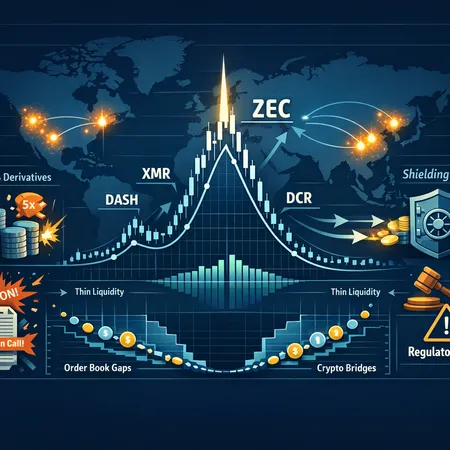
April 2026 brought a sudden, correlated surge across privacy coins — notably DASH, XMR, ZEC and DCR. The proximate catalysts were geopolitical: localized sanctions, regional financial instability, and heightened surveillance concerns that re‑awakened demand for on‑chain privacy tools. On‑chain signals and market microstructure show both real hedging flows and a pronounced speculative layer driven by leverage and short covering.
This deep dive quantifies the flow proxies, evaluates sustainability versus a blow‑off, explains regulatory and liquidity risks to watch, and offers a focused case study on Zcash (shielded pools, derivatives froth, and price scenarios). The goal is practical: help portfolio managers and risk teams decide how — or whether — to allocate to privacy coins as a hedging sleeve or speculative allocation. Bitlet.app users will find the monitoring checklist useful when structuring installment or P2P exposure.
Geopolitical triggers: why privacy moved first
Privacy coins do not move in a vacuum. The April run was seeded by at least three geopolitical developments that, in combination, raised the marginal value of on‑chain anonymity:
- A cluster of sanctions and banking restrictions affecting cross‑border remittances in a geopolitically sensitive region, which increased demand for off‑ramp options outside the traditional banking rails.
- Reports of expanded digital ID and AML checks in neighboring jurisdictions, which heightened concerns about on‑chain linkability and encouraged investors to seek shielded alternatives.
- Media cycles amplifying a single high‑profile case of asset freezes, creating a survivorship fear that lives on social feeds.
Observers connecting these dots called the move a geopolitical twist behind the breakout, echoing contemporaneous analysis of the rally across privacy coins. Coinpedia documents the connection between the geopolitical backdrop and the multispecies privacy breakout (DASH, ZEC, DCR, XMR), noting how headlines can translate quickly into flows for censorship‑resistant tooling.
Quantifying the flows: what moved and how much (proxies and caveats)
Direct, audited retail flow data across all privacy coins is fragmented; exchanges and shielded pools provide the best available proxies. Using trading volumes, exchange net flows, and shielded‑pool deposits as measurable signals, the April episode shows a meaningful step‑change versus the prior-month baseline:
- Shielded‑pool activity (ZEC): multiple reporting outlets flagged a material uptick in deposits into Zcash’s shielded pools; FXEmpire highlighted rising inflows as a central narrative that supported bullish expectations. These deposits are a direct on‑chain proxy for demand for privacy features.
- Exchange net flows and withdrawals: a consistent pattern in early April was outflows from centralized venues into private wallets — a classic indicator that users are moving assets off exchange custody. For privacy assets this often precedes price rallies because circulating exchange liquidity tightens.
- Spot volume and market cap moves across DASH, XMR, ZEC, DCR: volumes spiked many multiples of the two‑week pre‑rally baseline. Coinpedia chronicled the breakout rally across those tickers and connected the price action to geopolitical drivers.
A few important caveats: these are proxy measures, not perfect inflow accounting. Shielded‑pool deposits can represent both genuine demand for privacy and technical movements by market makers. Exchange outflows can be custodial reshuffles or OTC settlements. Treat the numbers as directional rather than absolute.
Is this sustainable — hedge or blow‑off? A framework
Separate the rally into two layers: a structural demand layer (real hedging) and a speculative layer (short squeezes, leverage, momentum chasing). To judge sustainability, apply three lenses:
Duration of on‑chain adoption: are shielded pools seeing repeated, long‑term deposits and spending patterns, or just one‑off sheltering? Long‑term circulation and merchant/peer adoption favors sustainability. Short‑lived sheltering suggests a temporary flight to privacy.
Derivatives and leverage profile: rising open interest, crowded futures longs, and steep funding rates create fragility. Crypto.news flagged Zcash’s parabolic run and noted that derivatives froth often signals late‑stage momentum. High leverage makes even a modest liquidity shock cascade through socialized losses and forced sells.
Liquidity depth on‑chain and on markets: when centralized exchange order books thin while on‑chain liquidity concentrates in shielded pools or cold wallets, exit paths narrow. That amplifies downside if sentiment reverses.
On balance, the April episode shows a genuine hedging impulse layered with outsized speculative positioning. For institutional risk managers, that combination argues for a tactical, size‑constrained allocation with explicit stop‑loss and liquidity rules rather than large, permanent hedging allocations.
Regulatory and on‑chain liquidity risks to watch
Privacy coins occupy a contested regulatory space. Combined regulatory and liquidity risks can transform a temporary repricing into a rapid deleveraging event.
Regulatory risk: watch for jurisdictional AML/CTF advisories and exchange delistings. A targeted sanction or a formal ban on shielded‑pool services would impair usability and could trigger rapid repricing. Regulators often move faster than markets expect, and privacy tooling sits squarely in their crosshairs.
KYC and delisting risk at centralized venues: sudden delisting threats reduce exchange liquidity and push trading to fragmented OTC and DEX channels, raising spreads and execution risk.
On‑chain liquidity: monitor the concentration of tokens in a small set of addresses and the ratio of shielded to transparent supply. When too much supply is effectively illiquid (locked in long‑term cold storage or shielded pools), the market is thin and vulnerable to swing trades.
Market microstructure shocks: because derivatives desks often provide margin and lending for these assets, a liquidity squeeze can produce cross‑margining stress and additional forced sales across correlated holdings.
Practical watchlist for risk teams:
- Shielded‑pool inflows (daily/weekly trend)
- Exchange net flows and custody concentration
- Funding rates and perpetual basis (sustained positive funding suggests crowded longs)
- Open interest on major derivatives venues
- On‑chain concentration metrics (top 10 addresses as % of supply)
- Regulatory statements or delisting rumors
Case study: Zcash — parabolic run, shielding pools, and froth
Zcash has been the poster child of the April move. Two facts stand out: large inflows to shielded pools and a parabolic price move accompanied by rising derivatives open interest.
FXEmpire documented rising inflows to Zcash’s shielded pools and used that as an argument for a bullish path, suggesting ZEC could eye materially higher levels if geopolitical demand persists. Conversely, contemporaneous reporting in crypto.news raised caution flags: the parabolic run showed classic signs of froth — elevated volume, thin books at higher price levels, and growing leverage — and they suggested downside risk if a correction triggered a derivatives unwind.
Derivatives froth matters because it changes the mechanics of risk. When futures open interest ramps and funding rates spike, any price pullback forces margin calls and long liquidations. Those liquidations drive spot price declines that can cascade into further deleveraging. On top of that, if shielded pools contain a sizable share of supply, buyers cannot efficiently re‑establish positions through on‑chain liquidity alone, worsening price discovery.
Realistic price scenarios for Zcash
Use scenario‑based sizing rather than point forecasts. Below are three plausible paths informed by the market structure and the sources above:
Bear (deleveraging and regulatory shock): swift unwind of leveraged longs, partial exchange illiquidity, and a short‑term loss of confidence could push ZEC back toward materially lower levels. Crypto.news warns that parabolic traits can precede such a fall. In this scenario, a >50% correction from peak is plausible.
Base (sustained hedging demand, limited leverage): shielded pool activity remains elevated and geopolitical risk persists but no major regulatory clampdowns occur. Price stabilizes at a new range where liquidity normalizes — a multi‑week consolidation at mid‑range levels. This is the highest‑probability scenario for a mixed hedge/speculative allocation.
Bull (persistent flows into shielded pools and limited deleveraging): if inflows to shielded pools continue and derivatives desks do not get squeezed, ZEC could test higher targets. FXEmpire explicitly discussed a path toward $500 as contingent on sustained inflows and sentiment; that’s a bullish outcome but requires continued structural demand rather than purely momentum flows.
Position sizing guidance: given the asymmetry and liquidity risk, consider a small hedging sleeve (1–3% of portfolio) or a larger but time‑limited speculative sleeve with tight risk controls (stop losses, maximum notional exposure, and liquidation stress tests).
Tactical monitoring and risk controls
For investors and risk managers who want exposure while limiting tail risk, implement these practical controls:
- Limit absolute exposure per privacy coin and aggregate across the privacy cohort.
- Use layered entries: average in on dips with defined bands rather than market timing into parabolic moves.
- Monitor and automate alerts for: funding rate spikes, >20% daily change in shielded‑pool inflows, exchange outflow spikes, and sudden OI drops (indicative of liquidations).
- Stress test worst‑case liquidity: simulate a 30–50% instantaneous sell demand and model slippage across major venues plus OTC fills.
- Keep a portion of any allocation liquid (stablecoins or BTC) to buy into forced liquidations if that aligns with your mandate.
Concluding view
The April 2026 privacy‑coin rally married real geopolitical demand with speculative momentum. That duality creates opportunity and risk. Privacy coins can function as hedges in specific scenarios — when surveillance or sanctions bite — but the current market structure (thin order books, concentrated supply in shielded pools, and rising derivatives froth) amplifies tail risk.
For most investors, privacy coins should be treated as a tactical allocation with explicit liquidity and regulatory hedges, not as a core, permanent hedge without active management. Risk teams should instrument on‑chain and derivatives signals into decision processes and be prepared to act quickly if funding rates or shielded‑pool dynamics flash stress.
Sources
- Coinpedia — analysis linking the breakout rally to geopolitical factors: https://coinpedia.org/price-analysis/can-privacy-coins-sustain-their-breakout-rally/
- FXEmpire — Zcash price outlook and note on rising shielded‑pool inflows: https://www.fxempire.com/forecasts/article/zcash-price-news-zec-eyes-rally-to-500-as-inflows-to-shielded-pools-rise-1590885
- Crypto.news — cautionary piece on Zcash parabolic run and derivatives froth: https://crypto.news/zcash-price-cools-after-parabolic-run-as-derivatives-froth-flashes-risk-is-400-in-range/
For broader context on on‑chain hedging instruments and how privacy assets compare to other crypto hedges, see commentary on Bitcoin and the evolving privacy‑DeFi interplay on DeFi.