XRP’s Quiet Buildup: Do Derivatives, On‑Chain Flows and Ledger Resilience Signal a Real Breakout?
Summary
Introduction — why this study matters
The narrative around XRP lately has been quieter than a meme‑fuelled pump, yet the underlying plumbing tells an interesting story. For intermediate traders and crypto researchers, noise and signal live in different data feeds: derivatives flows can reveal how players are positioned, on‑chain transfers track real supply shifts, and chart overlays like the Ichimoku cloud show whether momentum aligns with those flows.
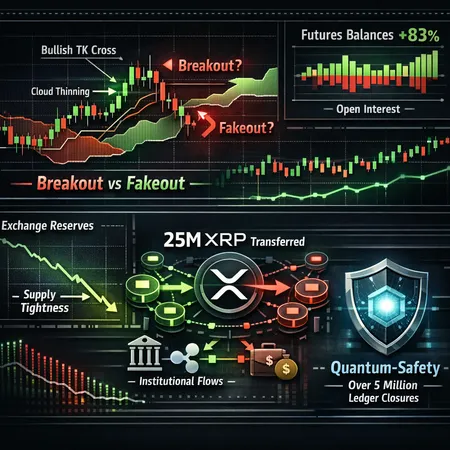
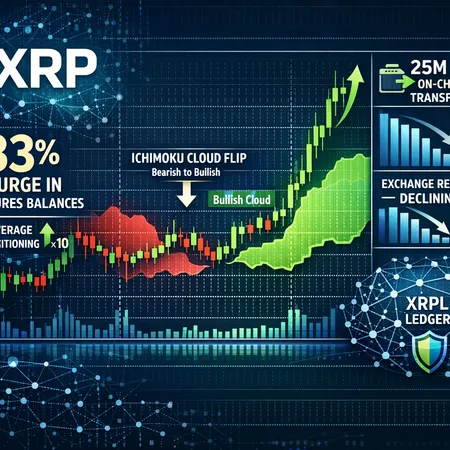
This piece synthesizes five threads — the recent 83% jump in futures balances, an Ichimoku flip, a 25 million XRP transfer, declining exchange reserves, and XRPL’s quantum‑security posture — to evaluate whether XRP is set for a real breakout or just another short‑lived pop.
Derivatives: the 83% surge in futures balances and what it implies
A dramatic near‑term signal came from a reported 83% jump in XRP futures balances within 24 hours. The spike is meaningful for two reasons: it signals increased leverage and it shows how quickly positioning can change in derivatives markets. The original data note points out that such a rapid increase is easy to miss unless you watch futures balance metrics closely (83% in XRP futures balance is important).
What does this imply? First, more futures balance tends to mean more outstanding contracts — both longs and shorts — and therefore higher potential for liquidation cascades if the price moves unexpectedly. That amplifies volatility and can either accelerate a breakout (if longs are squeezed) or deepen a decline (if shorts are squeezed the other way).
Second, the directional composition of that increase matters. A raw balance jump doesn’t tell you whether longs or shorts dominated the new demand; it only tells you that leverage has increased. If most of the added volume sits in long positions, a positive catalyst could convert positioning into a strong, sustained rally. But if shorts were building, a bullish catalyst could still produce a sharp short‑squeeze that lacks follow‑through.
Finally, watch funding rates and open interest together with balance. A balance spike plus rising open interest and positive funding tilts toward buyers — a setup conducive to trend continuation. Conversely, balance growth paired with negative funding (shorts getting paid) hints at bearish bets being entrenched despite the balance increase.
Technical context: Ichimoku cloud flip and the broader setup
Technically, coinpaper reported an Ichimoku cloud flip toward bullishness on certain timeframes, which is often interpreted as a momentum shift if confirmed by price staying above the cloud and leading spans aligning (Ichimoku cloud flips bullish as Ripple moves 25M coins on chain).
A few practical points for traders:
- The Ichimoku system favors confirmation. A Kumo (cloud) flip on a daily chart carries more weight than an hourly flip. Traders should look for price to hold above the cloud and for the Tenkan/Kijun cross to remain supportive.
- Ichimoku complements, not replaces, volume and order‑flow checks. If the cloud flips but futures open interest is dominated by leveraged shorts, the flip could be a technical decoy.
- Use the cloud as a dynamic support/resistance band. In accumulation phases, a bounce from the cloud with solid volume and declining exchange reserves strengthens the breakout case.
Taken together, the Ichimoku flip increases the plausibility of a trend change — but it is not definitive without the supply/demand context outlined below.
On‑chain transfers and supply dynamics: what a 25M XRP move tells us
Large on‑chain transfers attract attention because they can represent many things: intra‑exchange shuffles, OTC deals, treasury movements, or whale accumulation. Coinpaper covered a notable 25 million XRP transfer tied to Ripple-related flows, and the market reacted to the size and timing (Ripple moves 25M coins on chain).
How large transfers affect supply/demand:
- Transfers into cold wallets or custodial addresses known for long‑term storage reduce circulating supply available for trading — a bullish signal if demand is steady or rising.
- Moves to exchanges increase sell pressure potential; moves off exchanges suggest the opposite. The intent behind a transfer matters as much as its size.
- Even transfers between labelled Ripple addresses can matter if they change the distribution between exchange custody and long‑term holders.
From an accumulation standpoint, clusters of large transfers off exchanges combined with declining exchange reserves form a textbook tightening of supply. That tightening increases the chance that incremental demand (e.g., from derivatives deleveraging or new buyers) translates into price appreciation rather than being soaked up by available sellers.
Exchange reserves: falling balances and what accumulation looks like
Separate on‑chain work has documented declines in exchange reserves for XRP, which is a classic on‑chain demand signal — buyers are pulling coins off exchanges and into private custody or long‑term storage (XRP eyes another rally as exchange reserves decline).
Why exchange reserves matter to traders:
- Lower reserves mean less available supply for immediate selling — this can magnify price moves.
- Reserve decline is distinct from price action: you can see accumulation into wallets even while price grinds sideways. That phase often precedes a sharper trend move once liquidity tightens enough.
- Watch the pace of reserve decline. A slow, steady drawdown often indicates organic accumulation; sharp, sudden withdrawals can be exchange rebalancing or custodial consolidation and require context.
When you overlay exchange reserve decline with rising futures balances and technical bullishness, the hypothesis becomes: leverage is building while the spot supply available to satisfy leveraged buyers is shrinking. That’s a necessary condition for a sustained breakout — but not sufficient.
The contrarian take: why it might not yet be a 'real' breakout
Not every setup that looks ready for lift‑off completes the mission. Bitcoinist argued recently that the real XRP move hasn't happened yet, cautioning that price action lacks the breadth and follow‑through typical of confirmed breakouts (Real XRP move hasn’t happened). Their analysis highlights two important caveats:
- Breakouts require confirmation across spot and derivatives. If long-only momentum is offset by heavy short positioning, or if volume and exchange liquidity don’t support higher prices, the move can fail.
- Structural liquidity (order book depth) and macro catalysts matter. A spike driven purely by forced liquidations without new buyer interest often collapses when volatility normalizes.
So, while the balance of signals leans bullish, the lack of convincing follow‑through in price and breadth so far keeps the door open for a false breakout.
XRPL quantum‑security: a quick primer and why resilience matters for accumulation
A less headline‑grabbing but strategically important topic is XRPL’s exposure to quantum threats. If market participants believed XRPL were highly vulnerable to quantum attacks, that could suppress long‑term accumulation. Fortunately, research suggests only a small fraction of XRP supply is materially exposed to such risks (Only 0.03% of XRP supply is vulnerable to quantum threats).
Key takeaways:
- The estimated vulnerability is tiny (on the order of 0.03%), meaning quantum concerns are unlikely to be a major driver of price in the near to medium term.
- Ongoing upgrades and cryptographic best practices across the industry reduce systemic shock risk; XRPL’s design and community attention to security are reassuring for institutional accumulation.
- For traders, quantum‑resilience is a background risk — worth watching for long‑term allocation decisions but less relevant for near‑term breakout mechanics driven by liquidity and positioning.
Synthesis: convergence of signals — are we close to a real breakout?
Bring the threads together:
- Increased futures balances (+83%) show leverage and positioning have ramped up. That raises the potential for sharp moves via liquidations, but direction depends on the composition of those positions.
- Ichimoku cloud flips indicate an improving momentum backdrop; on their own they’re encouraging but require confirmation through price holding key levels.
- Large on‑chain transfers (25M XRP) and consistent exchange reserve declines point to a tightening of spot supply — a bullish structural factor for sustained moves.
- XRPL’s low quantum vulnerability removes a potential structural deterrent to accumulation.
- The contrarian caution is real: without clean price confirmation (breadth, sustained volume, and a drop in bearish open interest), the market can still produce a short‑lived rally.
Net assessment: conditions for a real breakout are assembling. The most important missing piece is conviction in the form of sustained order‑book depth, rising spot demand, and a directional shift in derivatives composition (net long positioning or sustained reduction in short pressure). If those arrive, the structural supply tightening will amplify the move.
Practical checklist for traders and researchers
If you want to monitor whether the buildup turns into a durable breakout, track these signals together:
- Futures balance composition: are new contracts skewing long or short? Watch exchange reports and derivatives analytics.
- Open interest vs. funding rates: rising OI + positive funding favors bulls; rising OI + negative funding favors entrenched shorts.
- Exchange reserves trend: continued outflows are bullish, especially when paired with large transfers to cold wallets.
- Ichimoku confirmation: price stays above the cloud on the daily and weekly timeframes; Tenkan/Kijun cross remains bullish.
- Order‑book depth: look for sell walls fading and bids building at higher levels.
- Volume breadth: healthy spot volume across exchanges reduces the odds of a purely liquidation‑driven spike.
A practical tip: monitor these signals on multiple timeframes and pair your technical bias with position sizing that anticipates potential forced volatility from leveraged counterparts.
Conclusion — verdict and the signals that will change it
XRP’s quiet buildup combines leverage growth, improving technical momentum, tangible supply tightening, and reassuring security posture. Those are encouraging conditions for a real breakout. However, the move requires confirmation: a clean, volume‑backed price breakout accompanied by a shift in derivatives composition and sustained reduction in exchange reserves.
For cautious traders: treat the current setup as high potential, not guaranteed. Watch the checklist above and consider staggered entries or options strategies that balance upside participation with downside protection.
For researchers: the interplay between futures balances and exchange reserves is an area worth deeper quantitative study — especially measuring how past spikes in futures balance correlated with subsequent reserve movements and realized volatility.
On a closing note: as on‑chain accumulation and derivatives positioning evolve, platforms like Bitlet.app make it easier for users to observe and react to changing liquidity dynamics while managing exposure.
Sources
- https://u.today/83-in-xrp-futures-balance-is-important-easy-to-miss-signal?utm_source=snapi
- https://coinpaper.com/16157/xrp-price-prediction-ichimoku-cloud-flips-bullish-as-ripple-moves-25-m-coins-on-chain?utm_source=snapi
- https://u.today/xrp-eyes-another-rally-as-exchange-reserves-decline-to-274-billion?utm_source=snapi
- https://bitcoinist.com/real-xrp-move-hasnt-happened/
- https://finbold.com/only-0-03-of-xrp-supply-is-vulnerable-to-quantum-threats/?utm_source=snapi
For additional context on market bellwethers, see Bitcoin. For on‑chain pattern comparisons across markets, check coverage of XRP.