Solana as a Stablecoin Rail: What $10.5B USDC in a Month Means for Liquidity and Institutional Flows
Summary
Why Circle’s $10.5B USDC Mint on Solana Is a Relevant Inflection
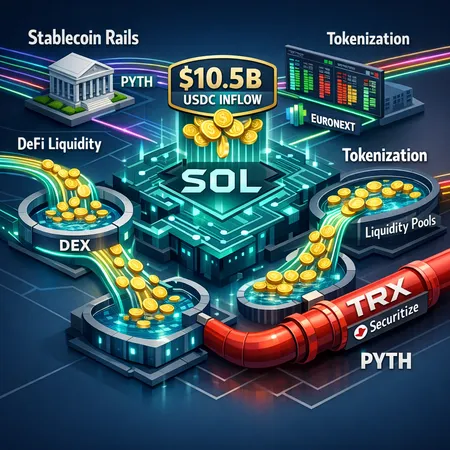
Circle’s decision to mint roughly $10.5 billion of USDC on Solana in a short window is more than a headline number. It changes the liquidity topology of the crypto market: sudden, large stablecoin supply on a single chain increases short‑term depth for swaps, stablecoin‑based lending, margin, and on‑chain settlement. The report that Circle minted over $10.5 billion USDC on Solana highlights how quickly dollar rails can reallocate when operational and cost advantages align (Crypto.News article).
Technically, Solana offers low latency and low nominal fees compared with congested EVM chains. That environment makes it attractive for builders who need fast quote updates, high‑frequency AMM ticks, or large batched settlement. It’s not just more dollars on Solana — it’s dollars that can move through DeFi primitives faster, lowering execution slippage and enabling new product designs that were previously constrained by fee ceilings or block time.
For context, many market participants still view Solana as an ecosystem optimized for throughput: sub‑second blocks and cheap transactions mean LPs can manage concentrated liquidity strategies more actively, and lending markets can scale without per‑txn fee drag. That practical advantage is what likely accelerated the migration of USDC supply onto the chain.
How Larger USDC Supply Affects DeFi Liquidity and Throughput
When a large stablecoin tranche lands on a chain, several things happen simultaneously.
Depth and slippage improve for dollar‑paired pools, which benefits traders executing large swaps and market makers providing tighter two‑way quotes. DeFi throughput rises because more value circulates in native smart contracts rather than waiting on cross‑chain bridges.
Derivatives and margin desks that rely on on‑chain collateral can scale more aggressively. Faster settlement and lower fees reduce carry and financing costs for protocols using on‑chain USDC as collateral.
Composability is amplified: lending protocols, AMMs, and liquid staking products can chain together larger flows without the cost friction that used to fragment activity across chains.
But there are tradeoffs. Concentration risk grows: a heavy chunk of USDC sitting on Solana increases systemic exposure if there’s a chain‑specific outage, a wallet compromise, or an upstream operational issue with minting or burns. Builders and integrators must consider redundancy and fallback rails to avoid single‑chain settlement risk.
Competing Rails: Tokenization on TRON and the Multi‑Chain Future
Stablecoin rails are not a winner‑take‑all market. While Solana is soaking up USDC, other rails are actively courting institutional flows. Securitize’s expansion to TRON — enabling tokenized securities and institutional asset rails on TRON — is a clear signal that tokenization is spreading beyond a single chain and that institutions will route different asset classes to different networks depending on custody, regulatory posture, and cost (Securitize on TRON).
TRON’s low fees and high throughput make it attractive for high‑volume tokenized securities and alternative stablecoin rails. That means dollar settlement may bifurcate by use case: Solana could dominate high‑frequency, DeFi native dollar flow, while TRON (and other rails) could capture tokenized institutional securities and predictable cash‑management flows. Traders and liquidity providers will soon be optimizing not just for token pairs but for the specific rails those tokens live on.
A multi‑rail landscape increases the need for reliable bridging and cross‑chain liquidity aggregation. Bridges remain a weak link: latency, fees, and security assumptions differ and can negate the on‑chain performance advantages if moving dollars between rails is costly or risky.
Institutional Market Data: Why Pyth + Euronext Matter for On‑Chain Activity
Fast, reliable market data is a prerequisite for institutional activity on‑chain. The expansion of Euronext FX to publish institutional FX and precious metals pricing to the Pyth Network is pivotal because it better equips on‑chain protocols with high‑quality reference prices for hedging, settlement, and risk checks (Euronext + Pyth coverage).
Oracles like PYTH reduce latency and improve the fidelity of price feeds for on‑chain derivatives, automated risk management, and capital efficiency. When institutional‑grade FX and metals data are natively available on chains, product teams can build on‑chain hedging strategies that mirror off‑chain institutional workflows, which lowers the barrier for treasury desks and custodians to participate on‑chain.
This combination — abundant USDC on rails like Solana and robust institutional feeds via PYTH — makes the chain more attractive for sophisticated market‑making, OTC matching, and structured products that require real‑time, auditable pricing.
Cross‑Chain Flows: What Changed and What’s Likely Next
With multiple rails competing for dollar liquidity and better price infrastructure arriving, cross‑chain flows will become both more frequent and more specialized. Expect these patterns:
Specialization by use case: certain rails will win for particular activities (high‑frequency swaps, tokenized securities, large custodial settlements).
More sophisticated routing logic: institutions and DeFi routers will route dollar liquidity based on latency, fee schedules, oracle availability, and counterparty requirements rather than blindly favoring a single chain.
Increasing demand for atomic settlement or near‑atomic near‑instant cross‑chain mechanisms. Otherwise, bridging costs and slippage will erode the gains from native on‑chain throughput.
Practical Implications for Builders, Liquidity Providers, and Traders
The rise of Solana’s USDC supply and parallel developments on other rails change operational priorities. Below are practical takeaways for different stakeholders.
Builders and Integrators
Design with multi‑rail primitives: don’t assume liquidity will remain on one chain. Build modular adapters that let users pick rails depending on cost, speed, and compliance needs. Consider layered fallbacks so payments can reroute if a chain experiences stress.
Bake in oracle diversity: integrate PYTH and other reliable feeds for critical pricing and risk logic. Institutional users will expect auditable, low‑latency pricing consistent with off‑chain references.
Account for settlement risk: if your UX promises ‘on‑chain finality’ for cross‑chain transfers, quantify the bridging and custodial counterparty exposures. Bitlet.app integrations and similar custodial partners will be judged on how they mitigate these risks.
Liquidity Providers (LPs) and Market Makers
Rebalance across rails: with improved throughput and lower slippage on Solana, concentrated liquidity and dynamic LP strategies can earn higher fees, but capital must be split strategically across chains to manage fragmentation risk.
Optimize for fee vs. risk: low transaction fees on Solana allow more active LP management, but be wary of chain‑specific smart contract risk and concentrated counterparty exposure if too much capital accumulates on a single rail.
Use robust hedging infrastructure: leverage PYTH feeds and multi‑market hedges to defend against oracle divergence and cross‑chain re‑pricing events.
Traders and Institutional Desk Operators
Choose rails by execution profile: if your strategy needs low slippage and high throughput (e.g., arbitrage, programmatic market making), Solana‑native liquidity may be preferable. For custody and tokenized securities settlements, TRON or other rails might offer regulatory or operational advantages.
Watch for fragmentation arbitrage: fragmented liquidity offers opportunities but also complexity. Efficient routers that can stitch liquidity across rails while minimizing bridging risk will be valuable.
Monitor mint/burn flows: large, concentrated mint events (like the Circle USDC issuance) can presage transient liquidity imbalances and should inform execution timing and block‑level order placement.
Risks and Open Questions
The current phase of multi‑rail growth surfaces several important risks and unanswered questions:
Operational concentration: large stablecoin mints on one chain create single‑chain systemic exposure. What contingency plans exist for cross‑chain settlement backups?
Bridge security and latency: until cross‑chain settlement becomes both cheap and secure, fragmentation will cost capital efficiency.
Regulatory posture: tokenization initiatives and institutional rails will be judged by local regulators. Chains that offer predictable compliance and clear custodial models may attract more institutional flows even if their tech is marginally less efficient.
Actionable Checklist for Decision Makers
- For architects: build modular, multi‑rail adapters and integrate PYTH oracles for critical pricing; plan fallback settlement workflows.
- For LPs: run capital‑efficiency simulations that include bridging costs and potential chain outages; concentrate where risk‑adjusted returns are highest.
- For traders: map execution logic to rails and implement dynamic routing that accounts for slippage, fees, and oracle latency.
Solana’s recent absorption of large USDC supplies shows how quickly liquidity can rewire when latency, fees, and data infrastructure align. But the broader market will remain multi‑rail: tokenization on TRON and institutional feeds via PYTH and Euronext mean institutions will choose rails based on more than raw throughput. For DeFi architects and institutional integrators, the key task is pragmatic: design systems that are fast where speed matters, redundant where risk matters, and oracle‑driven where price integrity matters.