XRP's Quiet Spot vs. Derivatives Frenzy: Futures, Reserves, Ichimoku & Quantum Risk
Summary
The disconnect: calm spot, noisy signals
At first glance the XRP market looked inert: price action in the spot charts was quiet, ranges narrow, volume unremarkable. That surface calm, however, masked significant activity beneath: a sudden 83% surge in XRP futures balances, large on‑chain transfers, and technical indicators like an Ichimoku cloud flip that traders rarely ignore. For on‑chain analysts and derivatives traders, this is the classic “pressure building under an intact lid” scenario — the lid may hold, or it may blow.
In this piece I’ll walk through the empirical signals, what they imply about leverage and positioning, how the quantum‑safety conversation affects custodial risk, and practical trading and risk hypotheses that reconcile spot inertia with derivatives heat. Expect tactical ideas you can monitor and a short execution checklist. (And yes, many traders now run these checks alongside platforms like Bitlet.app when sizing entries.)
Quick primer: what changed
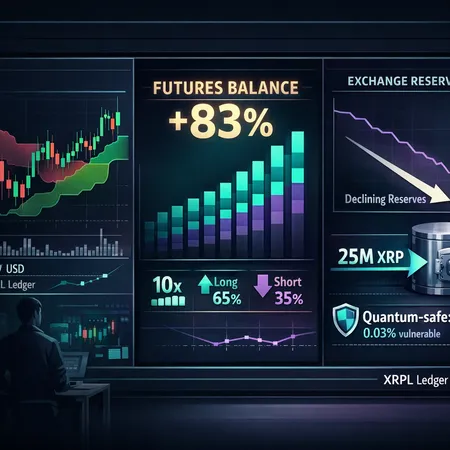
- Futures balance: an 83% one‑day jump in XRP futures balances was reported recently — a derivatives signal that usually means more capital and leverage are being deployed into perpetuals and futures pools (read the report).
- Exchange reserves: centralized exchange XRP balances have declined toward roughly $2.74 billion — a sign that available spot inventory is being drawn down (report link).
- On‑chain and technical: Ripple moved 25 million XRP on‑chain and Ichimoku indicators have flipped bullish in short‑to‑medium frames, a confluence of on‑chain transfer + technical momentum signals (analysis).
- Custodial risk: analysis suggests only 0.03% of XRP supply is currently vulnerable to quantum threats — useful context for long‑term custody thesis (study).
Reading the futures balance surge: leverage, not immediate spot demand
A near‑doubling (83%) of “futures balance” in 24 hours is a nontrivial derivatives event. That metric is best read as an increase in the notional or margin that traders are allocating to futures contracts — it doesn’t necessarily mean net directional conviction in the spot order books, but it does indicate one or more of the following:
- Elevated leverage: More traders or larger funds are willing to run levered positions (long or short) in futures markets because margin is cheap or expected volatility is upcoming.
- Positioning concentration: A sudden increase can be concentrated among market makers, prop desks, or large speculators (more risk of concentrated liquidation cascades if funding shifts).
- Volatility anticipation: Traders often preposition in derivatives ahead of catalysts (earnings, legal rulings, regulatory news, or scheduled on‑chain events). The imbalance between derivatives and spot can be the market “buying time” for a catalyst.
This metric should be triangulated with funding rates, open interest, and liquidation levels. If funding turns strongly negative while long notional climbs, that suggests leveraged longs are paying shorts and are at risk of forced deleveraging. Conversely, high open interest with neutral funding can be benign — more like structural hedging.
Exchange reserves and 25M XRP transfers: the liquidity squeeze narrative
Exchange reserves declining toward ~$2.74B (as noted in reporting) is a classic on‑chain sign of off‑exchange accumulation or cold‑storage inflows. When large custodians, funds, or whales withdraw balance from CEXs, the spot float available for quick selling drops. Two implications:
- Tighter available float increases price impact for buys. Even if spot volume is muted, a thin order book combined with derivatives‑driven buying can push prices sharply when the lid comes off.
- Off‑exchange accumulation often precedes multi‑week rallies. Institutional accumulation tends to be slow; withdrawals to custody can indicate longer time horizons.
The 25M XRP move reported alongside an Ichimoku flip is especially meaningful because it couples actual coin movement with technical momentum. Large transfers alone can be noise; combined with a bullish Ichimoku signal they suggest a higher probability of directional follow‑through. See the reporting that ties these two events together for context (Coinpaper analysis).
Ichimoku flip: why it matters here
Ichimoku is a multi‑line momentum and trend system. A bullish flip — e.g., conversion line (Tenkan) crossing above the base line (Kijun) with price above the cloud — signals trend change to traders who use the system. In an asset where on‑chain flows are drawing supply down, Ichimoku acts as a force multiplier for momentum traders: the technical confirmation can trigger systematic entries that amplify moves initiated by derivatives positioning.
But be cautious: Ichimoku is lagging compared to high‑frequency derivatives moves. Use it as a trend filter rather than an entry trigger in isolation.
Quantum safety: why 0.03% vulnerable matters for custody narratives
Claims that only 0.03% of XRP supply is vulnerable to quantum threats change the risk calculus for long‑term holders. Quantum vulnerability has been a theoretical black swan in crypto custody: if a meaningful share of supply were at risk, institutional custody would need expensive mitigation.
The reported low vulnerability number reduces that tail risk, making long‑term cold storage strategies more palatable to risk‑averse institutions and custodians. In other words, a smaller quantum attack surface lowers the structural premium some allocators might have demanded for XRP exposure. See the analysis for details and methodology (Finbold analysis).
That said, quantum is still a low‑probability, high‑impact risk — institutions will continue to favor audited multi‑sig, hardware modules, and progressive migration strategies to quantum‑resistant protocols over time.
Putting the signals together: likely market-state hypotheses
- Pre‑rally accumulation + leveraged momentum: Falling reserves + large transfers suggest accumulation; rising futures balances suggest leverage being placed. Combined, this is the classic setup for a fast, volatility‑driven move when spot liquidity gives way.
- Event hedging or arbitrage flows: Increased futures notional could be traders arbitraging between spot and perpetuals around expected catalysts; in that case the move may resolve after funding normalizes.
- Concentrated speculative positioning: If the futures balance increase is concentrated among a few players, a short squeeze or liquidation cascade is more probable.
Each hypothesis translates into different trade tactics and risk sizing.
Tactical trading strategies: reconciling spot inertia with derivatives heat
Below are actionable approaches you can tailor to size, timeframe, and risk appetite.
1) Delta‑light, convex longs (options): targeted upside exposure
Rationale: If you believe accumulation + leverage sets the stage for a fast move but want to avoid liquidation risk, buy convexity via calls or call spreads rather than levered futures longs.
- Trade idea: Buy out‑of‑the‑money call spreads expiring 30–90 days to capture a punctuated rally while limiting downside cost. If implied vols rise, roll carefully.
- Risk: Option premium can decay; ensure strike selection aligns with realistic move scenarios derived from on‑chain liquidity and historical order‑book depth.
2) Calendar and funding plays (capture derivative inefficiencies)
Rationale: Elevated futures balances often come with distorted funding and term structure.
- Trade idea: If funding for longs is expensive, consider shorting the perpetual and hedging with spot buys (negative carry if funding is paid). Alternatively, buy longer‑dated futures while shorting near maturities to capture contango/backwardation adjustments.
- Risk: Funding regimes can flip quickly; active monitoring required.
3) Spread trades across exchanges (liquidity imbalance arbitrage)
Rationale: Exchange reserve decline can create temporary cross‑exchange spreads.
- Trade idea: Monitor spreads and execute cross‑exchange buys where local spot is cheap; hedge on exchanges with higher implied futures exposure. Use limit orders to avoid taker fees and slippage.
- Risk: Execution and withdrawal latency, especially if large transfers move the market.
4) Scalp with strict liquidation collars (for futures users)
Rationale: If you accept using futures, manage tail risk.
- Trade idea: Use smaller size, staggered entries, and always place stop‑losses at liquidation buffer distances. Consider pairing futures exposure with protective options (buy puts or pay for a delta hedge via spreads).
- Risk: Stops can be taken in flash moves; prefer defined‑risk option protections if possible.
5) Portfolio custody posture (long‑term holders)
Rationale: With quantum vulnerability appearing minimal, custody can be structured more confidently but still conservatively.
- Practice: Use multi‑sig, hardware security modules, and progressive plan for quantum‑resistant key rotation. Document custodian SLAs and on‑chain monitoring for abnormal transfers.
Execution & monitoring checklist
- Watch funding rates and open interest across major perpetual venues hourly.
- Monitor exchange reserves and large transfers in real time; tag transfers by known custodians where possible.
- Use Ichimoku as trend confirmation, not sole signal. Combine with VWAP and order‑book depth reads.
- Size derivatives exposure based on liquidation distance, not just notional. Keep worst‑case backtests for historical squeezes.
- If running options, monitor implied vol shifts; be ready to roll if vols spike pre‑catalyst.
Also, keep an eye on macro/regulatory items that could flip sentiment quickly. For context, traders often compare XRP flows against other markets — for many, XRP behavior is meaningfully correlated with broader crypto derivatives cycles and occasionally decouples from spot cues like DeFi lending pressures.
Sample trade hypotheses (concrete examples)
- Short‑term speculative: Buy 30–45 day call spreads (10–20% OTM) for 0.5–1% of portfolio. Hedge with 10% spot buy and keep a 2.5% stop on spot — target 2–4x spread returns.
- Funding arbitrage: Short perpetuals where long funding is high, hedge with spot buys sized to minimize basis risk. Close when funding normalizes or if open interest drops 30%.
- Custodial accumulation: Institutions scale into spot via staggered off‑exchange purchases and cold transfer; monitor exchange reserve decline to time the final accumulation leg.
Conclusion: watch the seams, not just the surface
Muted spot action does not mean nothing is happening. The recent 83% jump in futures balances, exchange reserve declines, 25M XRP on‑chain transfers, and Ichimoku flips together form a richer signal set: elevated leverage, off‑exchange accumulation, and a technical environment that can amplify directional moves. Low quantum vulnerability eases certain custody fears, further smoothing the path for systemic accumulation.
Translate these observations into trades by emphasizing convexity, hedged derivatives structures, and disciplined risk controls. Keep live monitors for funding, open interest, and exchange balances; those will tell you whether this divergence resolves in a squeeze, a slow grind higher, or a quick unwind.
Sources
- U.Today — 83% increase in XRP futures balance: https://u.today/83-in-xrp-futures-balance-is-important-easy-to-miss-signal?utm_source=snapi
- U.Today — XRP exchange reserves decline to $2.74 billion: https://u.today/xrp-eyes-another-rally-as-exchange-reserves-decline-to-274-billion?utm_source=snapi
- Coinpaper — Ichimoku flip and 25M XRP on‑chain transfer: https://coinpaper.com/16157/xrp-price-prediction-ichimoku-cloud-flips-bullish-as-ripple-moves-25-m-coins-on-chain?utm_source=snapi
- Finbold — Only 0.03% of XRP supply vulnerable to quantum threats: https://finbold.com/only-0-03-of-xrp-supply-is-vulnerable-to-quantum-threats/?utm_source=snapi