Geopolitical Spillovers to Centralized Exchanges: Binance UAE Relocation, Liquidity Risks and Custody Contingencies
Summary
Executive summary
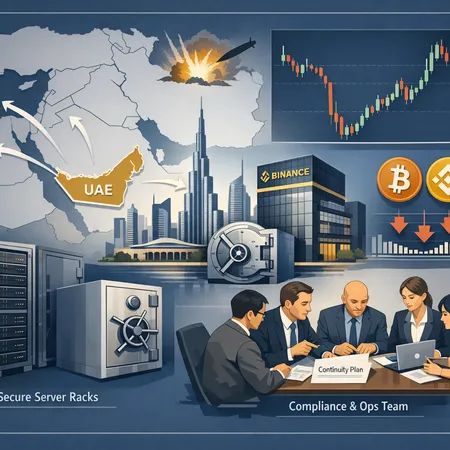
A recent report that Binance offered temporary relocation to UAE staff after strikes near Iran forced firms to weigh safety against continuity. That episode is a clear example of how geopolitical risk bleeds into exchange operations, custody responsibilities and market structure. For compliance officers and operations teams, the lesson is simple but urgent: continuity planning must treat geopolitical events as first-class operational failures, not rare footnotes.
The UAE relocation report: what happened and why it matters
According to reporting, Binance offered a temporary move for its UAE-based staff as strikes related to Iran rattled the region, stressing the company’s operational posture and employee choices. The report noted that Binance explored relocating some staff to the UAE on a temporary basis while monitoring safety and regulatory implications (NewsBTC report).
That description matters for two reasons:
- It demonstrates how exchanges respond to immediate personal-safety questions for onshore staff, not just IT failovers. Staff relocation influences service continuity, support rotas and decision chains.
- It forces choices about onshore vs. offshore presence. Employees may decline relocation; regulators in the new host jurisdiction may have requirements; and the physical move can change the legal and compliance profile of a team.
Operationally, these human decisions can be the weak link. If senior compliance or ops staff cannot relocate quickly, sensitive tasks (AML escalations, emergency custodian sign-offs, hot wallet key ceremonies) are delayed — and those delays create liquidity and legal risk.
How regional conflicts disrupt exchange uptime, liquidity and market structure
Infrastructure and uptime: not only data centers
It’s tempting to think of continuity as purely technical — redundant data centers, cloud failover, DDoS defenses. In reality, human and regulatory continuity matters equally. When regional conflict affects staff mobility, government communications, or telecommunication links, exchanges can face partial outages even if their core matching engines are redundant.
Consider the following pathways of disruption:
- Key-person absence that delays emergency wallet operations or legal approvals.
- Temporary enforcement by local authorities that restricts staff movement or access to on-site systems.
- Cross-border payment frictions for fiat rails that degrade deposit/withdrawal queues and push users into alternative on-ramps.
Liquidity fragmentation and order-book effects
Liquidity is fragile under stress. Market makers narrow sizes or widen spreads when they face uncertainty about execution or counterparty solvency. For centralized exchanges (CEXs) this shows up as:
- Wider spreads and lower depth on order books, increasing slippage for large trades.
- Withdrawal delays that encourage off-exchange liquidity runs, amplifying pressure on CEX order books.
- Cross-exchange arbitrage slowing when on-chain congestion, regional banking limits, or KYC frictions impede settlement.
BNB — as an exchange-native token — can be affected both by operational narratives (Binance’s ability to operate normally) and by sentiment. If market participants fear that an exchange’s operations are constrained, they may reduce BNB exposure or de-risk positions, producing outsized moves in thin markets.
Market sentiment and BTC reaction scenarios
Geopolitical shocks do more than interrupt systems; they change investor behavior. Analysts have suggested Bitcoin’s short-term path could hinge on whether regional tensions ease. One note argued that BTC could deliver a significant “catch-up rally” if tensions abate, because macro flows and risk-on positioning would quickly resume (CryptoPotato analysis). Conversely, continued escalation tends to push flows into perceived safe-haven assets or into stablecoins onshore, squeezing risk assets.
Commentators like Anthony Pompliano have recently framed Bitcoin as increasingly entangled with geopolitics and macro flows, suggesting that conflict-driven narratives can both lift and depress BTC price depending on capital flows and regulatory responses (Benzinga coverage). For institutional traders and compliance teams, that means planning for scenario-based liquidity impacts, not just binary up/down forecasts.
What custodial and regulatory contingency planning should look like
Designing a resilient custody and exchange operations plan requires layered, practical controls. Below are recommended elements grouped by audience.
For centralized exchanges: operational continuity playbook
- Legal-entity and jurisdiction map
- Maintain an up-to-date map of legal entities, licenses and regulatory obligations by country. Know where critical functions are legally anchored.
- Staff continuity and relocation protocols
- Pre-authorize relocation options and clear rules for emergency sign-off. Plan for role redundancy: multiple people trained to perform hot wallet tasks and compliance escalations.
- Georedundant infrastructure + human-in-the-loop failovers
- Technical redundancy is necessary but insufficient. Combine cold/hot wallet key-splitting across jurisdictions with pre-arranged, auditable key-ceremony procedures.
- Liquidity contingency agreements
- Pre-arranged liquidity arrangements with market-makers and alternative venues (including OTC desks) with defined activation triggers and fee structures.
- Regulatory engagement playbook
- A rapid-notice protocol for regulators in affected and host jurisdictions. Clear templates for reporting degraded services, withdrawal limits and remediation timelines.
- Communications and customer segmentation
- Proactive, tiered communication plans for retail vs. institutional clients. Avoid ambiguity that drives runs — transparency reduces panic-driven withdrawals.
- Legal and insurance readiness
- Update insurance policies for geopolitical clauses, and ensure legal counsel is ready to map sanctions or travel restrictions to operational constraints.
For institutional compliance officers and custodial users
- Counterparty mapping and limits
- Assign exposure limits to each CEX and custodian, reflecting concentration thresholds and operational risk metrics.
- Multi-custody and multi-venue liquidity strategy
- Employ at least two independent custodians and maintain trading relationships across multiple CEXs and OTC liquidity providers to avoid single-point failure.
- SLA and crisis-testing
- Embed geo-specific SLA clauses (e.g., relocation failure, telecom outage) and run tabletop exercises annually. Stress-test large withdrawal and settlement scenarios under degraded conditions.
- On-chain reconciliation and proof-of-reserves
- Require real-time or frequent proofs of custody and automated reconciliation pipelines. If an exchange delays disclosures, escalate to secondary liquidity providers.
- Compliance playbook for travel and sanctions
- Have procedures to handle sudden changes in staff availability due to travel bans or sanctions — including delegated authorities and notarized power-of-attorney for emergency actions.
Practical checklist: immediate actions and medium-term investments
Immediate (0–72 hours):
- Activate incident channel and point people; notify counterparties of potential delays.
- Freeze high-risk automated flows (if appropriate) and prioritize institutional withdrawals.
- Communicate transparently with clients about expected service impacts.
Near term (72 hours–30 days):
- Initiate cross-venue hedges to protect large positions from slippage.
- Re-run key-person backup validations and rotate personnel into redundancy roles.
Medium term (30 days–12 months):
- Implement georedundant key custody (M-of-N across jurisdictions) and legal entity restructuring where necessary.
- Contractualize liquidity backstops with market-making partners and establish cold-wallet recovery playbooks.
Case notes: why human decisions matter as much as infrastructure
The Binance UAE relocation report is a reminder that geopolitics forces binary human choices: relocate, stay, or disperse. Those choices cascade into operations. A senior compliance lead refusing relocation can delay AML escalations; an IT lead stuck from reaching an on-prem console can prevent a wallet migration. Technical resilience paired with human contingency (trained backups, delegated authority, notarized emergency powers) is the only practical defense.
For many institutions, decentralized alternatives — including custody models anchored in multisig or decentralized finance rails — present complementary hedges. Still, CEXs remain central to liquidity formation. Coordinating contingency plans across on-chain and off-chain venues reduces single-point-of-failure risk. For context on how market participants view Bitcoin during geopolitical shocks, see analysis suggesting BTC’s path could shift materially once tensions ease (CryptoPotato) and commentary on BTC’s macro role (Benzinga/Pompliano).
Governance, documentation and drills: turning policy into practice
Policies mean little without verification. Ops teams should:
- Maintain a living, signed continuity playbook accessible to regulators and auditors upon request.
- Run quarterly tabletop exercises that simulate cross-border staff unavailability and test activation of alternative signatories.
- Keep a versioned record of key-ceremony participants and a cryptographic audit trail for custody operations.
Compliance officers should insist on clearly defined thresholds that trigger liquidity backstops, emergency communications and regulatory notification timelines.
Final takeaways for compliance officers and ops leads
- Treat geopolitical risk as an operational hazard: operational continuity planning must be people-plus-tech, not technology-only.
- Map legal, staff and infrastructure dependencies — and remove single points of failure through redundancy and pre-authorized delegations.
- Expect liquidity fragmentation and plan both hedges and communications that reduce panic withdrawals.
- Institutional users should diversify custody and execution venues, require robust SLAs, and run regular stress tests.
Exchanges like Binance demonstrating staff relocation options underline an emerging reality: the geography of operations matters again. Institutions and exchanges that plan for human, legal and infrastructure disruptions will preserve liquidity and trust more effectively.
For institutions integrating both centralized and decentralized layers into continuity plans, platforms such as Bitlet.app illustrate how custody and P2P rails play into broader liquidity strategies — but the core requirement remains the same: rehearsed, contractualized contingency.
Sources
- NewsBTC — Binance’s UAE haven tested by Iran strikes
- CryptoPotato — Analyst: Bitcoin could see a big catch-up rally once geopolitical tensions ease
- Benzinga — Anthony Pompliano: Bitcoin has true product-market fit
For additional reading on market microstructure and alternative rails, institutional teams often follow developments in Bitcoin and in DeFi.