Privacy-Coin Resurgence: Why ZEC, XMR, DASH and DCR Spiked in April 2026 and How to Manage Risk
Summary
Executive snapshot
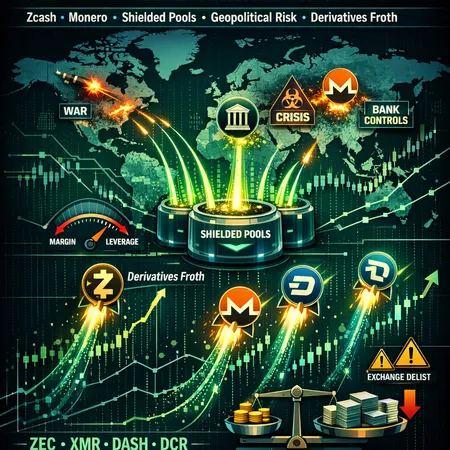
April 2026 delivered one of the most visible privacy-coin rallies in years. ZEC, XMR, DASH and DCR all moved sharply higher after a cluster of geopolitical shocks pushed capital-seeking actors toward censorship-resistant rails. The move combined real demand — capital flight, regulatory arbitrage and censorship-resistance needs — with speculative leverage and thin liquidity, especially on smaller venues. This piece unpacks the catalyst timeline, on‑chain signals (notably ZEC shielded pool inflows), the derivatives froth around ZEC’s parabolic run, and pragmatic sizing and hedging tactics for investors and risk managers.
Timeline: the early-April catalysts that lit the fuse
Geopolitical sparks and market psychology
In the opening week of April, a series of regional escalations and sanctions-related announcements created acute uncertainty for some cross-border capital flows. That uncertainty translated into two behavioral responses that matter for blockchain assets: a short-term demand for privacy/censorship-resistant rails, and a broader risk-off move in conventional markets that pushed risk premia up for many asset classes.
The spike was rapid. Within days traders began rotating into privacy tokens perceived as easier to move outside surveillance-heavy rails. For many market participants the narrative was straightforward: when on‑ and off‑ramps become politically sensitive, privacy coins look attractive. For context on the broader privacy-coin breakout earlier in April, see a market overview that charts how geopolitics can catalyze these rallies.
On‑chain evidence and exchange dynamics
Shielded pools and inflows (ZEC in focus)
Zcash’s shielded pools registered a sharp uptick in inflows concurrent with the rally. Shielded pools — where transactions can hide sender, recipient and amount — are a direct product-market fit for those prioritizing privacy or needing discretion in cross-border transfers. Multiple market reports observed increased movement into ZEC’s privacy set as prices ran, which aligns with classic capital flight behavior where parties seek reduced on-chain traceability. Read the reporting on Zcash’s inflows and the warnings that accompanied its traction.
Monero (XMR) operates differently: privacy is on by default through ring signatures and stealth addresses, so flows are less visible on-chain by design. That makes precise measurement harder, but behavioral signals — such as increased peer-to-peer volume and flows through decentralized onramps — suggested elevated demand.
Exchange delist risk and liquidity compression
Liquidity matters. Many institutional and retail venues had previously delisted or limited privacy tokens for AML/Regulatory reasons; that means a rally can become self-reinforcing as available supply on compliant exchanges shrinks. Less exchange-listed depth raises the bar for buyers and can create sharp price moves on relatively modest orderflow. Risk managers should note that delist risk is both a structural limiter of market depth and a source of asymmetric execution risk — particularly if regulators tighten guidance in response to a surge in on‑chain privacy usage.
ZEC’s parabolic run: momentum, froth and caution flags
The parabolic ascent and analyst coverage
ZEC produced a textbook parabolic breakout: fast price appreciation, rising headlines and a spike in derivatives activity. Several analysts and outlets flagged the move, noting both the sheltering demand and the potential for a blow‑off top. Market commentary at the time even projected stretched targets as traders chased momentum — some analysts cited numbers in the mid‑hundreds of dollars as possible near‑term peaks.
Derivatives froth — why it matters
Derivatives amplify both gains and losses. Signs of froth during the ZEC run included outsized growth in perpetual futures open interest, elevated funding rates (funding turning persistently positive as longs paid shorts), and concentrated large leveraged positions on a handful of exchanges. Those are classic blow‑off ingredients: when funding rates climb and leverage concentrates, the system becomes susceptible to sharp deleveraging cascades if a catalyst or liquidity gap triggers liquidations.
Analysts expressed caution about an exhaustion scenario where momentum traders and fickle liquidity providers step back. A careful read of the commentary around the rally shows both bullish narratives about adoption-driven demand and repeated cautions about momentum-driven risk. See more discussion of the parabolic ZEC move and the derivatives risks flagged by market coverage.
Two scenarios: blow‑off versus sustainable adoption
- Blow‑off scenario: rapid, leisureless buying by momentum traders and capital flight creates a short-lived price spike. Once short-term buyers pause or regulators respond, funding rate reversals and margin calls cascade, producing a sharp drawdown. Liquidity dry-up on delisted or low-cap venues exacerbates the drop.
- Sustainable adoption scenario: sustained use cases (remittances, peer-to-peer OTC flows, privacy-preserving payments for legitimate commercial activity) lead to continued demand. For sustainability you want to see stable or increasing on‑chain usage metrics, growing merchant acceptance or fiat on/off-ramp infrastructure that supports long-term utility.
Right now the market exhibits elements of both: real demand exists, but the pace and composition of buying — heavy on leveraged products — increases the chance of an abrupt reversal.
Liquidity, leverage and exhaustion indicators to watch
Risk managers should watch a compact set of indicators that historically preface exhaustion in crypto rallies:
- Funding rates: sustained positive funding above a stress threshold (e.g., daily funding consistently >0.05–0.1% depending on market norms) suggests crowded long positioning.
- Perpetual open interest (OI): rapid OI growth outstripping spot volumes is a red flag — leverage is building on top of thin spot liquidity.
- Exchange concentration: if a small number of venues or counterparties hold most OI, the market is fragile.
- Depth / orderbook imbalances: shallow bids during pullbacks that face large ask walls can accelerate downward moves.
- Options skew/gamma: compressed option skew or short-dated call-heavy activity signals speculative call-buying; conversely, sharply rising put-buying implies risk-off.
During April’s spike, many of these indicators flashed: funding rate spikes on ZEC perpetuals, surging OI and concentrated positions were widely reported — classic momentum-era danger signs.
Practical portfolio sizing for privacy exposures
Privacy coins can have asymmetric return potential but also idiosyncratic tail risk (exchange delisting, regulatory action, liquidity shock). Here are practical sizing rules for investors and risk managers:
- Strategic allocation cap: 0.5–3% of total investable assets for conservative portfolios; 3–7% for more aggressive crypto-native allocations. Treat privacy positions like concentrated thematic or frontier exposures.
- Risk-budget approach: size positions so a 50–70% drawdown consumes no more than a pre-set portion of your risk budget (e.g., maximum drawdown allocation of 2–3% of portfolio NAV).
- Staggered entries: ladder buys at multiple price levels to avoid full exposure at a local peak.
- Liquidity-adjusted sizing: reduce allocation to coins with thin spot liquidity or where most activity happens off-compliant venues.
Remember: portfolio exposure should reflect both conviction in the narrative (capital flight and censorship resistance) and honest appraisal of execution risk (delist or freeze risk, custody complications).
Hedging tactics and pragmatic instruments
Hedging privacy holdings requires balancing cost with protection. Common approaches include:
- Short futures: the simplest hedge; size shorts to offset percentage exposure. Beware of funding costs on prolonged hedges.
- Options collars: buy puts and sell covered calls to cap downside while financing part of the hedge. Collars work well if options markets exist with reasonable liquidity.
- Diversified volatility hedge: buy short-dated puts on broader crypto indices or BTC/ETH as a tail hedge against systemic deleveraging, which often drags privacy tokens down.
- Cross-asset hedges: in severe geopolitical scenarios, consider FX hedges or gold exposure as a parallel protection against local currency shocks.
- Cash and stablecoin dry powder: keep a portion of the portfolio in liquid cash-stablecoins to add liquidity or buy dips; platforms like Bitlet.app facilitate access to on/off ramps and P2P liquidity in certain regions.
Hedging costs are real: options and futures are not free. Match hedge tenor to the likely persistence of the catalyst — short-dated puts for momentum blow-offs, longer hedges when structural risk is apparent.
Operational risks and compliance considerations
Privacy tokens invite additional operational friction: custody complexity, KYC hurdles with custodians and exchanges, and potential downstream compliance scrutiny. For institutions, these frictions are not theoretical — they affect the ability to execute, hedge or even settle trades under stressed scenarios. Risk managers must incorporate operational stringency into sizing and liquidity plans.
Putting it together: a sample framework for a risk manager
- Signal detection: monitor funding, OI, shielded-pool inflows (for ZEC) and P2P volume (for XMR). When multiple signals align, treat it as heightened regime risk.
- Tactical sizing: cap new privacy exposures within pre-defined limits (e.g., 1–3% of crypto allocation), reduce if liquidity or compliance risk increases.
- Hedging: establish a baseline hedge (e.g., 30–50% of exposure via futures or put options) during frothy periods; scale back hedges as on‑chain usage metrics justify a re-rating to structural demand.
- Contingency planning: prepare for exchange outages or freezes — maintain diversified custody, keep fiat/stablecoin rails ready, and test off-exchange settlement pathways.
Final assessment: opportunity amid risk
The April 2026 episode reinforced a simple but underappreciated dynamic: privacy coins can reassert relevance quickly when geopolitical risk or capital controls bite. Demand drivers — capital flight, censorship resistance and regulatory arbitrage — are real and can support prices beyond pure speculation. But the mechanics of modern crypto markets (derivatives, concentrated liquidity, exchange policy) can turn a protective narrative into a fragile one if leverage and froth dominate.
For most investors and risk managers the right posture is cautious curiosity: respect the potential, limit exposure relative to overall risk budgets, and use explicit hedges that match the likely shock scenarios. Watch funding, open interest and shielded-pool metrics closely — they tell you when the move is demand-driven and when it’s just momentum on borrowed time.
For readers tracking privacy-token flows and market structure, follow ongoing on‑chain metrics and derivatives updates and consult exchange notices about delisting or custody constraints. And if you’re deploying capital regionally, ensure operational options for settlement are tested well in advance.
Sources
- Can privacy coins sustain their breakout rally? — Coinpedia
- Zcash price cools after parabolic run as derivatives froth flashes risk is 400 in range — Crypto.news
- Zcash price news: ZEC eyes rally to $500 as inflows to shielded pools rise — FXEmpire
- Zcash could rise 420 after 62% weekly price spike, traders predict — Decrypt
Additional internal resources: many traders compare these flows to broader market signals — for instance, narratives that still find Bitcoin useful as a macro bellwether and DeFi primitive flows as liquidity sources. For a focused look at privacy protocols, see coverage on Zcash.