Why Solana Is Becoming the Go‑To Stablecoin Rail After $10.5B USDC Mint
Summary
Why the $10.5B USDC on Solana matters now
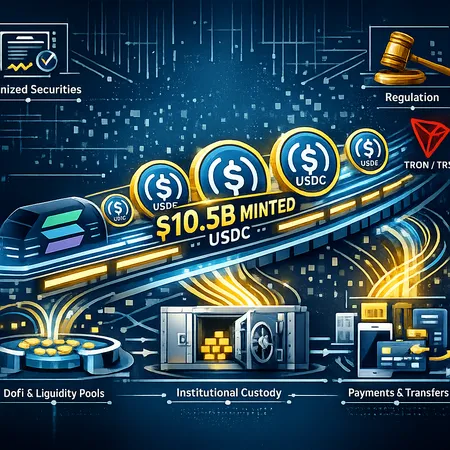
Circle’s decision to mint more than $10.5 billion USDC on Solana is not just a headline number — it’s a practical indicator that institutions and liquidity providers view high‑throughput chains as viable dollar rails. The move underlines two linked realities: first, stablecoin rails are the new plumbing for dollar liquidity, and second, throughput and cost materially change what products are feasible at scale.
High‑frequency market making, micropayments at retail scale, and large treasury operations all behave differently when transactions cost a few cents and confirm in sub‑second to single‑second finality, rather than hundreds of milliseconds with variable fees. For many teams building financial products, that difference drives product design choices and routing decisions.
What high‑throughput rails deliver for institutional products
Throughput, cost and finality — the product levers
High throughput reduces two implicit costs: latency and the operational burden of batching. Lower latency improves hedging and reduces exposure windows for algorithmic market‑making. Low fees make micro‑payments and high‑turnover treasury strategies profitable. Finality characteristics (how quickly a block can be considered irreversible) matter for settlement guarantees and reconciliation.
Solana’s architecture is optimized for large transaction volumes and low per‑tx costs, which is why Circle’s mint was executed there at scale. That architecture enables product behaviors that legacy rails (or low‑throughput layer‑1s) struggle to support economically.
Composability and money leg efficiency
Beyond raw speed, composability—the ability to combine smart contracts, DEX liquidity, lending pools and on‑chain oracles—lets teams route dollars through optimized paths in real time. That’s where DeFi flows become attractive: a treasury can deploy liquidity across DEX pools, borrow against assets, or execute programmatic payouts without leaving the chain. Stablecoin rails thus reduce the reconciliation friction between Treasury systems and decentralized liquidity.
Stablecoin rails are powering new DeFi primitives that combine settlement, credit, and asset servicing in‑chain, which appeals to product leads designing end‑to‑end fintech experiences.
Solana’s strengths — and the tradeoffs institutions must acknowledge
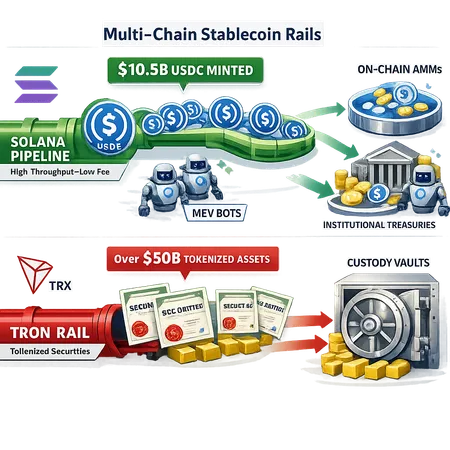
Solana’s selling points are clear: extremely low fees per transaction, high throughput measured in thousands of transactions per second, and an expanding ecosystem of liquidity venues and on‑chain services. These are the reasons Circle significantly grew USDC supply on Solana. See reporting on the mint for context: Circle minted over $10.5 billion USDC on Solana.
But tradeoffs remain. Solana’s history includes network congestion and intermittent outages; as a result, institutional teams must factor in operational resilience and fallback routing. Additionally, tooling maturity (enterprise-grade custodial integrations, reconciliation tooling, audited smart‑contract infrastructure) is improving fast but varies by chain.
Use cases unlocked by a dominant stablecoin rail
DeFi flows: liquidity, yield, and programmatic treasury
When a chain offers predictable low fees and deep DEX liquidity, treasuries can pursue active liquidity management: auto‑rebalancing across pools, capturing yields from lending markets, and executing fast treasury swaps to hedge exposure. These are DeFi flows in practice — money routing, not just custody. For product teams, that opens native in‑app earning features, instant conversions, and settlement into on‑chain instruments.
Payments and payroll: cheap, instant settlement
Micropayments, streaming payrolls, and merchant remittances become feasible when per‑tx costs are negligible. Institutions can implement programmable payouts (salary streams, usage‑based billing) with near real‑time settlement, reducing float and FX friction for cross‑border payments.
Tokenized securities: issuance and secondary markets
A growing use case is tokenized securities: equities, debt, and funds represented as on‑chain tokens with programmable corporate actions. The move by Securitize to expand tokenized securities to TRON signals that institutional rails will become multi‑chain. Securitize’s TRON integration shows competitors are vying to host regulated asset rails beyond Ethereum and Solana: Securitize expands to TRON.
This is competitive for Solana: tokenized securities need fast settlement and low fees for secondary trading, but they also require mature custody, compliance, and KYC/AML controls. TRON (TRX) offers cost characteristics that appeal to issuers, and the market will likely fragment across chains depending on issuer priorities.
Operational, custody and regulatory considerations for institutional issuers
Routing significant dollar volume on‑chain is not just a technology decision. It touches legal, accounting, and operational control points.
Custody models and counterparty risk
Institutions must decide between self‑custody, managed custodians, or hybrid models. Managed custodians provide operational simplicity and insurance but introduce counterparty risk and fee structures. Self‑custody reduces counterparty exposure but increases operational overhead and requires robust key‑management and disaster recovery.
For institutions routing USDC (or other stablecoins) on Solana, look for custodians who support SOL‑native signing, have audited integrations with block explorers and infra providers, and offer clear processes for mint/redemption flows with Circle or corresponding issuers.
Bridge and redemption mechanics
Multi‑chain strategies often rely on bridges. These are convenience layers but add counterparty and liquidity risk. For example, if an institutional desk sources USDC on Solana and later needs to move back to a fiat corridor for redemption, the path and counterparties used (DEX, CEX, bridge operator) determine settlement speed and risk exposure.
Treasury teams should document preferred routing for each liquidity state (on‑chain markets, internal omnibus accounts, fiat redemption paths) and run regular failover drills.
Attestations, reserve transparency and legal reconciliation
Stablecoin issuers publish reserve attestations; institutions need to incorporate these statements into legal and compliance frameworks. Counterparties should be contractually required to provide proof of holdings and reconciliations. Where tokenized securities are involved, smart contracts must map to legal entities and custodial arrangements to ensure enforceability off‑chain.
Securitize’s TRON expansion highlights another layer: tokenized securities often come with regulatory wrappers and KYC gates. Issuers must ensure that on‑chain transfer restrictions and off‑chain registries remain synchronized.
AML/KYC and on‑chain analytics
On‑chain activity is observable, but linking addresses to entities requires analytics and processes. Institutions should integrate on‑chain monitoring for sanctions screening, suspicious activity detection, and counterparty risk checks. Complying with AML regimes while preserving operational agility requires careful tooling and policies.
Smart contract and infra audits
Any programmatic treasury logic (streams, automated rebalancers, or tokenized instrument contracts) must be audited. But audits are not absolutes—operate with layered mitigations: multi‑sig, time‑locks for large treasury actions, and kill switches for emergent incidents.
What TRON + Securitize means for competition in rails
Securitize’s onboarding to TRON indicates institutional rails will not be monopolized. Different chains will compete on cost, throughput, latency, compliance feature sets, and ecosystem services (custody, market‑making, custodial KYC). TRON (TRX) has historically been attractive for low fees at scale, while Solana offers high throughput with a growing ecosystem for DeFi flows. Issuers and product teams should expect a multi‑chain reality and design products that can route between rails based on cost, liquidity, or regulatory requirements.
Practical checklist for product leads and treasury teams
- Map your flows: list each use case (payments, liquidity management, tokenized issuance) and the on‑chain requirements (finality, fee tolerance, composability).
- Custody decision: evaluate custodians for SOL support, insurance, settlement SLAs and incident history.
- Redemption & bridge plan: document primary and fallback rails to convert on‑chain dollars to fiat; test them.
- Compliance: integrate on‑chain analytics, KYC gating for tokenized securities, and attestations into the legal playbook.
- Operational drills: simulate outages, bridge failures, and smart‑contract incidents; validate manual off‑ramps.
- Cost modeling: include gas, bridge fees, two‑sided liquidity slippage, and custodial spreads in P&L models.
- Vendor due diligence: require SOC/ISO certifications where relevant and review incident response timelines.
Next steps and product design implications
For fintech product leads, the technical lesson is simple: rails change product economics. Low fees and instant settlement make new UX patterns possible (instant customer refunds, streaming payments, in‑app hedging). For treasury teams, the operational lesson is also simple: you can get better yields and faster settlement, but you must build the procedures and controls to manage non‑bank rails.
Design systems to be chain‑agnostic where reasonable: abstract custody providers, keep settlement adapters modular, and create decision trees for automatic routing by cost, liquidity, or compliance. Tools like Bitlet.app and other stack providers will increasingly offer middleware that simplifies routing, custody orchestration, and compliance integrations — but institutional teams should still validate those integrations end‑to‑end.
Conclusion
Circle’s $10.5B USDC mint on Solana marks a tipping point: institutions are treating high‑throughput chains as production dollar rails. That unlocks compelling DeFi flows, payment rails, and tokenized securities use cases, but it also forces institutions to confront custody models, bridge risk, and regulatory reconciliation. TRON’s Securitize integration shows competition will intensify, and issuers will choose chains based on a tradeoff matrix of cost, throughput, and compliance capabilities.
For product leads and treasuries, act like engineers and lawyers: prototype small, instrument every flow, and codify playbooks before routing large dollar volumes on‑chain.