Bitcoin’s April 2026 Rally Above $73K: Triggers, Sustainability, and Risk Management
Summary
April 2026 breakout: a quick read
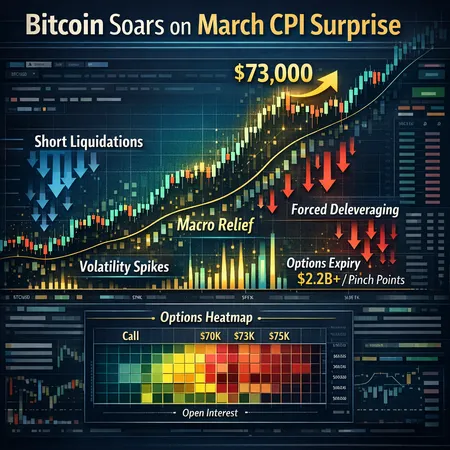
Bitcoin’s jump above $73,000 in early April 2026 felt abrupt — and the drivers were layered. A March CPI print that cooled inflation expectations re-opened risk-on flows; at the same time, concentrated short positions and a major $2.2 billion-plus options expiry created a feedback loop of deleveraging and delta-hedge flows that pushed prices higher in compressed time. For many traders, Bitcoin remains the primary market bellwether, so this move cascaded into broader crypto sentiment and flows.
This article breaks down what actually happened, why the move was so violent, whether it can persist, and, most important for intermediate-to-advanced traders and allocators, how to position and protect portfolios now.
What triggered the surge: CPI, risk repricing, and immediate market reaction
The proximate macro catalyst was a surprising moderation in U.S. inflation data. Coverage across outlets highlighted how the CPI surprise loosened front-end rate expectations and reaccelerated risk appetite; reporting noted Bitcoin climbing above $73,000 as investors digested lower immediate policy risk and short-covering dynamics (Invezz coverage). Other contemporaneous write-ups put the move into the context of CPI-led repositioning across assets (Crypto.news analysis).
Why CPI matters here: when inflation cools unexpectedly, the market prices a lower probability of aggressive near-term hikes. That reduces the risk-free discount and raises risk-asset valuations — equities and crypto alike. In crypto markets this effect is magnified because liquidity is thinner and derivatives positions are highly leveraged, so a comparatively small re-rating in macro risk can produce outsized price moves.
Short liquidations and forced deleveraging: the mechanics
Short liquidations were the obvious amplifying factor. Large pockets of perpetual futures shorts and concentrated directional bets create a tinderbox: when price moves against those shorts, exchanges’ auto-liquidation engines and margin calls force buy-side flows into the market. NewsBTC’s cautionary stories of earlier rapid rebounds and attendant liquidations are a useful reminder of how quickly leverage can amplify moves (NewsBTC cautionary tale).
Mechanically, the sequence looks like this:
- A CPI surprise re-prices risky assets higher; spot begins to climb.
- Funding rates flip as longs pay shorts (or shorts get squeezed), raising carrying costs for short positions.
- Automated margin calls trigger forced buy orders on exchanges, exacerbating price moves.
- Dealers and high-frequency liquidity providers widen spreads, reducing depth, which further steepens moves.
On-chain and exchange-level reports from early April showed unusually high liquidation prints during the initial leg. That forced deleveraging is self-reinforcing: as shorts are removed, some liquidity providers and arbitrage desks have to rebalance delta exposures, generating more buying.
Options expiry dynamics: the $2.2 billion pinch and why expiries matter
A concentrated options expiry — over $2.2 billion centered on BTC and ETH — was due around the same window and acted as a pressure point (U.Today preview). Large expiries create pinch points because market makers who sold options will delta-hedge their exposure. When the underlying moves toward a cluster of strikes, dealers buy or sell the underlying to remain hedged; this dynamic creates gamma feedback that can amplify directional moves.
Key mechanics traders should understand:
- Dealers short calls will buy BTC as spot rises to remain delta-neutral; this buying can stack with short-covering.
- Conversely, dealers short puts will buy as spot falls. When many positions are clustered at nearby strikes, hedging flows are concentrated and magnified.
- The closer spot approaches a large open-interest strike at expiry, the more acute the hedging flows become — resulting in a ‘pin’ or violent move toward that strike, sometimes irrespective of valuation.
Timing mattered: the expiry’s concentration around the mid-70k strikes coincided with the short squeeze, so delta-hedgers were adding fuel to a fire already primed by CPI and funding pressures.
Macro relief, geopolitics and market structure: why the rally wasn’t purely technical
While short squeezes and options gamma explain the speed and mechanics of the rally, macro relief — specifically cooling inflation — provided the fundamental floor. Analysts flagged the interaction between macro and geopolitical narratives; some argued the next leg of the rally would depend on easing geopolitical tensions that currently cloud macro outlooks (CryptoPotato analyst view).
At the same time, episodic shocks such as oil-price spikes and war-driven risk premiums still influence broader market liquidity and correlation structures (Crypto.news contextual piece). The net effect: short-term repricing can be fast and deep, but sustainability needs follow-through across macro prints and liquidity conditions.
Historical analogues: when macro relief produced sharp rallies
There are helpful precedents. Two useful analogues for portfolio managers:
Post-CPI relief rallies where a single softer-than-expected inflation print knocked futures yields lower and forced de-risking reversals — rapid upward repricing across risk assets followed by consolidation as the market digests new rate expectations.
Short-squeeze + options pinch events in crypto’s history where dealer hedging around concentrated strikes powered a sharp directional move and then reversed or consolidated once open interest rolled off. Those moves typically delivered large intraday or intrawEEK returns, but they were followed by elevated volatility and retests of support as new cash flows and positioning settled.
The takeaway from historical analogues is not that rallies are fake — they can represent genuine de-risking of monetary policy — but they are frequently bumpy and subject to re-tests once the impulse is absorbed.
Is the rebound sustainable? Scenarios and signals to watch
Sustainability comes down to a few conditional questions and observable signals:
- Macro follow-through: will subsequent CPI and PCE prints confirm the disinflation narrative? If not, this rally can be vulnerable to mean reversion. (See reporting tying the initial move to CPI readings: Coinpaper analysis).
- Options open interest and strike concentration: if roll-offs remove the gamma pinch without a material drop in OI, the market could stabilize higher. If new short sellers reload into low-liquidity windows, another squeeze becomes possible.
- Funding rates and exchange flows: persistently positive funding and renewed coin inflows (exchange withdrawals) support a more durable move.
- Liquidity and depth at key levels: how exchanges and OTC desks behave when spot retests 70–72k.
Best-case (sustained): macro prints continue to ease, options OI rolls up higher (new buyers), and institutional flows push spot higher; volatility narrows as liquidity normalizes.
Worst-case (mean reversion): a subsequent hawkish surprise or geo shock resets rate expectations, options dealers rebalance by selling spot at elevated prices, and liquidity evaporates, leaving a fast retracement.
Practical trade and position guidance (intermediate-to-advanced)
For traders and allocators, here are actionable approaches that respect the heightened volatility environment:
Size and leverage discipline: reduce one-way leverage. If you trade futures, cap position size relative to realized volatility and avoid adding to highly leveraged directional bets into expiries.
Use options for asymmetric exposure: buy long-dated call spreads for bullish exposure while selling short-term call credit against expected theta if you have a bearish near-term view — but keep margin and assignment risk managed. Consider buying protective puts (or put spreads) rather than relying on stop-losses alone in illiquid spikes.
Trade the expiry mechanics: if you identify a clustered expiry at certain strikes, trade around expected dealer hedging windows. That can mean fading violent extension after the first squeeze or tagging momentum into the gamma-driven leg if you have quick execution and tight risk controls.
Multi-venue execution: use a mix of spot, block OTC, and options to reduce market impact. Institutions and allocators should consider phased accumulation to avoid paying expiration-driven premiums.
Hedging and rebalancing rules for allocators: if Bitcoin is part of a strategic allocation, use horizon-based DCA or rebalancing bands rather than trying to time the top/bottom of these macro-driven squeezes. Platforms like Bitlet.app that offer installment and accumulation products can be part of a disciplined allocation toolkit, but they shouldn't replace explicit hedging strategies where required.
Risk management checklist
A concise checklist to reduce surprise losses:
- Know your liquidation price and maintain margin buffers equal to at least several days of realized volatility.
- Avoid increasing leverage into clustered expiries and major macro prints.
- Use options to cap downside — e.g., buy puts or collar exposures for large spot holdings.
- Monitor funding rates, open interest, and exchange flows hourly during suspected stress windows.
- Size exposures as a fraction of portfolio volatility, not nominal capital — target constant-dollar volatility contributions.
Closing thoughts
April’s jump past $73k combined a genuine macro repricing with market-structure mechanics that made the move unusually sharp. That mix — CPI-driven optimism, short squeezes, and options-expiry gamma — explains both the speed and the risk of reversal. For traders, the event is a reminder that liquidity and derivatives positioning matter as much as fundamentals; for allocators, it reinforces the value of plan-based accumulation, hedging, and position sizing.
If you trade the event, trade it with humility: volatility can be generous on both sides. Keep a clean risk plan, watch the macro calendar, and monitor options and funding dynamics closely.
Sources
- https://invezz.com/news/2026/04/10/bitcoin-climbs-above-73000-as-inflation-cools-and-risk-appetite-returns/?utm_source=snapi
- https://coinpaper.com/16157/xrp-price-prediction-ichimoku-cloud-flips-bullish-as-ripple-moves-25-m-coins-on-chain?utm_source=snapi
- https://crypto.news/bitcoin-clings-to-72k-while-3-3-inflation-and-war-driven-oil-spikes-rattle-us-markets/
- https://u.today/crypto-options-alert-bitcoin-and-ethereum-set-for-22-billion-expiry-event?utm_source=snapi
- https://www.newsbtc.com/news/a-bitcoin-cautionary-tale/
- https://cryptopotato.com/analyst-bitcoin-could-see-a-big-catch-up-rally-once-geopolitical-tensions-ease/