Why Solana Became the Dominant Stablecoin Rail: USDC Flows, DeFi Liquidity and Institutional Rails
Summary
Introduction
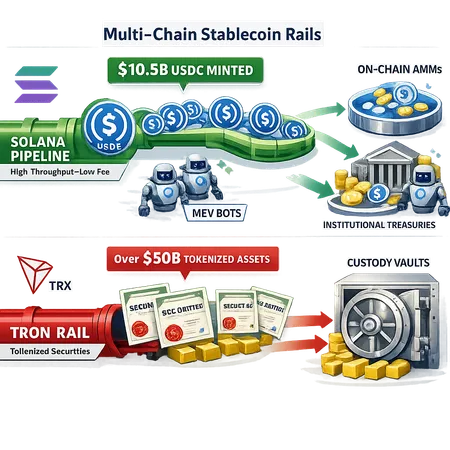
Circle’s decision to mint more than $10.5 billion in USDC on Solana in a single month was not just a headline — it was a liquidity signal. The move, covered in industry reporting, accelerated flows of on‑chain dollars into a high‑throughput network that offers near‑instant settlement and micro‑penny fees. For treasury teams, DeFi builders and product managers, this is now a live experiment in real‑world routing: do you keep dollars on Ethereum, or route a meaningful share to Solana (or other rails) to capture speed and cost advantages?
For context, many market participants still treat Bitcoin and Ethereum as market references, but the day‑to‑day dollar plumbing for applications and institutional issuers is becoming multichain and operational. Solana’s USDC adoption is an important case study in that transition.
How USDC minting and on‑chain settlement works on Solana
USDC on Solana is an SPL token — the same concept as ERC‑20 on Ethereum — but the operational flow behind a mint is off‑chain first and on‑chain second. When a corporate customer or market maker deposits USD with Circle, Circle issues USDC by minting tokens on the target chain. Those tokens appear in the receiver’s Solana address once Circle executes the mint and submits the transaction to the Solana cluster.
Because Solana batches transactions and uses Proof‑of‑History sequencing, finality is achieved in seconds. Circle’s mass issuance to Solana in the referenced month demonstrates this model at scale: fiat enters Circle’s custody off‑chain, reserves are recorded, and Solana receives newly minted USDC via on‑chain settlement. Coverage of that event can be found in industry reporting on Circle’s activity on Solana.
Redemption is symmetric: when a holder requests fiat, Circle burns the SPL USDC on Solana (removing supply) and arranges off‑chain settlement. The critical operational detail for treasurers is that the on‑chain settlement step is fast and low cost, but the fiat leg—compliance, banking rails, KYC/AML—remains an off‑chain process tied to Circle’s custodial and regulatory posture.
Why Solana is winning dollar on‑chain flows
There are three practical advantages pulling dollar flows to Solana: throughput, cost and composability. Solana’s architecture targets very high transaction throughput and tiny fees per interaction, which directly benefits repeated settlement operations, market‑making loops and low‑touch micro‑payments. When Circle reliably mints USDC on Solana at scale, it creates the on‑chain supply that traders and protocols can use without bridge hops.
Low settlement latency reduces the capital drag on market makers: faster round‑trip trades mean narrower spreads and more efficient use of capital. Composability on Solana—programs calling each other within a fast block—lets complex trading and lending flows execute with fewer timeouts and less slippage. Market commentary has noted this surge as part of a broader multi‑chain infrastructure trend that institutional participants are watching closely.
That said, the cost advantage is also a product of a particular network design that favors throughput over decentralization, which has governance and operational implications discussed below.
Implications for DeFi liquidity and MEV
Concentrated USDC liquidity on Solana changes how DeFi markets behave. Pools with deeper on‑chain dollars allow automated market makers (AMMs) and order books to offer tighter quotes and larger trade sizes without moving price as much. For bootstrapping new products this is a boon: lower slippage attracts swaps, lending protocols can source cheap collateral, and on‑chain credit lines can settle quickly.
But faster settlement and high transaction density also reshape MEV (miner/validator extractable value). Traditional MEV models assumed slower block cadence and mempool visibility; Solana’s parallelized execution and different block production roles change the timing and tools available to extractors. Validators and block producers who control ordering can still profit from front‑running, sandwiching or reorg‑based strategies, and high‑frequency actors can exploit sub‑second windows.
For DeFi builders, this means architecting with MEV mitigation in mind: batch auctions, private relayers, or commit‑reveal designs can reduce extractable rent. Treasuries using large on‑chain swaps should consider incremental fills and time‑weighted execution to avoid being picked off in a fast environment. The DeFi ecosystem on Solana will likely evolve distinct anti‑MEV patterns compared with Ethereum, and teams should treat design patterns as chain‑specific rather than one‑size‑fits‑all.
Institutional demand and the multi‑chain rails story (including TRON and tokenized securities)
Institutional issuers and tokenized securities change the calculus for multi‑chain rails. The design goal for many institutions is predictable settlement finality, low transaction cost, and an auditable ledger—properties that high‑throughput chains like Solana and TRON can deliver. Recent announcements that Securitize is expanding tokenized securities support to TRON underline this point: institutional issuance looks for rails where token settlement aligns with business needs and investor expectations.
TRON’s expansion for tokenized securities shows that institutions value throughput and deterministic behavior enough to explore alternatives to Ethereum. For treasurers this means the on‑chain dollar is becoming multi‑modal: some products will settle on Solana for speed, others on TRON where specific custodians or markets exist, and still others on Ethereum for regulatory or composability reasons. Commentary on how multi‑chain infrastructure is attracting institutional flows supports the idea that stablecoin rails will not be monolithic but diversified across chains.
Benefits and risks: throughput, fees, centralization tradeoffs
Benefits
- Speed and cost: Faster finality and cheaper transactions reduce friction for treasury operations and DeFi primitives. That translates into tighter spreads and cheaper programmatic settlement.
- Operational predictability: Low variance in confirmation time simplifies UX and reduces failed settlement windows.
Risks
- Centralization tradeoffs: High throughput often requires more centralized sequencing or fewer, specialized validators. This can increase censorship risk or single‑point outage probability.
- Network-level outages: Solana has experienced outages and performance degradations; operational resilience is not the same as probabilistic finality on more decentralized layers.
- Custodial and regulatory dependency: USDC remains subject to Circle’s custody, redemption policy and regulatory posture. On‑chain minting does not eliminate off‑chain counterparty risk.
For institutional teams, these are not binary choices but risk vectors you measure against your tolerance and SLAs.
Practical guidance for treasurers and DeFi builders
Multi‑rail strategy: Adopt a policy that splits flows across rails based on use case. For high‑frequency market making or micropayments, route a percentage to Solana. For regulated custodial issuance or long‑term holdings, prefer rails with stronger decentralization or auditability.
Custody & redemption playbook: Use well‑known, regulated issuers (Circle for USDC) and document redemption processes and timings. Test fiat off‑ramps from each chain—timing for an on‑chain burn to fiat settlement is often longer than the on‑chain confirmation window.
Bridge risk management: Minimize reliance on cross‑chain bridges for routine settlement. When necessary, use diversified bridge providers, maintain insurance policies, and build reconciliation tooling to track wrapped vs native supply.
MEV‑aware execution: For large swap or rebalance operations, break orders into slices, use TWAP or dollar‑cost averaging, and consider private order flow or batch auctions when available. Monitor validator behavior and error rates, and deploy fallbacks.
Observability and SLAs: Instrument on‑chain tooling with robust monitoring (confirmation times, RPC latency, failed tx rates). Include chain‑specific SLAs in vendor contracts. Treasurers should keep a runbook for network outages—this must include an operational switch to alternate rails such as TRON or Ethereum.
Product-level UX: If you’re building user‑facing rails, clearly label settlement expectations by chain: “USD via Solana: near‑instant, low fee; redemption subject to Circle process.” Transparency reduces support costs and compliance friction.
Institutional integrations: If you expect tokenized securities demand, evaluate the chain ecosystems where institutional partners (custodians, broker‑dealers, compliant DEXs) are active. For example, Securitize’s move into TRON signals that tokenized securities liquidity and custody models will not be limited to one chain.
Conclusion
The surge of USDC issuance on Solana is concrete evidence that stablecoin rails are becoming a competitive battleground driven by throughput, cost and operational realism. That shift has practical consequences: DeFi liquidity concentrates differently, MEV dynamics evolve, and institutions will route flows to the rails that best match their operational and regulatory needs. For treasury teams and builders the appropriate response is pragmatic: design multi‑rail strategies, instrument execution to reduce MEV and bridge risk, and explicitly measure the tradeoffs between speed and decentralization.
Evaluating where to route on‑chain dollars is now a product decision as much as a technical one—tools like Bitlet.app and other routing solutions can help automate parts of that assessment, but teams must still own policy, testing and risk limits.