Grayscale’s Aave Spot ETF Push: What the SEC Review Means for Tokenized-Asset ETFs
Summary
Executive snapshot
Grayscale’s latest filing to convert an Aave-linked trust into a spot ETF is more than a product tweak — it’s an experiment in translating decentralized-token characteristics into a 1940 Act ETF wrapper. The filing has already prompted regulatory scrutiny and public reporting about a substantive SEC review and the proposed fee structure, underscoring the regulatory and market complexity that comes with tokenized-asset ETFs. For institutional investors and product teams evaluating non-Bitcoin spot ETFs, the AAVE case will be a live test of whether traditional ETF mechanics can be reconciled with DeFi-native realities.
How a closed-end trust becomes a 1940 Act ETF: the mechanics that matter
Converting a closed-end trust into a 1940 Act ETF is procedural on paper but structural in practice. A classic closed-end trust (like many early crypto trusts) issues a fixed pool of shares whose price can deviate from net asset value (NAV). A 1940 Act ETF, by contrast, operates with continuous creation/redemption mechanisms that keep market prices tethered to NAV via authorized participants (APs) who exchange baskets of underlying assets for ETF shares and vice versa.
For a tokenized asset such as AAVE, the conversion requires implementing operational components that ETFs rely on: daily NAV calculation, AP pipelines that can deliver or receive AAVE, and a qualified custodian to hold the tokens. The custodian must satisfy 1940 Act and custodian rules, which for crypto means robust private key controls, insured custody where possible, and documented segregation of assets. Unlike equities, on-chain tokens add technical layers — on-chain settlement, potential chain reorgs, forks, and smart-contract risks — that trustees and custodians must operationalize.
Another critical ETF element is surveillance and arbitrage ability. ETFs succeed when APs can arbitrage away persistent premiums/discounts, which presumes reasonably liquid underlying markets and the absence of trade frictions. For Bitcoin ETFs, surveillance sharing and liquid spot markets made arbitrage workable. For tokens like AAVE, the question is: are there sufficiently deep, transparent venues for APs to source and return AAVE without undue slippage or counterparty risk? Grayscale’s filing implicitly asserts yes, but the SEC will probe those assumptions closely.
Why Grayscale is targeting AAVE now
There are a few likely drivers behind Grayscale selecting AAVE for conversion. First, AAVE is a leading governance token in the DeFi ecosystem with established on-chain usage and recognizable name-brand value among institutional allocators. Second, Grayscale appears to be extending the playbook it employed with Bitcoin (and its attempts around GBTC) to diversify its ETF suite — creating productized access for institutions that prefer a regulated, custodial wrapper to holding native tokens.
Market timing matters too. Volatility in the broader crypto market, renewed institutional interest in yield-generating or governance-linked exposures, and a crowded product roadmap among asset managers all push Grayscale to innovate. And, per public reporting, the product economics — including a proposed fee structure highlighted in filings — must justify the operational lift of token custody and compliance. That economics-and-compliance tradeoff likely explains both the product push and the headline attention to fee levels.
The SEC review: custody, liquidity, and token governance under scrutiny
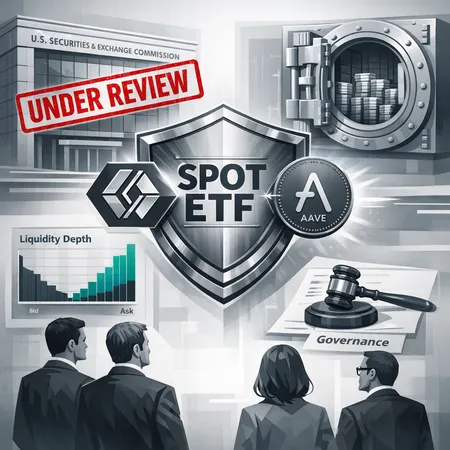
Public coverage indicates the SEC has launched a substantive review tied to the AAVE ETF filing and its fee structure, and that scrutiny will broadly center on three technical pillars: token custody, underlying market liquidity, and governance-token legal status.
Token custody: The SEC will examine whether custodial arrangements meet the credentialing and control expectations for 1940 Act funds. For tokens, this means reviewing key-management practices, multi-signature schemes, segregated cold vs. hot storage, and recoverability plans for lost keys. Unlike cash or securities, custody of private keys is a single point of failure — a reality the SEC will not ignore. Grayscale must show it has a qualified custodian with audited processes and robust insurance/indemnities where feasible. This topic is discussed in filings and reporting around the conversion effort.
Underlying liquidity and market surveillance: The commission will want evidence that AAVE markets are deep and transparent enough to support daily NAV and AP arbitrage. That includes evaluating on-chain liquidity, centralized exchange listings and volumes, fragmentation across venues, and susceptibility to market manipulation. Surveillance-sharing agreements — a mainstay of earlier crypto ETF approvals — may need to be negotiated with multiple spot venues or market-makers to satisfy the SEC’s market-integrity concerns.
Token governance and securities analysis: Governance tokens like AAVE carry voting rights and ecosystem incentives that may invite a securities-law analysis. The SEC will likely assess whether AAVE functions predominantly as an investment contract under the Howey framework in certain contexts. If the SEC or staff view aspects of AAVE as tied to purchaser expectations of profit derived from others’ efforts, that could complicate approval. Grayscale must either convince the SEC that AAVE is sufficiently utility-like and decentralized, or that the ETF’s structure neutralizes any securities concerns.
For readers who want the original reporting, Grayscale’s conversion announcement and the SEC review coverage are discussed in industry write-ups and filings; for example, Grayscale’s intent to convert is summarized in correspondence and press reporting, while reporting has flagged the SEC’s review and the proposed fee-level questions.
Possible market outcomes: approval, delay, or rejection and how each affects AAVE
There are three high-level outcomes, each with distinct implications for AAVE tokenomics and price discovery.
Approval: If the SEC greenlights a spot AAVE ETF, institutional access widens materially. ETF mechanics would channel incremental demand through APs and custodians, potentially compressing exchange-listed AAVE supply (short-term) if investors park capital into the ETF rather than OTC positions. The creation/redemption process should keep ETF price close to NAV, improving on-chain price discovery as the ETF’s NAV provides a consolidated reference price. Moreover, ETF approval would signal regulatory comfort with token custody and governance considerations, paving the way for more altcoin ETF launches. AAVE tokenomics could see longer-term effects: increased institutional holdings, potential staking or lock-ups elsewhere reduced, and revised velocity patterns as tokens move into regulated wrappers.
Delay: A prolonged SEC review creates policy and operational uncertainty. Market-makers and APs may be reluctant to subject themselves to the operational burden without clarity, dampening arbitrage and liquidity benefits. In practice, a delay can leave the incumbent trust trading at a discount or premium, depending on market sentiment, while on-chain liquidity remains the primary price-discovery mechanism. For tokenomics, delays may increase short-term volatility, as traders speculate on regulatory outcomes and shelf-risk.
Rejection: A rejection — particularly one grounded in custody or securities determinations — would raise the bar for future altcoin spot ETFs. Fund sponsors would face greater compliance and legal hurdles, custodians might tighten thresholds for token custody, and investors would see elevated premiums for direct exposures until other regulated channels emerge. For AAVE specifically, rejection could depress institutional demand expectations and prolong reliance on decentralized venues for price discovery.
Technical nuances that institutional product teams must weigh
Product and risk teams assessing a tokenized spot ETF should evaluate several operational and legal specifics before proceeding.
Qualified custody and insurance: Does the custodian operationalize multi-party computation (MPC) or multi-sig in a way that meets fiduciary duty? Are loss scenarios modeled and insured? The 1940 Act lens intensifies these questions.
Creation/redemption mechanics: Can APs reliably source AAVE at scale without incurring market impact? Is there an in-kind basket process that mitigates tax frictions for large institutional participants?
NAV calculation and forks: How does the fund treat chain reorganizations, forks, or token upgrades that could affect asset counts? Is there a clearly defined protocol for treatment of airdrops tied to snapshot dates?
Surveillance and AML: Are reporting and surveillance agreements in place with major venues that trade AAVE? Are there mechanisms for suspicious-activity reporting and transaction monitoring compatible with fund compliance?
Legal classification: Has the sponsor obtained or weighed legal opinions regarding AAVE’s status under securities law? Would the fund’s offering documents include disclaimers or structural features to limit any securities-law exposure?
These operational and legal design choices will ultimately determine whether tokenized ETFs are practical at scale or remain bespoke, high-cost products.
What the AAVE filing signals for future altcoin spot ETFs
If Grayscale’s AAVE conversion is approved, it would create a precedent that tokenized governance assets can be ETF-ized under a 1940 Act framework — provided custody, liquidity, and legal tests are satisfied. That outcome would likely accelerate product filings for other major DeFi tokens that can demonstrably pass the same tests.
Conversely, stringent SEC pushback or a narrow approval with heavy conditions (high fees, extra disclosures, limited AP participation) would signal higher entry costs and tighter guardrails for altcoin ETFs. Sponsors would then need to justify the economics to investors; smaller tokens with thin markets would be sidelined. Either way, the regulatory stance on AAVE will become an industry benchmark.
Institutional product managers should watch for two specific signals from the SEC: (1) whether surveillance-sharing expectations for tokenized spot ETFs mirror those set in earlier Bitcoin ETF reviews, and (2) how the commission treats governance tokens in relation to securities law. Those answers will inform not just product design but also which tokens are commercially viable as ETF candidates.
Practical takeaways for investors and product teams
Expect extended timelines: Unlike Bitcoin, altcoin spot ETF reviews will likely be longer and more conditional. Factor that into product roadmaps.
Focus on custody design: Custody is not just a technical problem — it’s the regulatory hinge. Product teams must choose custodians with proven controls and clear indemnities.
Stress-test liquidity assumptions: Model AP sourcing costs and slippage across venues; realistic arbitrage assumptions will determine whether the ETF can stay tight to NAV.
Monitor legal signals: Any SEC commentary or staff letters on governance-token status will reverberate across filings and market expectations.
Consider client education: Institutional allocators may need help understanding how an ETF’s NAV interacts with on-chain dynamics and what it means for AAVE tokenomics.
Bitlet.app and other platforms that serve institutional or retail bridges should prepare for a world where regulated wrappers coexist with native on-chain exposures — product differentiation will be key.
Conclusion
Grayscale’s AAVE spot ETF bid is the next, logical step in the market’s effort to bring regulated, ETF-style access to DeFi-linked tokens. The SEC’s review will probe custody arrangements, market liquidity, and the legal nature of governance tokens. Approval would accelerate institutionalization of altcoins; delay or rejection would force sponsors to rethink economics and compliance design. For product managers and institutional investors, the AAVE filing is both a blueprint and a stress test — one that will help define the roadmap for tokenized-asset ETFs across the crypto ecosystem.
Sources
- Grayscale moves to convert Aave trust into spot ETF: Grayscale moves to convert Aave trust into spot ETF
- Reporting on SEC review and fee structure: Aave faces SEC review as Grayscale files 2.5% fee ETF