Ethereum Vulnerability After $543M Whale Dump: Bear Pennant, $1,950 Support and Trade Plans
Summary
Executive snapshot
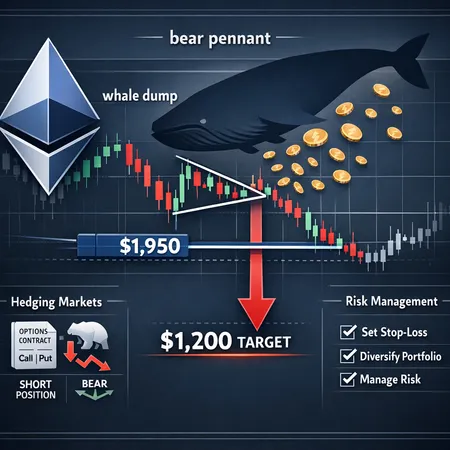
The market narrative for Ethereum tightened after reports of a $543M whale dump that coincided with collapsing intraday range and a classic bear pennant forming on daily/4H charts. Analysts pointed to immediate support near $1,950 and warned a confirmed break could project a downside target near $1,200. This piece layers on-chain liquidity context, the technical mechanics of the pennant, scenario-based trade plans (entry, stop, sizing), hedging approaches for risk managers, and how short-term hedging markets interact with ETH’s longer-term fundamentals.
What the whale dump means for liquidity and market microstructure
A large, publicized sale — reported as roughly $543M — matters for two reasons: price impact and information signaling. If the chunk hit centralized exchange order books, it likely sucked liquidity across multiple price levels, producing large slippage and triggering derivative liquidation cascades. If executed OTC, its immediate book impact is muted but the change in public balances still increases circulating supply available to market sellers.
On-chain traces and exchange flows give different signals. An on‑book dump tends to widen bid-ask spreads and reduce visible depth for several hours to days, leaving the market more vulnerable to follow‑on moves. A whale sale also sends a behavioral signal: algos and other whales may interpret it as distribution, increasing shorting activity and reducing willingness of liquidity providers to step in. Both dynamics amplify the downside risk inherent in a tightening price structure.
The chart: bear pennant, volume profile, and key levels
A bear pennant is a tightening, triangular consolidation after a preceding down move (the flagpole). Technical elements to watch here are: declining volume during the pennant, converging trendlines, and a breakout accompanied by a volume spike. The measured move for a pennant is typically the height of the flagpole projected from the breakout point — which is how some analysts arrive near a $1,200 downside target once $1,950 gives way.
Two practical, observable confirmations matter more than theory: a daily close below $1,950 and increasing sell volume on that break. A failure to break on volume — or a fast retest and hold — flips the edge back toward the buyers. Conversely, a clean breakdown followed by a retest that fails to reclaim the former support turns it into resistance and increases probability of the measured move completing.
Scenario A — ETH breaks $1,950: trade and hedge road map
If ETH breaks and closes below $1,950 on elevated volume, expect momentum sellers and systematic strategies to accelerate downside. Short-term and medium-term plans:
Short-term traders (swing): consider entering short on confirmation (daily close below $1,950) or a decisive 4H breakdown with a stop above the upper pennant boundary or the retest high. Use position sizing to limit capital at risk to 1–2% of account equity. A suggested stop technique: place the stop above the nearest technical invalidation (e.g., above the pennant high) or use ATR × 1.5–2 as a volatility-aware buffer.
Momentum traders (futures/perp): avoid excessive leverage. If using perpetual swaps, keep leverage low (≤3x) and use a dynamic stop based on funding and volatility. Liquidations during a strong move are common; prefer staggered entries and partial profit-taking around intra-range support clusters (e.g., prior demand zones).
Token managers / treasury: overlay hedges rather than outright sells. Practical hedges include buying puts or put spreads that protect the portfolio between current levels and the $1,200 range. A cost-efficient structure: buy a near-term ATM put and sell a lower-strike put (vertical) to cap cost, or buy a multi-month put for longer tail risk protection.
Execution notes for large sizes: avoid hitting the market. Use TWAP/VWAP execution or negotiate OTC where available. If protecting a large balance sheet, combine futures shorts (to capture immediate downside) with longer-dated options (to cap replacement cost if markets snap back).
Scenario B — ETH holds $1,950: how to position
If $1,950 holds after a meaningful test—particularly on a low-volume pullback—buyers may regain control and the pennant can collapse to the upside into a short squeeze:
Traders can look for intraday long entries on confirmed bounce patterns (hammer candlesticks, bullish divergence on momentum indicators) with stops below the tested support, sized to risk 1–2% of capital.
Larger managers anticipating mean reversion can scale into exposure using limit buys in the $1,950–$2,100 band and use collars to limit downside if volatility re-emerges. Collars (long spot + short call + long put) keep participation in upside while capping tail risk cost-effectively.
If conviction is long-term, accumulate on strength (retest-and-hold) rather than buying the dip immediately. Remember that heavy leverage from sellers can push prices lower even if fundamentals remain intact; preserve liquidity in treasury allocation plans.
Hedging mechanics and Vitalik’s hedging-first perspective
Vitalik Buterin has argued for building markets that prioritize hedging and risk-transfer over pure speculation — a useful conceptual lens when thinking about active risk management. Deep, liquid hedging markets (liquid options, transparent OTC desks, institutional futures) allow professional managers to separate short-term volatility from long-term allocation decisions. See the analysis of his views for context here.
Operationally, hedges fall into two families:
Derivative hedges: outright short futures/perps, buying puts, or structured collars/vertical spreads to cap cost. Vertical put spreads, for example, reduce premium outlay compared to naked puts while still offering meaningful downside protection.
Execution hedges: staggered selling, TWAPs, and OTC trades to reduce market impact. For large balance sheets, always think liquidity schedule rather than one-off block sales.
Hedging markets themselves can be a feedback loop: aggressive put buying raises implied vols and can steepen skew, which increases the cost of further hedges — a self-reinforcing mechanism during stress. That’s why layering (combining short-dated micro protection with longer-dated tails) is often cheaper and more effective.
Practical trade ideas and risk parameters
Below are concrete ideas tailored to intermediate/advanced participants. These are frameworks, not prescriptions — adapt sizes and tenors to mandate and risk appetite.
Conservative treasury hedge (token manager): buy 3–6 month put at ~80% of spot (cheaper tail cover) and sell a higher strike call to finance part of it (collar). Use OTC to reduce slippage for large notionals.
Tactical swing short (trader): enter short on a confirmed daily break below $1,950. Target first lower support zone near $1,500 and the measured move near $1,200. Stop: above pennant upper boundary or 1.5× daily ATR above entry.
Cost-efficient downside protection (options trader): buy a 1–2 month ATM put and sell an OTM put ~25–35% below spot (a put spread). This limits max payout but keeps hedge affordable.
Short-term protection with leverage control (futures): hedge 30–50% of exposure using low-leverage (1–3x) short futures, then top up options for tail risk.
Execution best practices: break large orders into smaller tranches, prefer limit orders near liquidity pools, and monitor funding rates when using perpetuals.
Interplay between short-term hedging markets and long-term fundamentals
Short-term hedges manage drawdown; fundamentals determine the persistence of price regimes. Ethereum’s longer-term drivers — staking yields, L2 adoption, developer activity, DeFi usage, and macro liquidity — remain independent variables. Hedging markets provide optionality: they let holders stay allocated to long-term fundamentals while protecting against tactical shocks.
But hedging markets are not neutral. Heavy demand for downside protection pushes implied volatility higher, which in turn makes further hedges more expensive. That cost dynamic shapes whether managers hedge frequently (rolling shorter dated protection) or buy multi-month protection for tail defense.
Practical takeaway: match hedge tenor to your conviction horizon. If you believe ETH fundamentals are intact for 12+ months, use layered short-dated hedges plus a single, cheaper long-dated tail; if your view is tactical, favor short-dated option structures or selective futures exposure.
Checklist for traders and risk managers (actionable)
- Confirmation: wait for a daily close below $1,950 with volume to confirm breakdown; otherwise treat moves as tests.
- Position sizing: risk ≤1–2% of equity per trade for discretionary traders; proportion hedged for managers based on NAV volatility targets.
- Stops: use technical invalidation (pennant upper boundary) or ATR-based buffers (1.5–2× ATR).
- Execution: use TWAP/VWAP or OTC for large blocks to avoid slippage caused by thin order books after a whale event.
- Hedging combos: vertical put spreads and collars to reduce premium costs, and futures for instantaneous directional exposure.
- Monitor derivatives: funding, open interest, and skew for early signs of forced deleveraging.
Conclusion
The reported $543M whale dump and the tightening into a bear pennant raise the odds of a meaningful downside if $1,950 fails. But markets are path-dependent: volume on the break, follow-through selling, and liquidity depth will define the speed and extent of any decline. Use a mix of execution hygiene (TWAP/OTC), volatility-aware stops, and layered hedges to manage risk. Vitalik’s hedging-first framing is a timely reminder: better and cheaper hedging markets reduce the need for knee‑jerk portfolio changes and help allocate risk rather than capitulate to short-term noise.
Bitlet.app users and institutional managers alike should treat this as a risk event to manage, not necessarily a time to panic: hedging and disciplined sizing buy time to let fundamentals reassert themselves.