Why Bitcoin Is Still So Volatile Despite Steady ETF Flows — What Traders Should Do
Summary
Executive snapshot
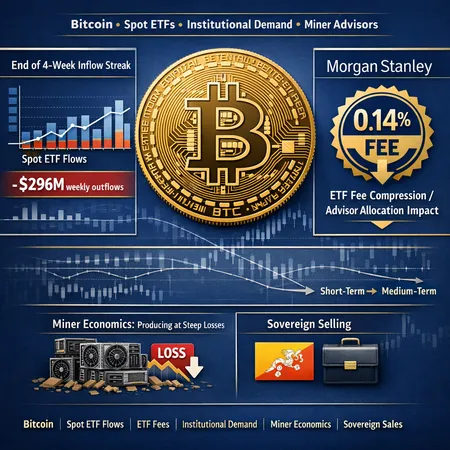
ETF flows are an important new backbone for Bitcoin, but they are not a magic stabilizer. Over the past week, spot-BTC ETFs recorded inflows that nearly erased last week’s outflows, a sign that institutional demand remains present even after short-term pullbacks. You can find the flow update in Cointelegraph’s recent coverage showing inflows nearly offsetting the prior outflows.
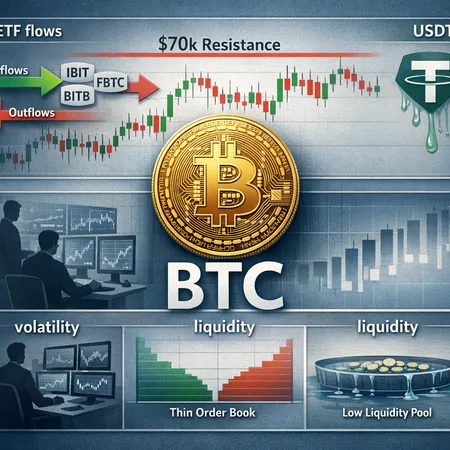
At the same time, price action is struggling to clear high-conviction technical zones around $69k–$70k, and liquidity dynamics — especially stablecoin behavior and exchange operational risk — are creating episodic volatility spikes that ETF receipts alone cannot neutralize. This article explains why those forces interact the way they do and gives practical guidance for intermediate traders and allocators deciding whether to lean into ETF-driven bids or pare risk.
ETF flows: why steady inflows don’t equal stability
The headline is straightforward: major spot BTC ETFs are taking in capital consistently, and flows can provide a persistent bid under price. Cointelegraph reports that recent spot ETF inflows nearly erased the previous week’s outflows, demonstrating how quickly institutional flows can shift the supply-demand picture on centralized venues.
But flows are only one piece of liquidity. Inflow numbers tell you how much capital is being allocated to ETFs, not how that capital is executed into the spot market in real time, nor how resilient the rest of the liquidity plumbing is when prices move abruptly. ETFs can smooth demand over the day, but they do not instantly neutralize concentrated selling or thin order books on smaller venues. In practice, ETF buys often get routed through large OTC desks and prime brokers, which in turn interact with exchange order books — and those last legs are where volatility can be amplified.
For many allocators on Bitlet.app and elsewhere, ETF flows are a medium-term structural bullish input. Yet operational frictions, timing of conversion, and the presence of cross-market sellers (leveraged funds, miners, or algo desks) mean ETFs reduce but don’t eliminate episodic spikes in realized volatility.
Technical pressure: the $69k–$70k battleground
Technically, Bitcoin has run into selling pressure near the $69k area and a psychological ceiling at $70k, where profit-taking and algorithmic resistance cluster. Recent technical commentary flagged that a 3% drop and a loss of momentum in the bulls correlate with selling around these levels, suggesting momentum exhaustion even during flow-positive days.
Why does a few percent matter? Because modern order books are shallow above certain highs: passive liquidity (limit sell orders) accumulates at rounded numbers. When price nears those zones, even modest outflows or liquidity withdrawals can trigger stop cascades and rapid repricings. Traders should observe on-chain and exchange order-book depth near $69k–$70k rather than assuming inflows guarantee a clean pass-through.
Institutional narratives: catalysts vs probability-weighting
Two institutional narratives dominate the conversation now, and they lead to different playbooks.
Wintermute’s approach highlights a set of catalysts that could spark a renewed rally — items like macro re-pricing, derivative positioning squeezes, or ETF concentration dynamics. Wintermute lists three catalysts that traders should watch closely; these are scenario-driven and useful for constructing asymmetric trades that bet on a high-impact upside.
By contrast, the 50/50 thesis (popularized in parts of the institutional community) treats the current market as a bifurcated world: a material probability of a strong continuation higher if catalysts align, and an equally plausible path of a multi-week consolidation or drawdown if liquidity dries up or macro headwinds reassert.
Reconciling these views: it’s reasonable to allocate some capital to asymmetric upside scenarios (options structures, staged buys on dips) while keeping a separate, conservatively sized core that is hedged or sized to survive extended volatility. NewsBTC’s breakdown of Wintermute’s catalysts is a good primer for scenario construction and trade sizing.
Stablecoins, USDT softness, and liquidity amplification
Stablecoins sit at the intersection of fiat on-ramps, retail liquidity, and exchange settlement. When stablecoins behave normally, they smooth the mechanical fiat-to-crypto conversion and back. But recent reporting on USDT weakness tied to macro and operational anxieties shows how stablecoin flows can turn from stabilizing to destabilizing fast.
AmbCrypto’s coverage highlights USDT softness amid shutdown fears — when a major stablecoin shows stress, two things happen quickly:
- Traders hesitate to move into or out of crypto using that vehicle, creating a temporary choke point for liquidity.
- Arbitrageurs widen spreads and demand higher risk premia to accumulate BTC, meaning ETFs or OTC desks must pay more to source immediate liquidity.
The net effect: even modest selling can cause outsized price moves because the usual counterparties are less willing (or able) to absorb flow. Add to that the risk of exchange operational outages — whether maintenance, regulatory interference, or solvency concerns — and you have an environment where available liquidity is much less than the headline ETF inflow numbers might imply.
Exchange operational risks: why buckets of liquidity can vanish
Exchange-level issues are underappreciated by many allocators. Operational risks range from short-lived API throttling to more severe disruptions such as withdrawal freezes. When those events happen, on-exchange order books thin rapidly and cross-exchange arbitrage takes time to rebalance, producing price dislocations.
Even with steady ETF creation flows, if exchanges experience partial outages or large custodians pause movements, that ETF demand becomes a future execution problem rather than an immediate buffer. In short: ETFs can push demand into the system, but system-level frictions determine how that demand interacts with spot prices hour to hour.
Practical framework for traders and allocators right now
Below are concrete, implementable steps aimed at intermediate traders and portfolio managers who need a bias but also protection when volatility spikes.
Combine flow monitoring with order-book depth checks
- Don’t treat ETF inflows as a single data point. Track rolling ETF creation/redemption and watch exchange order-book depth, funding rates, and derivatives open interest. A steady ETF inflow with vanishing on-exchange liquidity is a warning sign.
Size dynamically and use layered entries
- Consider staging buys via a systematic ladder rather than a single execution. If you expect ETF bids to continue, add on shallow pullbacks but keep a core position small enough to tolerate a 20–30% realized drawdown without forced liquidation.
Use options and asymmetric risk structures
- When volatility is elevated, consider buying calls with staggered strikes or using call spreads to gain upside while limiting premium outlay. For allocators preferring downside protection, put spreads or collars can reduce tail exposure at a known cost.
Hedge via cross-venue and collateral management
- Maintain access to multiple liquidity rails (stablecoins, fiat pairs, and prime broker lines). Given USDT softness risk, keep alternative stablecoins or fiat rails available and test withdrawal paths regularly.
Have pre-defined triggers for de-risking
- Define technical and liquidity triggers (e.g., a close below a multi-day VWAP, a >15% one-day drawdown, or a major exchange withdrawal freeze) that prompt concrete actions such as reducing size or increasing hedges.
Monitor the three catalyst buckets and weigh probability
- Use a checklist based on Wintermute’s catalyst framework: macro repricing signs, derivatives squeeze signals, and concentrated ETF concentration. If two of three catalysts begin to align, tilt toward participation; otherwise preserve dry powder.
Scenario sketches: how to think about outcomes
Upside scenario (30–40%): ETF demand accelerates, derivatives positioning compresses shorts, and macro risk premia fall. Liquidity recovers at higher prices, making staged buys and call structures profitable.
Range-bound scenario (30–40%): ETF flows continue but are offset by profit-taking and thin order books near $70k. Volatility remains elevated; the right play is opportunistic rebalances and option premium selling with defined risk.
Downside scenario (20–30%): Stablecoin stress or an exchange operational event causes a liquidity vacuum, leading to a sharp drawdown. Here, de-risking and pre-positioned hedges preserve capital.
These probabilities are illustrative, not predictive. The key is to keep positions sized for survival and to treat ETF flows as an important but not decisive input.
Final thoughts
ETF flows are an important structural positive for Bitcoin, and recent data showing inflows nearly erasing last week’s outflows is encouraging. But price mechanics live in the microstructure: order-book depth, stablecoin behavior (notably USDT), and exchange operational health. For traders and portfolio managers the sensible posture in this environment is conditional participation — allocate to ETF-driven bids with staged sizing, hedges, and explicit liquidity and technical triggers for de-risking.
If you’re building execution plans or institutional allocations, combine flow-watch (ETF creation/redemption) with real-time liquidity checks and a written contingency for stablecoin or exchange stress. These are the practical steps that separate reactive traders from durable allocators.
For further reading on ETF flows and technical momentum, see the Cointelegraph updates on ETF inflows and Bitcoin momentum. For catalyst-driven trade ideas consider Wintermute’s breakdown, and for liquidity concerns review the coverage on USDT softness. Bitlet.app customers and traders should treat ETF flow data as part of a broader liquidity and risk framework rather than a sole source of conviction.
Sources
- Spot Bitcoin ETFs add $167M, nearly erase last week’s outflows
- Bitcoin price drops 3% as analyst warns bulls lack momentum around $69k
- These three catalysts could spark Bitcoin’s next rally, according to Wintermute
- Bitcoin price dips amid USDT weakness — is BTC topping out?
Additional internal context: For many traders, Bitcoin remains the primary market bellwether, and developments on DeFi rails often presage liquidity shifts in spot markets.