Ripple's UAE Push: RLUSD <> AEDZ Rails on the XRP Ledger and What It Means for MENA Payments
Summary
Quick take — why this matters now
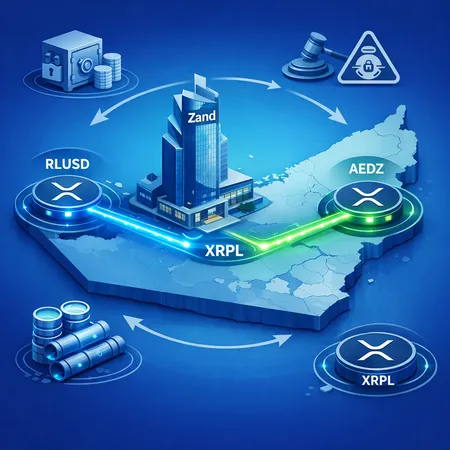
Ripple’s expanded deal with Zand Bank connects RLUSD and AEDZ as operational rails on the XRP Ledger (XRPL). In plain terms, that means a USD‑pegged stablecoin (RLUSD) and an Abu Dhabi dirham pegged token (AEDZ) can be transferred and settled on‑chain with XRPL’s finality and messaging capabilities, under a regulated banking partner in the UAE. For payments teams focused on MENA corridors, this is a live experiment: not vaporware, but a regulated pilot that tests stablecoin settlement inside a bank‑friendly wrapper.
This article explains what the integration actually does, why Ripple chose Zand and the UAE, and the practical implications and obstacles payments and product managers must evaluate before launching pilots or production services.
What the expanded integration actually does (RLUSD ↔ AEDZ rails)
At the technical and operational level the deal creates a set of on‑chain rails and off‑chain plumbing:
- Token rails on XRPL: RLUSD (Ripple’s USD‑pegged token) and AEDZ (Zand’s AED‑pegged token) are issued and transferrable on XRPL, enabling near‑instant settlement and transparent transaction provenance.
- Two‑way conversion rails: The integration is designed to allow funds to move USD value into RLUSD, route on XRPL to a counterparty in the UAE, then redeem into AEDZ (or vice versa), minimizing the need for correspondent banking legs.
- Regulated custody and settlement model: Because Zand is an on‑bank issuer/partner, the initiative layers traditional KYC/AML and fiat custody controls over on‑chain transfers — a hybrid model that addresses many bank compliance concerns.
Think of it as a tokenized, bank‑backed bridge: on‑chain rails for speed and programmability, with an on‑bank counterparty providing regulated fiat on‑ and off‑ramps. Reports from the expansion outline these usage details and how the RLUSD ↔ AEDZ flows are expected to operate in a live environment (U.Today report on the expansion).
Why Zand and the UAE — regulatory clarity and corridor logic
Two practical reasons make Zand and the UAE a logical next step for Ripple:
- Regulatory clarity and sandboxes. The UAE — including ADGM and other financial free zones — has been explicit about digital asset frameworks, which reduces legal uncertainty for banks experimenting with tokenized rails. Coverage of the Zand tie‑up notes how the RLUSD/AEDZ linkage is being scoped within a regulated framework on the XRPL (Cryptopolitan coverage).
- Strategic payments corridor. The UAE is a regional payments hub for the Gulf, East Africa and South Asia. A tested on‑chain AED corridor offers faster settlement and lower operational friction for remittances and corporate treasury flows between these markets.
Ripple’s leadership has publicly emphasized that XRP and on‑ledger liquidity remain central to the company’s payments strategy — positioning practical stablecoin rails in regulated jurisdictions is a way to operationalize that thesis (Garlinghouse comments).
Implications for cross‑border payments and bank adoption in MENA
For payments and product teams, the practical upside is concrete but conditional:
- Faster settlement windows. On‑chain settlement via XRPL closes the intra‑bank float that costs time and capital in correspondent models. That can materially reduce treasury requirements for corporates and banks.
- Programmability and composability. Stablecoins on XRPL enable embedded rules (sweep triggers, conditional payments) that can speed reconciliation and reduce disputes.
- Bank buy‑in via regulated issuance. Because AEDZ is tied to a licensed UAE bank, many compliance teams will see the model as less risky than fully permissionless stablecoins.
However, adoption depends on counterparties accepting tokenized AED liquidity inside existing settlement chains. Pilot success will require local clearing firms, treasury desks and correspondent banks to integrate token‑fiat translation points.
For teams evaluating corridors, consider these KPIs: on‑chain settlement latency, end‑to‑end cost per payment (including on/off‑ramp spreads), required liquidity buffers, and reconciliation effort reduction. Practical pilots should run with measurable volume and a small set of corridor partners first — for many fintechs, interoperability with existing rails is as important as the on‑chain novelty.
For context on how XRPL fits into broader crypto rails and liquidity markets, many teams still benchmark against more developer‑centric DeFi rails like Ethereum — but XRPL’s focus on payments differentiates it for this use case (see discussions in crypto payments coverage and platform adopters such as exchanges and wallets). For market perspective, note the broader ecosystem overlap with DeFi primitives and the role of market‑making in providing corridor liquidity.
How Ripple’s custody and staking upgrades matter for bank adoption
Institutional adoption of tokenized rails depends on custody and operational controls. Ripple’s recent push to enhance institutional custody and staking tooling addresses one of the key blockers to bank participation: the ability to hold, segregate and secure tokenized assets with clear audit trails and governance.
The new custody and security feature set positions the company to offer custodial primitives that satisfy bank risk teams, while maintaining the benefits of XRPL settlement; the platform upgrades were explicitly framed as tools to ease bank adoption and institutional flows (thenewscrypto on custody upgrades).
Practically, payments teams should ask potential partners the following about custody:
- Is custody segregated and compliant with local trust/account rules?
- How are keys managed for hot vs. cold wallets, and what SLA exists for recovery?
- Are staking and yield tools optional, and what counterparty risk do they introduce?
Ripple’s custody story reduces one class of operational risk — but it does not eliminate the need for thorough legal and operational due diligence when integrating bank‑issued tokens such as AEDZ.
Realistic obstacles: liquidity, on‑ramp regulation, and CBDCs
The expansion is promising, but the real world introduces several constraints payments teams must plan around:
- Liquidity depth and market‑making. Real corridor utility requires deep two‑way liquidity. Without committed market makers or bank liquidity pools, spreads and slippage can make tokenized rails uneconomic for larger flows.
- On‑ and off‑ramp compliance. Banks and exchange partners must align on KYC/AML, suspicious activity reporting, and fiat settlement timing. Regulatory fragmentation across jurisdictions (e.g., KYC intensity in Gulf vs. South Asia) can raise operational complexity.
- Stablecoin peg and redemption risk. Token peg stability and redemption assurances matter. Any failure to maintain redeemability to fiat at par undermines bank treasury confidence.
- CBDC interplay. As MENA central banks explore or roll out CBDCs, tokenized bank‑issued stablecoins may need to coexist with or adapt to CBDC rails — coordination with monetary authorities is necessary to avoid regulatory conflict.
Payments teams should model scenarios where on‑chain transfers occur but fiat settlement windows still create residual credit exposure — the hybrid design still requires careful intraday liquidity modeling.
Decision checklist for payments/product managers
If you’re assessing whether to pilot or integrate RLUSD ↔ AEDZ rails on XRPL, use this practical checklist:
- Corridor fit: Do your counterparties operate in UAE or adjacent MENA corridors where AED tokenization reduces settlement complexity?
- Liquidity partners: Are market makers or bank liquidity providers committed to two‑way pools to keep spreads competitive?
- Custody & compliance: Can your legal and AML teams sign off on a bank‑backed token model and the custody provider’s controls? (Note Ripple’s custody upgrades reduce friction here.)
- Integration Complexity: Can your back‑office reconcile tokenized flows with accounting and existing FX nets? How will exceptions be handled?
- KPIs for pilot: Define latency, cost per transfer, liquidity buffer, and reconciliation efficiency targets before go‑live.
- Regulatory monitoring: Track local on‑ramp laws and CBDC developments and have a rollback/fallback plan to correspondent banking if required.
Platforms in the ecosystem — including parts of the exchange and P2P stack — will need to update risk models and settlement logic. Tools such as Bitlet.app that connect payments plumbing with user flows may shorten time‑to‑market when integrating token rails.
Conclusion — a pragmatic step, not a silver bullet
The RLUSD ↔ AEDZ integration with Zand on the XRPL represents a pragmatic, regulated experiment: it demonstrates how bank‑backed stablecoins can deliver faster, programmable settlement inside a supervised environment. For payments and product leaders in MENA, the opportunity is real — lower settlement times, better reconciliation and programmable logic — but success depends on liquidity commitments, robust on/off‑ramp processes, and careful regulatory alignment.
If your organization is considering a pilot, start small, secure liquidity partners up front, and measure the full end‑to‑end cost and operational impact. The technical rails are maturing; the operational work is now the gating factor.
Sources
- https://u.today/ripple-extends-its-uae-zand-partnership-with-extensive-rlusd-usage-details?utm_source=snapi
- https://www.cryptopolitan.com/ripple-partnership-zand-bank-rlusd-xrpl/
- https://thenewscrypto.com/ripple-expands-institutional-custody-services-with-new-security-and-staking-tools/?utm_source=snapi
- https://www.cryptopolitan.com/garlinghouse-xrp-army-top-of-mind-for-ripple/