Institutionalization of Privacy-Layer Assets: What Binance’s 5x Aztec Perpetuals Mean for Liquidity and Risk
Summary
Why Binance’s 5x Aztec Perpetuals matter
Binance adding 5x perpetuals for Aztec (ticker: AZTEC) is more than a product launch — it’s a signal. Exchange listings with leverage institutionalize an asset class by creating a fungible, marginable price stream that derivatives desks, market makers and quant funds can trade programmatically. For many traders, Bitcoin remains the primary market bellwether, but adding tradable perpetuals on a privacy L2 token introduces a new vector for both speculation and hedging.
This institutionalization has three practical effects: deeper derivatives liquidity (spot-to-derivative basis trades become viable), intensified funding-rate mechanics (continuous long/short carry), and a higher-stakes liquidation plumbing (5x means faster blowups). Binance’s design choices — leverage cap, mark-price model and funding schedule — determine how those effects show up in realized volatility and tail risk.
Perpetual mechanics: what 5x, mark pricing and funding actually change
Leverage profile and liquidation velocity
A 5x perpetual compresses the capital needed to express directional views. That’s attractive for liquidity providers who can earn funding and for traders seeking exposure, but it accelerates liquidation velocity: a 20% adverse move, which a spot holder weathers, can wipe out a 5x perpetual position quickly once margin buffers plus maintenance margins are breached.
Risk teams should not treat a 5x perpetual like a leveraged spot ETF. The interaction of intraday funding, exchange margin calls, and concentrated liquidity on smaller books increases cascade risk during abrupt moves.
Mark price, index construction and fairness
Exchanges typically use a mark price to reduce manipulation-driven liquidations. Mark pricing often blends spot index prices across venues and may include a time-weighted component. That matters more for privacy tokens because the underlying liquidity is fragmented: OTC desks, centralized spot books, decentralized AMMs on privacy L2s and thin regional markets all contribute noisy price signals.
A misleading mark (either stale or disconnected from the visible order book) can cause outsized forced liquidations. Risk teams must model mark-index latency and its correlation with spreads before allowing large exposures.
Funding design and incentive flips
Funding payments (longs pay shorts or vice versa) tether perpetual prices to spot over time but also create directional carry. For a thinly traded privacy token, funding rates can swing wildly — incentivizing aggressive market-making in one direction and then reversing when sentiment or liquidity shifts.
On a 5x contract, funding-driven flows are amplified: a recurrent funding debit can force levered participants to deleverage into thin liquidity, producing slippage and temporary price dislocations.
Monero’s whipsaw: a case study in liquidity fragility
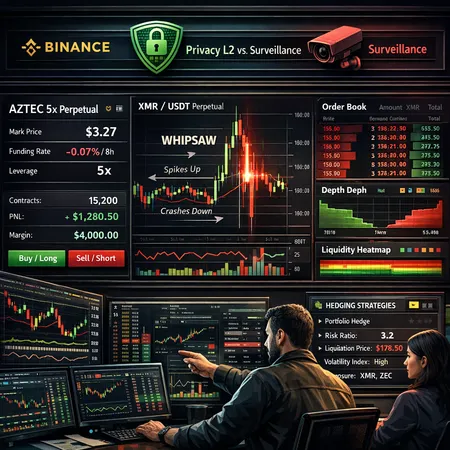
Monero (XMR) recently experienced a violent price whipsaw that illustrates how privacy token microstructure can produce dramatic, short-lived moves. Sharp reversals and liquidity vacuum events have two common drivers: concentrated limit-book depth and reactive liquidity provision pulling orders simultaneously.
As covered in reporting on Monero’s move, the spike behaved like a classic breakout failure or a strategic liquidity sweep where price briefly punctures resistance, sweeps stop-losses, then collapses back because natural buyers are absent at higher levels (analysis: Monero price whipsaws after channel break). For derivatives traders, that pattern translates into rapidly moving mark prices and clustered liquidations.
Contrast the Monero event with the broader market sell-off where privacy and privacy-adjacent tokens (including ZEC) underperformed during a downward slide; the broader momentum wash can exacerbate idiosyncratic moves in privacy assets (Zcash and altcoin losses coverage). When macro deleveraging hits, the thinner books of privacy tokens show the stress first.
What Binance’s Aztec perpetuals add — and where risks persist
Binance’s launch of 5x perpetuals for Aztec is noteworthy because it ties a privacy L2 native token into mainstream derivatives rails. Derivatives desks can now: (a) hedge spot exposure more efficiently, (b) provide two-way liquidity through market-making strategies using cross-product hedges, and (c) offer basis trades between spot, futures and funding rates.
But liquidity quality matters. Perpetuals can concentrate liquidity in the derivatives market while the spot remains fragmented. That asymmetric liquidity creates conditions where funding or futures basis moves detach from on-chain metrics — a dangerous gap for risk models that assume tight spot-derivative coupling.
Binance’s product likely uses standard mark-price and funding conventions, but traders should test the exchange’s specific index sources and funding cadence under stressed scenarios. The announcement that Binance added 5x Aztec perpetuals also mirrors a broader industry trend toward derivativeizing privacy-layer tokens, as larger venues attempt to capture flow from institutional desks (Binance Aztec 5x announcement).
Surveillance vs privacy: market structure and compliance dynamics
A unique friction for privacy tokens is the surveillance vs privacy tension. Exchanges and institutional counterparties face regulatory and compliance constraints that can affect liquidity provisioning to privacy assets. Market makers may restrict activity or demand higher spreads to offset AML/KYC and transaction-monitoring risk.
This tension can lead to time-varying liquidity: during high compliance scrutiny or negative headlines, quoted depth may vanish quickly. Conversely, when surveillance pressure eases or when a major exchange lists a perpetual, liquidity can temporarily spike as new participants enter. Risk teams should therefore include scenario tests that incorporate regulatory-driven liquidity pullbacks.
Practical hedging and sizing guidance for derivatives desks
Below are actionable guidelines for traders and risk teams evaluating whether to add privacy-asset exposure via perpetuals and how to size positions given liquidity whipsaws.
1) Baseline exposure limits and tapering
- Start with conservative notional limits relative to average daily traded volume (ADV) on both the spot and perpetual order books. For a nascent perpetual, limit initial positions to a small fraction (e.g., 1–2% of 24h ADV) and scale up as depth proves resilient.
- Use a taper schedule: increase exposure only after several non-stressed trading days where realized slippage and funding behavior stay within modeled bounds.
2) Stress-test for mark-price and funding stress
- Simulate abrupt mark-index divergence scenarios where external spot venues flash a price move while the exchange index lags. Quantify potential extra margin calls and worst-case liquidation cascades.
- Model extreme funding-rate swings and compute carry amortization under adverse scenarios.
3) Hedging toolkit
- Prefer cross-product hedges: offset perpetual exposure with spot OTC or BTC/ETH-quoted hedges where possible, recognizing basis and settlement mismatches.
- Use options or delta-hedged structures if available to cap tail risk. If options markets are unavailable for a privacy token, synthetic hedges via correlated assets (e.g., larger privacy-comparable assets) may help, though correlation can break down during stress.
4) Execution and liquidity monitoring
- Implement intelligent order-slicing and TWAP/VWAP algorithms that incorporate real-time book resilience metrics. Cancel-on-liquidity-drop rules can prevent signaled market impact during a fleeting sweep.
- Monitor order-book skew, hidden liquidity, and regional venue spreads. Use alerts for abnormal funding-rate moves, sudden widenings in bid-ask, or concentrated taker aggression.
5) Collateral and margining considerations
- Prefer higher-quality collateral or overcollateralization for positions in privacy tokens. Consider dynamic maintenance margins that widen when on-chain indicators (withdrawals, contract flows) suggest increasing fragility.
Broader market implications for derivatives liquidity
The entrance of big exchanges offering perpetuals for privacy L2 tokens will likely increase tradable liquidity, making hedging and structured-product construction more feasible. Yet, this is a double-edged sword: derivatives liquidity can concentrate risk and create synthetic leverage that’s disconnected from the on-chain economy of a privacy protocol.
Derivatives desks should treat privacy tokens as a distinct market microstructure regime rather than a simple extension of large-cap altcoins. Expect recurring episodes where funding, mark index and concentrated liquidation clusters create outsized realized volatility relative to spot capitalization.
Final checklist for risk teams and traders
- Validate index composition and mark-price latency for any exchange perpetual you use. Run historical reconstructions against spot prints.
- Size positions relative to both spot and perpetual ADV; start small and cubic-scale exposure with proven depth.
- Stress-test funding-rate shocks and simulate cascade liquidations under mark disconnects.
- Maintain disciplined collateral policy and dynamic maintenance margins.
- Prepare surveillance-contingency plans: when counterparties restrict flow, enact immediate de-risk protocols.
Adding Aztec perpetuals to major venues brings new tools for expressing views on privacy L2 growth and token economics, but it also requires upgraded risk hygiene. Monero’s whipsaw is a reminder: privacy tokens can move fast and unpredictably, and derivatives amplify those moves. Thoughtful position-sizing, hedging primitives and execution controls are the difference between a strategic allocation and a painful liquidation.
Bitlet.app risk teams and trading desks should incorporate these checks into their onboarding playbooks when they evaluate privacy-token derivatives.
Sources
- Binance rolls out 5x perpetuals on Aztec announcement: https://crypto.news/aztec-perpetuals-binance-rolls-out-5x-futures-on-privacy-l2-asset/
- Monero price whipsaws analysis: https://coinpedia.org/news/monero-price-whipsaws-after-channel-break-breakout-failure-or-strategic-liquidity-sweep/
- Altcoin losses covering privacy tokens including Zcash: https://decrypt.co/357693/zcash-bnb-sui-lead-altcoin-losses-as-crypto-market-slides/