Shiba Inu: Crash vs Shibarium Hype — How Traders Should Size Risk Ahead of Upgrades
Summary
The two competing narratives around SHIB
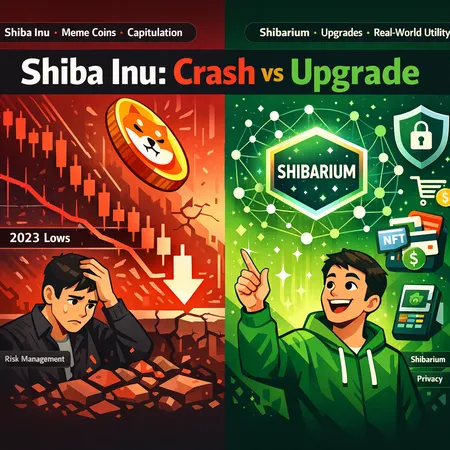
Shiba Inu (SHIB) is living under two distinct stories. One is a technical one: price action that has sliced through key support bands and pushed SHIB back toward 2023 lows, a move that looks like capitulation to many traders. The other is a forward-looking product narrative: believers point to Shibarium upgrades and a roadmap of scalability, privacy, and real-world utility as reasons SHIB can stage a meaningful comeback.
Both narratives are true in different ways — price is what traders do today, while roadmaps influence what investors expect tomorrow. Your job as a trader or community manager is to weigh the probabilities and size exposure so a broken trade doesn’t break you.
Recent price action and broken technical supports
In the last few months SHIB has shown classic signs of a failing bullish structure: lower highs, lower lows, and decisive breaks under short- and mid-term support bands. Several retail-level support zones that previously held have given way, and momentum indicators have often flashed oversold but not yet reversed.
This price weakness has been documented in market coverage noting SHIB at its lowest levels since 2023, a signal many interpret as capitulation rather than a healthy pullback. The price moves have also coincided with broader risk-off flows across crypto, which pushed some capital into traditional safe havens.
Why some investors are fleeing to gold and other havens
There are two intertwined drivers nudging capital away from memecoins like SHIB and into assets like gold:
Macro uncertainty and liquidity shifts. When risk assets wobble and macro headlines dominate, retail and institutional players often seek the perceived safety of gold or cash. Several recent pieces observed investors reallocating amid SHIB’s slide to 2023 lows, describing a clear flight-to-gold narrative (Coinpaper report).
On-chain signals and risk perception. Low active addresses, declining fee revenue, and reduced exchange inflows can amplify fear. When on-chain activity looks weak, the narrative shifts from "waiting for adoption" to "waiting for capitulation." Coverage highlighting SHIB at the lowest levels since 2023 reinforced the notion that market participants still prefer non-crypto safe assets for now (U.Today coverage).
Psychology matters: when large swaths of community sentiment turn defensive, price can undershoot fundamentals simply because selling begets selling.
What Shibarium upgrades actually propose (and the realistic timeframes)
The bullish camp points to Shibarium as the fundamental lever that can restore interest in SHIB. The upgrade roadmap often cited includes three pillars:
- Scalability: layer-2 improvements to increase transaction throughput and reduce fees for Shiba-linked dApps.
- Privacy features: optional privacy-preserving transactions or layers for specific use cases, appealing to certain user niches.
- Real-world utility: integrations with payments, gaming, or NFTs where SHIB is a currency or collateral.
Previews of the Shibarium roadmap and the bullish thesis suggest upgrades could improve user experience and open new use cases that translate into higher on-chain activity and token demand (Crypto.News preview). But two important caveats apply:
- Roadmap ≠ adoption. Technical upgrades must be paired with developer interest, meaningful dApp launches, and user incentives to move the needle.
- Timelines slip. Engineering, audits, and ecosystem partnerships often take longer than optimistic PR windows — and markets price forward expectations long before real utility appears.
On-chain signals to watch as objective evidence of Shibarium adoption
If you’re assessing whether Shibarium upgrades justify tactical allocation to SHIB, focus on measurable on-chain and ecosystem indicators instead of promises:
- Active addresses and new wallet growth on Shibarium. Sustained increases suggest new users are arriving.
- dApp revenue, number of transactions, and average fees on the Shibarium layer.
- Third-party integrations: wallets, exchanges listing Shibarium-native assets, or payment rails using SHIB.
- Developer activity: commits, GitHub PRs, and grant programs that show actual building.
- Token flows: net exchange outflows (long-term holders accumulating), vs sustained listing pressure.
A credible uptick across several of these metrics would strengthen the re-accumulation case.
Scenario planning: re-accumulation vs continued capitulation
Think in scenarios with explicit triggers and consequences rather than betting on narratives.
Scenario A — Re-accumulation (probability: conditional on on-chain adoption):
- Triggers: measurable rise in Shibarium active addresses, successful mainnet dApp launches, and sustained exchange outflows.
- Price response: a multi-week consolidation followed by a controlled rally as market participants re-price utility.
- Trader action: scale into small stakes on confirmation (e.g., accumulation after two consecutive weeks of rising on-chain activity), use staggered buys and tight risk controls.
Scenario B — Continued capitulation (probability: high while macro is risk-off):
- Triggers: no meaningful adoption signals, worsening macro liquidity, and persistent exchange inflows.
- Price response: further downside with thinner bounces and broadened technical breakdowns.
- Trader action: preserve capital by avoiding large tactical allocations, or use very small, optionality-sized positions with predefined stop-losses.
Practical risk-sizing rules for retail traders and community managers
Below are actionable, conservative rules of thumb tailored to meme coins like SHIB in an uncertain upgrade cycle. These are not investment advice but frameworks to manage downside while keeping upside optionality.
Position cap by portfolio percentage: limit SHIB exposure to a small fraction of your risk capital — commonly 0.5% to 2.0% of total investable assets for speculative upgrade plays. If you’re more risk tolerant and this is a thematic allocation rather than a short-term trade, nudge toward the higher end but never exceed what you can afford to lose.
Use scaled entries: split a target allocation into 3–5 tranches across a defined price range or conditioned on on-chain signals. This reduces single-point timing risk.
Set explicit stop frameworks: define a maximum tolerated drawdown per tranche (e.g., 30–50% on speculative memecoin tranches) or use support levels to anchor stops. Avoid moving stops to avoid ‘getting stopped out’ — that’s how losses creep into bankrolls.
Timebox your thesis: give Shibarium upgrades a reasonable runway (e.g., 3–9 months) and evaluate progress against objective milestones. If milestones aren’t met, consider trimming exposure.
Treat any allocation as optionality, not core: meme coins should be treated as asymmetric bets where the downside is often higher than the upside probability. Size accordingly.
Hedging where possible: if you manage a larger crypto allocation, consider reducing exposure to correlated risk assets (e.g., other memecoins) rather than using leverage or derivatives unless you understand them well.
Tactical checklist before placing a trade
- Has Shibarium rolled out a working mainnet feature with decent transaction volume?
- Are active addresses and developer activity trending up for at least 2–4 weeks?
- Are exchanges showing net outflows (accumulation) rather than inflows?
- Does your position fit within the allowed portfolio cap (0.5–2%) and your stop rules?
If the answer to most of these is no, then any buy should be tiny and primarily for optionality.
Managing community expectations and communications
For community managers, messaging matters. Don’t overpromise deterministic price moves from upgrades. Instead, explain the technology milestones, what will and won’t change price directly, and the objective signals you’ll be watching. This keeps the community aligned and reduces forced selling when timelines slip. Mention that Bitlet.app offers tools for dollar-cost averaging and risk-controlled entry if users want operational help executing a plan.
Final takeaways
- Shiba Inu’s current price action and flow into gold reflect a valid short-term capitulation narrative; the market often prefers safe havens during uncertain macro windows.
- Shibarium upgrades are a plausible reason for a longer-term bullish case, but roadmap optimism must be validated by adoption metrics before it justifies large tactical allocations.
- For retail traders and community managers: keep SHIB exposure small, use scaled entries, enforce stop and timebox rules, and condition larger allocations on objective on-chain adoption signals.
Balancing skepticism with optionality is the pragmatic path: allow for upside if Shibarium proves productive, but protect capital while the evidence is still being written.
Sources
- Shiba Inu price crashes to 2023 lows — Coinpaper
- Shiba Inu price prediction ahead of Shibarium upgrades — Crypto.News
- Shiba Inu at lowest level since 2023 — U.Today
For broader market context, remember that Bitcoin sentiment and DeFi activity can materially influence memecoin cycles, so watch cross-market signals as you size risk.