Institutions & Tokenized RWAs: $18.87M Tokenized-Gold Inflow, Sui and Hedera Takeaways
Summary
Executive snapshot: why this moment matters
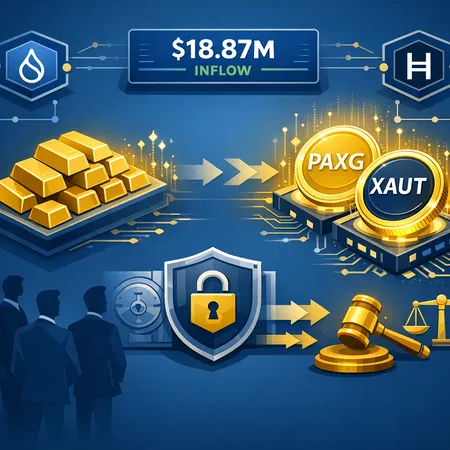
A newly created address purchasing $18.87 million of tokenized gold is more than a headline; it’s a concrete signal that large, concentrated capital can move into tokenized real-world assets (RWA) quickly. That trade—reported as a concentrated inflow into tokenized-gold offerings—fits a broader pattern: institutional teams testing programmable ownership of real assets for faster settlement, composability with on-chain finance and portfolio diversification. For many institutional product teams the core question is not whether tokenization is possible, but whether the legal, custodial and operational plumbing meets institutional standards.
Three case studies that illuminate demand and trade-offs
1) The $18.87M tokenized-gold inflow: what it signals
The reported $18.87M buy illustrates two things at once: appetite and operational readiness. Appetite—because large capital is willing to express exposure to physical gold in token form rather than via ETFs or futures; operational readiness—because tokenized gold issuers and custodians can accept and tokenize large blocks quickly. The trade also surfaces the critical distinction between token economics and off-chain custody: tokens like PAXG and XAUT represent claims on bullion, but those claims depend on how the issuer structures ownership and proof of reserves. See the reporting on that inflow for the raw data point here.
2) Sui Labs and institutional tokenization demand
Sui Labs is seeing a surge in institutional interest for tokenization use cases—largely because its architecture aims for high throughput, low latency and object-centric state that can simplify asset lifecycles. Institutions evaluating tokenization care about deterministic execution, modular settlement rails and predictable gas economics. Sui’s tooling for asset modeling and Move-based primitives appeals to teams that want to define custody rules, transfer restrictions and lifecycle events at the token-spec level. The reporting on institutional interest in Sui provides context for why product teams are lining up: it’s about enterprise-grade primitives and developer ergonomics (source: The Currency Analytics).
3) Hedera, FedEx and the enterprise tokenization narrative
Hedera’s publicized tie-up with FedEx is not just PR: it underlines a trend where logistics, identity and tokenized asset record-keeping intersect. Enterprise partners value the governance model, finality guarantees and the Hedera Token Service (HTS) model that can map to existing corporate processes. That said, partnerships like FedEx-Hedera also raise questions about vendor concentration, long-term commitment and whether token issuance remains agnostic or captive to corporate partners. Coverage of the Hedera–FedEx arrangements and the market reaction is useful reading for product teams weighing corporate-grade tokenization platforms (source: crypto.news).
Tokenized gold mechanics: PAXG vs XAUT and custody implications
At a product level, not all tokenized-gold instruments are fungible with each other. PAXG (Pax Gold) and XAUT (Tether Gold) are two widely referenced tickers that both aim to represent ownership of physical gold, but they differ in legal wrapper, custody attestation frequency and transfer mechanics. Practically, an institutional buyer must map three dimensions: legal ownership model (allocated vs unallocated), custody counterparty strength (reputation, insurance, vault locations) and on-chain issuance transparency (attestations, audits and proof-of-reserves). These dimensions determine counterparty credit risk, ability to request physical delivery, and whether the token can be composably used in on-chain DeFi strategies.
From a settlement perspective, tokens settle instantly on-chain, but underlying bullion movement is off-chain and subject to custodial procedures. That mismatch creates operational risk: a portfolio may show a tokenized position on-chain while the physical reconciliation trails, and redemption processes can be multi-step. For institutional compliance teams, the focus is on contractual rights—do token holders have direct legal title to allocated bars, or an indirect claim on a pool held by an issuer? These are not trivial distinctions when converting token exposure back to deliverable metal under stressed market conditions.
Why Sui and Hedera are attracting institutions
Institutional interest in specific chains is rarely about marketing alone; it’s driven by architecture, governance, and predictable total cost of ownership. Sui appeals because of its high throughput and Move-based programmable primitives that let legal and compliance rules be enforced at the token-definition level. Hedera attracts enterprises because of its governance council model, predictable performance, and token services designed to plug into existing enterprise identity and settlement workflows. Both chains are promising different trade-offs for asset managers: Sui for flexible, developer-friendly token logic; Hedera for governance-backed, enterprise-friendly token rails.
But interest isn’t universal. Institutions will probe the maturity of wallets, custodial integrations, regulatory clarity in local jurisdictions, and the availability of insurance and audit partners. The recent Sui demand story and the Hedera–FedEx example show two separate routes: one driven by developer tooling and scalability, the other by enterprise partnerships and integrated workflows.
Regulatory and custodial risk vectors product teams must quantify
Tokenized RWAs create a matrix of regulatory and custodial risks that traditional crypto-only playbooks often understate. Regulatory vectors include the risk of tokens being classified as securities or investment contracts, money-transmission licensing requirements, and cross-border AML/KYC obligations. Custodial risks include private-key custody models (self-custody vs qualified custodians), concentration risk when issuers hold large physical pools, and the depth of insurance and audit attestations.
Operationally, teams must also consider settlement finality mismatches, reconciling on-chain transfers with off-chain settlement ledgers and physical delivery processes. Another thorny area is insolvency: if an issuer becomes insolvent, how do token-holder claims stack up in the legal hierarchy versus custodial creditors? These are not theoretical questions—different issuance and custody structures produce materially different recovery prospects.
Practical steps for asset managers: a due-diligence and rollout checklist
Legal and regulatory fit
- Confirm whether the tokenized instrument is a security, commodity derivative, or a custodial claim in each jurisdiction where you operate. Engage external counsel early to map licensing and disclosure requirements.
Custody partner evaluation
- Insist on allocated custody, independent custodians with institutional pedigree, and strong insurance coverage. Verify whether the custodian segregates client assets or pools them—segregation materially reduces recovery risk.
Proof-of-reserves & audit cadence
- Prefer issuers that publish regular, independently attested proof-of-reserves and who allow auditors to reconcile on-chain token supply with off-chain bullion ledgers. Attestation frequency and the auditor’s reputation matter.
Settlement design and operational workflows
- Define on-chain settlement, off-chain reconciliation cadence, and redemption mechanics. Build runbooks for edge cases (failed redemptions, partial deliveries, sanctions screening flags).
Custody models and key management
- Decide whether to rely on third-party institutional custodians, use a qualified custodian with a managed key solution, or operate a split-signature model with multi-party computation (MPC). Match your choice to internal risk appetite and regulatory requirements.
Liquidity and market plumbing
- Assess secondary liquidity for the token and its integration with market-maker networks. Determine whether on-chain liquidity is sufficient or if OTC corridors are necessary for large blocks.
Insurance, indemnities and contractual protections
- Secure written insurance terms and indemnities from custodians and issuers where possible. Ask for clarity on coverage limits, exclusions and sub-limits tied to operational failures versus theft.
Pilot, iterate, scale
- Start with a small, monitored pilot that tests reconciliation, redemption and stress scenarios. Use the pilot to refine contracts, operational SLAs and counterparty onboarding.
How to think about settlement models in practice
There are several patterns for settlement: atomic on-chain settlement with off-chain custody reconciliation; hybrid settlement where custody movement is triggered by on-chain events but executed off-chain; and fully off-chain managed tokenization where the on-chain record is largely informational. Each model trades off speed against legal robustness. Asset managers must map their choice to investor mandates: if clients require physical deliverability at par, the chosen model must provide contractual and operational guarantees to make that promise credible.
Checklist summary for product teams
- Verify allocated custody and attestations
- Confirm legal title and insolvency positions for token holders
- Validate audit frequency and reserve proof methodology
- Test redemption and delivery workflows in pilot settings
- Ensure integration with institutional custodial key-management and insurance
- Model liquidity scenarios for large block trades and stress events
Conclusion: prudence, engineering and selective adoption
The $18.87M tokenized-gold trade, Sui’s institutional interest, and the Hedera–FedEx collaboration together show that tokenization of RWAs is moving from pilots to institutional consideration. That transition demands rigorous evaluation: token design and on-chain attributes matter, but legal scaffolding, custody quality and settlement plumbing will determine whether tokenized RWAs can scale as institutional-grade products. Asset managers and wealth teams should treat tokenized instruments like any other product—subject to legal review, operational testing and staged rollout—while recognizing the potential for faster settlement and novel portfolio exposures. Platforms across the ecosystem, including services like Bitlet.app, are beginning to provide tooling that bridges custody, settlement and execution; still, the heavy lifting remains on governance, auditability and contractual certainty.
Sources
- Coincu — Tokenized gold sees $18.9M inflow: https://coincu.com/news/tokenized-gold-sees-18-9m-inflow-as-gold-tops-5000/?utm_source=snapi
- The Currency Analytics — Sui Labs sees massive jump in tokenization interest: https://thecurrencyanalytics.com/altcoins/sui-labs-sees-massive-jump-in-tokenization-interest-from-big-money-242940
- Crypto.news — Hedera and FedEx partnership coverage: https://crypto.news/hbar-price-rises-after-hedera-and-fedex-partnership-but-risks-remain/
For context on how tokenized commodities interact with broader crypto markets, many teams still track on-chain liquidity metrics and cross-compare token issuers against traditional custodial reputations; for reading on adjacent DeFi flows see DeFi. Institutions still watch macro bellwethers such as Bitcoin even while they experiment with tokenized RWAs, and teams building tokenized products often categorize token behavior the same way they would any new financial instrument under their compliance frameworks.