Why Tokenized Gold and RWAs Are Back: A Practical Framework for Wealth Managers
Summary
Executive snapshot
Tokenized gold and real‑world assets (RWAs) are enjoying a clear resurgence. On‑chain tokenized commodities climbed to roughly $6.1 billion of activity and holdings, a scale that has pushed both crypto‑native traders and traditional investors to reassess commodity exposure in token form. Some market participants treat these tokens as digital gold, others as programmable collateral for yield generation. The choice changes the risk profile.
What's behind the renewed flows
There are two overlapping narratives powering the current inflows.
1) A flight to safe‑haven, with a crypto twist
Macro uncertainty — inflation worries, geopolitical volatility and intermittent equity selloffs — pushes capital toward gold. Tokenized gold products narrow the gap between traditional bullion and crypto markets by offering digital transferability, 24/7 settlement and lower minimums. High‑profile moves into gold‑backed tokens (for example, the publicized transfer of millions by Erik Voorhees) have increased visibility and signaled to others that accredited crypto holders will shift capital into tokenized precious metals when they want a hedge reported example.
2) On‑chain use cases and yield
Separately, DeFi primitives demand high‑quality collateral. Tokenized gold can act as a low‑volatility asset to borrow against, provide liquidity in pools, or be wrapped into structured products that produce yield. Some participants balance the desire for a safe asset with the incentive to earn on‑chain returns — effectively using tokenized commodities both as a hedge and an income source. This duality is one reason why RWAs have surged: they marry traditional commodity attributes with programmable finance.
According to market research, tokenized commodities scaled to about $6.1B, underlining that this is no longer a niche experiment but a sizeable market trend (CryptoNomist data).
Popular tokenized gold instruments: PAXG, XAUT and peers
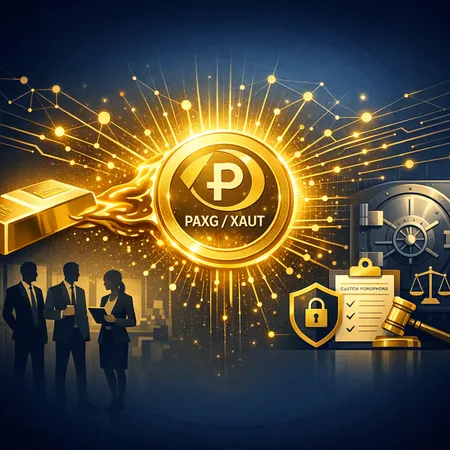
PAXG and XAUT are two of the best‑known tokenized gold tickers. Each aims to represent a claim on physical gold, but they differ in governance, issuer, and operational details. Investors should avoid treating ticker parity as product parity — redemption mechanics, audit cadence, storage arrangements and insurance levels differ by issuer.
- PAXG (Paxos Gold): Marketed as a token where each unit represents a specific amount of physical gold stored in vaults and redeemable for allocated bullion. Paxos publishes attestations and works with regulated entities.
- XAUT (Tether Gold): Tether’s gold token that likewise claims to represent physical ounces held in custody, and has liquidity on many centralized exchanges.
Beyond these, several newer tokenized gold products and tokenized commodities are emerging. The market now includes instruments with on‑chain governance, pooled tokens, fractionalized bullion and wrapped versions for cross‑chain use.
Custody and operational risks — what really matters
Tokenized gold’s promise depends on real‑world mechanics. The most important operational questions a wealth manager should ask:
- Is the underlying gold auditable and allocated? Allocated, LBMA‑grade bars with serial numbers are materially different from unallocated holdings. Regular, independent attestations are critical.
- Who holds the custody contractually? Good practice is an independent, insured custodian separate from the token issuer. Ask for custodian names, insurance terms and vault locations.
- What is the redemption process? Can token holders redeem on a 1:1 basis for physical bullion, and what fees, minimums and lead times apply? Some tokens are primarily transferable instruments and have restrictions on physical redemption.
- Are audits and attestation reports public and frequent? Monthly or quarterly third‑party attestations reduce opacity.
- Smart contract and bridge risk: If a token is wrapped, bridged or issued on multiple chains, cross‑chain bridge contracts can be an additional point of failure.
Custody is the bridge between the on‑chain token and the real asset. Weakness at that junction converts a nominally safe asset into an operationally risky instrument.
Regulatory and compliance considerations
Tokenized commodities sit at the intersection of commodity law, payments, and securities regimes — the legal classification can vary by jurisdiction. Practical points for compliance teams:
- KYC/AML implications: Many token issuers and platforms require KYC for on‑chain minting/redemption and for large OTC trades.
- Regulatory classification: In some regions tokenized gold is treated like a commodity or currency; in others regulators may assert securities or payments oversight. This affects custody rules and permissible client offerings.
- Tax treatment: Redemption vs secondary‑market transfers may trigger different tax events depending on local rules.
- Sanctions and counterparty screening: Custodians and issuers must implement screening. Wealth managers should verify provider policies.
Given these moving parts, institutional onboarding often requires legal sign‑off, tax modeling, and creating custodian/legal opinions as part of the investment approval.
How crypto‑native and traditional investors are positioning
Crypto‑native players tend to view tokenized gold as collateral and liquidity tooling. They leverage it in lending protocols, automated market‑maker (AMM) pools, and structured yield strategies. For these users, the most important attributes are on‑chain liquidity, low slippage, and composability with DeFi primitives.
Traditional investors — family offices, wealth managers and HNWIs — are more focused on the asset characteristics. They evaluate whether tokenized gold replicates bullion’s scarcity, redeemability, and storage assurances. Some allocate a small, defined portion of portfolio gold exposure to tokenized products for settlement efficiency and cost—especially when exposures must be transferred cross‑border or tokenized as collateral.
Crypto‑native and traditional flows are complementary: DeFi creates consistent on‑chain demand for high‑quality collateral, while traditional capital brings large, patient pools that increase overall market depth.
Practical routes to access tokenized precious metals
Wealth managers and investors have several options, each with tradeoffs:
- Centralized exchanges and custodial wallets: Quick access and liquidity, but counterparty risk rests with the exchange. Good for tactical exposure, not long‑term custody unless exchange is well vetted.
- Direct issuance platforms and trusted token issuers: Buy tokens directly from issuers or authorized dealers and keep them in self‑custody or institutional custodial wallets. This offers clearer redemption pathways and more direct auditing.
- Over‑the‑counter (OTC) desks: Useful for large blocks to minimize slippage and negotiate settlement terms, but require KYC and counterparties.
- DeFi liquidity pools and wrappers: Provide yield and composability, but introduce smart contract and impermanent loss risks. Prefer audited pools with reputable auditors and established TVL.
- Custodial institutional services: Specialized crypto custodians or integrated precious metals custodians that support tokenized holdings combine regulated custody with on‑chain access.
A practical onboarding sequence: 1) pick a strategy (hold vs use as collateral); 2) choose issuer(s) with frequent attestations; 3) verify custodian insurance and redemption mechanics; 4) pilot with a small allocation; 5) integrate tax and compliance workflows.
A due‑diligence checklist for wealth managers
- Issuer transparency: Public attestations, proof of reserves, legal disclosures.
- Custodian quality: Separate custody agreements, insurance coverage, vault locations.
- Redemption mechanics: Fees, minimums, timelines, and documentation required.
- Regulatory stance: How local regulators view tokenized commodities and whether the issuer has legal opinions.
- Smart contract security: Audits, bug bounties, multi‑sig custody of minting keys.
- Liquidity & counterparty exposure: On‑chain volumes, exchange listings, OTC availability.
- Operational flow tests: Reconcile small redemption and transfer to ensure end‑to‑end processes work.
Portfolio sizing and risk management
Treat tokenized gold as you would a specialized fund exposure. Start with conservative sizing (for many managers, single‑digit percentages of total portfolio commodities or 1–3% of net worth depending on risk tolerance). Monitor on‑chain indicators (transfer volumes, wallet concentrations, TVL in tokenized gold pools) and set stop‑loss / rebalancing triggers tied to redemption frictions or custodian changes.
Final thoughts: why this matters now
Tokenized commodities have moved beyond theory into measurable scale — the $6.1B figure signals market depth that can support institutional use. High‑profile flows into gold tokens accelerated attention and liquidity, but the value proposition isn't universal: tokenized gold can be a hedge, a collateral instrument, or a yield factory depending on how it's used. That flexibility is powerful — and it also demands rigorous operational and regulatory due diligence.
For wealth managers and crypto investors building a framework on tokenized commodities, the sensible path is a disciplined, checklist‑driven approach: assess custody, redemption, audits and legal standing before scaling allocations. Platforms across the industry, and even services like Bitlet.app in the P2P and installment space, will increasingly integrate RWAs — but managers must still translate that convenience into robust controls and clear client disclosure.