Why ENS Halted Namechain L2 and Chose ENSv2 on Ethereum L1 — A Playbook for Builders
Summary
Executive snapshot
ENS’s recent announcement to halt Namechain L2 work and deploy ENSv2 exclusively on Ethereum L1 reframes a debate many teams have had for years: when does L1 become the right home for systems that once seemed to need rollups? ENS cited falling gas costs and a Fusaka-driven increase in gas capacity as primary motivators; taken together these changes shrink the economic gap between L1 and some L2s for identity workloads. This investigation explains the technical and economic rationale, unpacks the implications for Ethereum scaling, and gives practical guidance for product leads and Web3 architects weighing where to build in 2026.
What ENS announced — the facts
In their public statement ENS said they would stop Namechain L2 development and proceed with ENSv2 on Ethereum L1. The project framed the decision around two levers: lower average gas costs and a higher per-block gas limit after protocol-level changes attributed to Fusaka, which increases the on-chain bandwidth available for transactions. The announcement is the clearest, high-profile example so far of a major identity system choosing L1 for its next-generation rollout rather than layering on a rollup.
For context on the announcement, see the reporting that summarized ENS’s stated reasoning: ENS to deploy ENSv2 exclusively on Ethereum, halts Namechain L2 development.
Why ENS’s reasons matter technically and economically
Falling gas costs and increased block capacity
Gas price is the immediate economic friction for on-chain interactions. When average gas costs fall, the per-operation fee for writes (like name registrations, updates or resolver writes) declines in real economic terms. Separately, changes that raise the network's effective per-block gas capacity — which ENS attributes to Fusaka — permit more stateful operations per block without driving immediate congestion. Combined, these two effects reduce the gap between L1 and L2 for workloads that are write-light but latency-sensitive.
A market-side view that complements ENS’s technical rationale is that Ethereum usage and scaling improvements have made L1 more attractive: industry commentary suggests Ethereum is more active and has improved scaling characteristics in recent cycles, which helps explain why some teams re-evaluate an L1-first option (The Motley Fool analysis on Ethereum).
The cautionary counterpoint: thin liquidity and price sensitivity
Lower gas costs don't fully eliminate risk. On-chain liquidity and miner/validator economics can change — and some analyses point to thin liquidity or volatility in on-chain markets that could make costs spike again under stress. One recent piece warns that metrics like ETH supply and market depth can produce instability that still makes L1 deployments risky under certain circumstances (AmbCrypto on ETH supply and instability). In short: lower baseline fees help, but they don't remove tail risks.
What this implies about Ethereum scaling right now
ENS’s choice is a signal: improvements in L1 bandwidth and cheaper average gas can change architectural calculus for some classes of dApps — notably identity/name services. But there’s nuance:
- Security vs. cost: L1 remains the canonical security boundary. For identity systems where long-term verifiability and censorship-resistance matter, L1’s finality and battle-tested validator set are compelling.
- Elastic demand and tail events: L1 pricing is still exposed to spikes when demand surges. Teams must plan for worst-case cost scenarios even if averages look good.
- Evolving spectrum not binary: The scaling landscape now looks less like "L1 too expensive" vs "L2 solved everything" and more like a continuum where application characteristics (write frequency, access patterns, composability needs) define the right choice.
For many teams, Ethereum is regaining appeal for primitives that need ironclad security and simple UX rather than extremely high throughput.
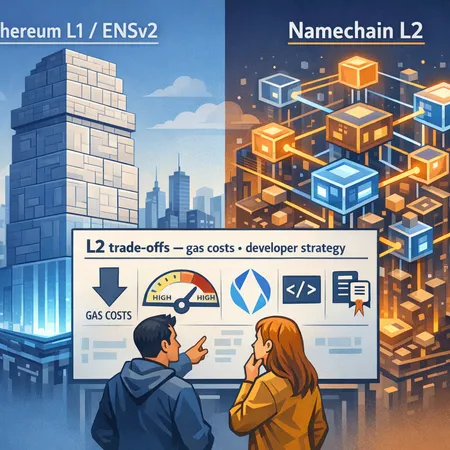
L1 vs L2 trade-offs for identity and naming systems
Identity and name systems have particular constraints that affect the L1/L2 choice.
Advantages of L1 for ENS-like systems
- Security and finality: Names and identity mappings are canonical state that benefit from the highest security assumptions. L1 reduces trust complexity.
- Composability and discoverability: On-chain name records deployed on L1 are universally addressable by wallets, explorers and other contracts without cross-rollup plumbing.
- Simpler UX for end users: No need to manage bridged assets or L2-specific wallets for basic name interactions.
Advantages of L2s for identity-like workloads
- Lower per-op cost (typically): For heavy write patterns, or when batching is available, rollups can still offer much lower marginal costs.
- Throughput and parallelism: L2s can sustain higher write volumes, enabling near-instant, low-cost user experiences at scale.
- Experimentation surface: L2s enable novel UX models — social recovery flows, micro-transactions for name features, etc. — at economic prices.
Practical trade-offs that matter
- Resolution speed vs. consistency: L2 state needs reconciliation with L1; names with legal or financial implications may prefer the simpler consistency model of L1.
- Upgrade and governance paths: Upgrading resolver logic or migration paths is operationally simpler when everything lives on L1.
- Interoperability costs: If your product needs to talk to DeFi stacks or other rollups frequently, being on L2 reduces friction; otherwise L1 may be simpler.
Developer tooling and operational implications
Shifting from an L2-first plan to L1 (or vice versa) has concrete tooling impacts.
- Tooling maturity: L1 has the broadest support from wallets, indexers, analytics providers and infra. That reduces integration work and long-term maintenance.
- Observability and debugging: Tracing and block-explorer behaviour is more mature on L1; some L2-specific tracing tools lag behind.
- Testing surface: L2s often require emulating rollup-specific failure scenarios (sequencer downtime, exit delays). L1-focused development simplifies the test matrix but increases the need for gas-efficiency testing.
- SDK and resolver design: For ENSv2, contract designs that assume L1 gas characteristics can use richer on-chain indexing patterns. If you planned for L2 gas assumptions, you may need to revisit gas budgets and batching logic.
Developer strategy keywords to keep front-of-mind: ENSv2, Namechain, L2 trade-offs, gas costs, developer strategy.
Will other projects reverse L2 plans or double down on rollups?
Expect a mixed market response.
- Who might reverse L2 plans? Projects where security, cross-app composability and simple UX are primary — wallets, registries, attestation factories and some identity systems — are likeliest to reconsider L1. ENS is a bellwether because name registries are fundamental, highly composable primitives.
- Who will double down on L2s? High-throughput consumer apps, games, micropayment platforms, and complex DeFi rails that need predictable low marginal costs still have a strong economic case for rollups. L2 innovation (zk-rollups, OP stacks, modular sequencers) continues apace and will keep driving differentiation.
In short: one major L1 pivot does not close the L2 story. It refines it. Teams will choose based on latency, cost profile and the value of L1 security for their threat model.
Tactical decision checklist for product leads and Web3 architects
If you’re deciding where to deploy in 2026, use this pragmatic checklist.
- Measure expected on-chain write profile
- Model per-user and peak write rates, not just averages. Simulate price spikes and batching opportunities.
- Define your security and trust model
- Is L1-level finality required? Are sequencer censorship or exit delays acceptable risks for your users?
- Cost-sensitivity and UX trade-offs
- Do users tolerate bridged assets or L2-specific wallets? Is gas predictability more important than average cost?
- Compose vs. isolate
- Will your contract need to interact frequently with L1-native DeFi, or will most rails live in an L2 ecosystem?
- Tooling and operational load
- Inventory the infra you'll need: indexers, relayers, rollup-specific monitoring, bridging safeguards. Estimate engineering and O&M costs.
- Plan migration and upgrade paths
- Design contracts and resolver patterns so that you can migrate or shard functionality if future economics change.
- Run pilot flows with real traffic
- Before committing, run a controlled pilot on mainnet L1 and on target L2(s) to measure latency, cost and user friction.
Practical pattern: favor a hybrid approach where core canonical state (e.g., authoritative name records) lives on L1 while high-volume, ephemeral interactions (UI customizations, social features) run on an L2 or even an app-specific sidecar. This pattern preserves security while capturing the scalability benefits where they matter.
Example architecture sketches (brief)
- L1-first canonical: Registrar and primary resolver on L1; feature flags, ephemeral metadata and high-frequency operations on a chosen L2. Clients read canonical names from L1 and fetch fast attributes from the L2.
- L2-first with L1 anchoring: Resolve names and perform fast interactions on L2, but anchor checkpoints or final settlement on L1 at scheduled intervals. This reduces cost while preserving long-term verifiability.
Final recommendations
- Don’t treat ENS’s decision as a universal prescription. Use it as data: the L1 economics have shifted enough that some identity workloads should re-evaluate assumptions.
- Build decision frameworks, not bets: cost models, threat models and interoperability requirements should govern the choice more than platform fashion.
- Embrace hybrid designs and keep migration paths clean. Today’s gas environment may be different tomorrow.
A practical note for teams building payments or subscription flows: services like Bitlet.app show how business models can be layered on both L1 and L2 rails; think about where your monetization and user friction align.
Conclusion
ENSv2’s move to L1 underscores a maturing Ethereum where improved on-chain capacity and lower average fees change deployment calculus for certain primitives. But it’s not the end of L2s — rollups remain essential for high-throughput, low-cost experiences. For product leads and architects, the right response is measured: model costs and risks, design hybrid architectures, and keep tooling and migration plans flexible.
Sources
- ENS to deploy ENSv2 exclusively on Ethereum, halts Namechain L2 development — https://news.bitcoin.com/ens-to-deploy-ensv2-exclusively-on-ethereum-halts-namechain-l2-development/
- Ethereum is more popular than ever — should you invest? — https://www.fool.com/investing/2026/02/09/ethereum-is-more-popular-than-ever-should-you-inve/
- Ethereum supply falls to 2016 levels — is ETH’s market unstable? — https://ambcrypto.com/ethereum-supply-falls-to-2016-levels-is-eths-market-unstable/