Why Ethereum Is Moving zk‑Proofs to the Base Layer: EIP‑8025, L1‑zkEVM and SEAL Explained
Summary
Executive overview
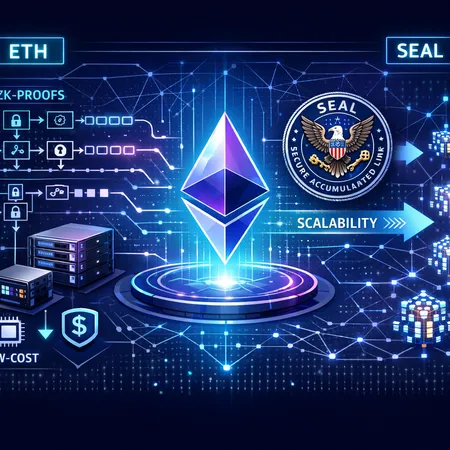
Ethereum’s core developers and research community are advancing a simple but profound shift: move validation work off the validator and into cryptographic proofs. Instead of every validator re‑executing all transactions to check a block, a small verifier can cheaply check a succinct proof that the block transition was computed correctly. That is the mental model behind L1‑zkEVM and related proposals such as EIP‑8025. The February L1‑zkEVM workshop clarified how this could be implemented in practice, and the Ethereum Foundation’s backing of SEAL indicates that the project is thinking seriously about the security and ecosystem risks that come with that change.
For engineers and product leads, the immediate payoff is obvious: cheaper, faster validation and lighter validator hardware. But the tradeoffs—prover economics, potential centralization of prover infrastructure, tooling and consensus integration—are nontrivial. This article walks through the technical case for zk‑based block validation, what the workshop revealed, how SEAL fits into the roadmap, and the downstream implications for scalability, decentralization and AI on Ethereum.
The technical case for zk‑based block validation
From re‑execution to verification
Today, block validation on Ethereum requires full or partial re‑execution of transactions by validators and full nodes. That means CPU cycles, memory for the EVM, and significant I/O for state reads/writes. A zk‑based approach swaps heavy computation for a small verifier: a prover performs the expensive computation once (or in batched/recursive fashion) and emits a succinct proof (a SNARK/STARK) that a particular state transition is correct. Validators then run a verifier, typically orders of magnitude cheaper than full re‑execution.
This architecture separates two roles: provers (heavy compute, generate proofs) and verifiers (lightweight, check proofs). In practice, provers could be specialized hardware/cloud services while validators remain widely distributed and inexpensive to run.
Key cryptographic patterns
There are a few common primitives in play:
- SNARKs/STARKs: succinct validity proofs with fast verification but differing trust/setup and performance tradeoffs.
- Recursive proofs: allow compressing many proofs into one, enabling batched verification across blocks or epochs.
- EVM compatibility layers: techniques to prove native EVM semantics (opcode‑level proofs) versus proving higher‑level state transitions (e.g., calldata → state root). L1‑zkEVM efforts focus on maintaining EVM semantics while leveraging zk proofs to avoid breaking existing tooling and smart contracts.
These patterns enable validators to accept a block after verifying a short proof, which reduces latency for new validators and speeds up chain synchronization and finality verification.
EIP‑8025 & the L1‑zkEVM workshop: practical design signals
The recent L1‑zkEVM workshop and previews around EIP‑8025 moved the conversation from theoretical promise to practical integration. The workshop highlighted several concrete areas:
- Implementation strategies for integrating a proof‑verification step into block validation without disrupting consensus and client diversity.
- Options for how proofs are packaged with blocks (on‑chain vs. proposer‑provided attachments) and how clients should handle optional vs. mandatory proofs.
- Performance targets and where hardware acceleration might be required for provers.
A preview of the workshop and the EIP’s potential role showed that developers are leaning toward incremental integration paths that preserve existing client behavior while enabling opt‑in or mandatory proof verification down the line. For a useful synopsis, see the L1‑zkEVM workshop preview and EIP‑8025 discussion. (Details and the workshop agenda were discussed in previews like this one.) Source: workshop preview and EIP‑8025 discussion.
How zk validation reduces validator hardware requirements and costs
Where the savings come from
Validators today must:
- Reexecute all transactions in a block (CPU-bound),
- Maintain and access a large in‑memory or on‑disk state trie (RAM + I/O),
- Run full EVM semantics and precompile logic (software complexity).
With zk validation, most of that per‑block compute is offloaded to the prover. The validator’s responsibilities shrink to: verify a mathematical proof, apply state diffs (which can be optimized), and perform normal consensus duties (attestation, gossip, slashing). Verifier work is typically a small number of elliptic curve operations or field arithmetic, so a validator can run on far less CPU and often less RAM, improving accessibility for validators on commodity hardware.
Quantifying cost and sync improvements (order‑of‑magnitude thinking)
Benchmarks vary by zk system, but relative measures are instructive: proof verification can be 100–10,000x cheaper in total CPU cycles than full re‑execution of the same transactions. Sync times that today require hours or days for a new node could drop to minutes for a verifier that trusts proofs. That reduces the barrier to becoming a validator and increases validator churn resilience.
Economic implications
Lower hardware requirements reduce fixed costs, enabling more nodes and better distribution of stake. However, proving itself costs—large GPU/TPU or cloud clusters, or specialized ASICs. That creates an economic division: cheap validators + expensive provers. Careful incentive design is required (prover markets, fees, slashing conditions, or decentralization subsidies) to avoid concentrating prover capacity in a few operators.
SEAL and the security roadmap: why the Ethereum Foundation’s backing matters
SEAL, backed by the Ethereum Foundation, is a security alliance intended to coordinate efforts to reduce protocol and user‑level risks as the base layer evolves. SEAL’s remit includes shared tooling, threat intelligence, coordinated audits, and standard practices for new primitives (like zk proofs).
Why is that important? Introducing a prover/verifier split creates new threat surfaces: compromised provers could submit false proofs (if there are bugs in the proving system), buggy recursive composition could yield catastrophic state corruption, and operational patterns (e.g., centralized prover pools) could be attacked or coerced. SEAL helps by:
- Standardizing proof validation patterns and client behaviors,
- Coordinating audits and formal verification for prover implementations,
- Developing incident response playbooks and responsible disclosure routines.
The Foundation’s support for SEAL signals that the community expects systemic changes and wants infrastructure to reduce correlated risks. Coverage of EF’s backing of SEAL provides the initial context and community reaction see coverage here.
Downstream implications: scalability, decentralization and AI
Scalability and throughput
At an architectural level, zk‑validated blocks do not magically increase transactions per second by themselves, but they drastically shrink validation overhead. That means:
- Faster block validation and lower finality latency in practice, especially for nodes joining the network.
- Easier integration of higher‑throughput execution layers (L2s) because the L1 becomes cheaper to validate and verify.
- Recursive aggregation strategies could compress many L2 proofs into succinct L1 proofs, improving overall system throughput.
This is good for applications: lower cost to validate means lighter clients and broader participation of economic clients (oracles, relayers, indexers).
Effects on decentralization
Lower validator hardware requirements are pro‑decentralization—they allow smaller operators and new entrants to run validators. But prover centralization is the countervailing risk: if only a few entities can cost‑effectively generate proofs, they could gain outsized influence over block acceptance timing or even attempt censorship through proposer mechanisms. SEAL and protocol design need to mitigate this with incentives, client diversity, open prover implementations and possibly on‑chain economic measures.
New primitives for AI and verifiable compute
Vitalik Buterin and others have outlined ways Ethereum can interoperate with AI using privacy‑preserving, verifiable interactions. zk proofs at the base layer create primitives for verifiable compute—an on‑chain verifier can accept a proof that a private model produced an output without revealing model internals or raw data. That opens paths for:
- Verifiable oracles that attest to complex ML inference,
- Private, auditable AI outputs for financial products,
- Reputation and accountability systems where model behavior is provably constrained.
Vitalik’s framework for how Ethereum intersects with AI and private/verifiable AI interactions provides a conceptual map for these opportunities and was recently discussed in detail in public forums read more about that framework here. Practical adoption depends on making ML proofs tractable (a work in progress) and building prover stacks that can handle model execution cost‑effectively.
Implementation challenges and open questions for engineers
- Prover economics and marketplace design: who pays for proofs, and how are provers rewarded or penalized?
- Client integration: how to add proof verification paths to multiple clients without breaking consensus or client diversity?
- Prover centralization: what antitrust/economic safeguards and open‑source efforts are necessary to avoid single‑point concentration?
- Compatibility with existing tooling and EVM semantics: are we proving opcode semantics or higher‑level state transitions?
- MTBF and resilience: how will proofs be reissued or challenged if a prover goes offline or emits buggy proofs?
The L1‑zkEVM workshop wrestled with many of these questions and narrowed some paths forward, but multiple research and engineering milestones remain before the design is ready for a hard fork recommendation. For a wider view of the Ethereum community’s plan to use zk‑proofs for faster block validation and architectural change, see this reporting and analysis here.
What product teams and protocol engineers should do now
- Prototype for both roles: test a lightweight validator that only verifies proofs, and a prover stack that generates real‑world proofs for common transactions.
- Engage with SEAL and community security coordination to align testing, audits and response playbooks.
- Model economics: simulate prover operating costs, validator incentives, potential fee structures and market concentration risk.
- Track client proposals and the evolution of EIP‑8025 and related EIPs; design for backward compatibility and opt‑in where possible.
Platforms that bridge users and protocol primitives, such as custodial or hybrid custody services, and services like Bitlet.app, will need to rework sync, validator monitoring and proof‑handling logic as these features move closer to mainnet feasibility.
Conclusion
Moving zk‑proofs to the base layer is not a silver bullet, but it is one of the most plausible routes to make Ethereum cheaper to validate, faster to sync, and more flexible for advanced use cases like verifiable private AI. The L1‑zkEVM workshop and EIP‑8025 preview showed concrete engineering routes and tradeoffs; SEAL’s backing shows the community is taking the attendant security risks seriously. The next 12–24 months will be about prototyping, economic design and standardization: expect iterative upgrades and close coordination between researchers, client teams, prover operators and security alliances.
Sources
- https://beincrypto.com/ethereum-zk-proof-eip-8025-integration/
- https://coinpedia.org/news/ethereum-plans-major-upgrade-to-use-zk-proofs-for-faster-block-validation/
- https://bitcoinist.com/ethereum-foundation-backs-seal-liquidchain-boom/
- https://www.benzinga.com/crypto/cryptocurrency/26/02/50502216/ethereums-intersection-with-ai-vitalik-buterin-shares-new-vision-for-how-the-two-technologi?utm_source=benzinga_taxonomy&utm_medium=rss_feed_free&utm_content=taxonomy_rss&utm_campaign=channel&utm_source=snapi