Stablecoin Risk After USD1’s Surge: What Treasurers Must Know
Summary
Overview: an inflection point for stablecoins
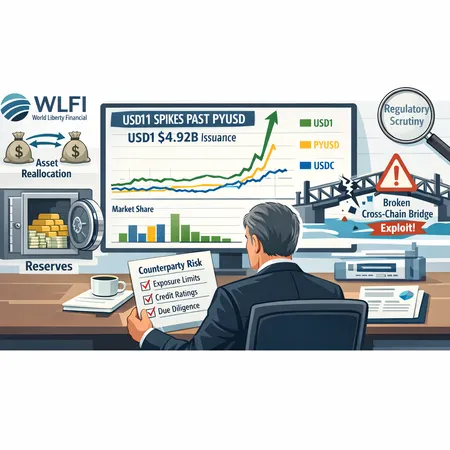
The stablecoin landscape is shifting fast. USD1’s issuance recently hit $4.92B, briefly overtaking PayPal’s PYUSD in market size — a milestone that signals rapid product-market fit but also concentrates attention on centralized issuer practices and reserve mechanics. For corporate treasurers and compliance officers, that combination of fast adoption and opaque operational choices raises practical questions: which stablecoins are appropriate for liquidity, payments, and corporate balance‑sheet exposure; how to assess counterparty risk; and how to structure cross‑chain custody without inheriting hidden liabilities.
This article walks through the market implications of USD1’s rise, examines how issuer and investor behavior (including World Liberty Financial’s reallocations) is reshaping treasury strategy, analyzes the Swapnet/USDC exploit and criticisms around issuer responses, and gives a tactical checklist for treasury teams and exchanges.
What USD1’s rapid rise means for market structure
USD1’s $4.92B issuance milestone is not just a vanity metric; it changes supply dynamics and liquidity distribution across rails. A larger issuance usually translates into deeper on‑chain liquidity, tighter spreads on DEXs, and greater acceptance in payment rails and custodial integrations. But it also concentrates systemic exposure: when one issuer grows fast, counterparties that route payments or hold treasury balances through that stablecoin accumulate correlated issuer risk.
From a market‑share perspective, USD1 overtaking PYUSD signals that enterprises, wallets, and onboarding partners are willing to shift real flows quickly when a product offers better settlement terms, integrations or perceived stability. That competition among issuers can be healthy — it drives innovation in redemption mechanics, fee structures, and custody options — but it also accelerates the pace at which treasuries must re‑assess exposures.
For many participants, the result is a two‑edged sword: more options and deeper liquidity, but higher operational tempo and the need for more granular counterparty analysis. For on‑chain native actors this is familiar territory; for traditional corporate treasurers, it demands new processes and vendorier diligence.
Issuer behavior, treasury reallocations, and the World Liberty example
Corporate treasuries and institutional investors are not passive owners of stablecoins; they actively reallocate based on perceived issuer strength, yield, and market access. The case of World Liberty Financial redirecting an $8M flow and reshaping its Bitcoin‑linked exposure into Ethereum is a useful microcosm of how treasury behavior can amplify market changes. That move, and announcements like it, influence other firms’ decisions and can create momentum around a particular ticker such as WLFI or USD1.
Practical takeaway: when a major corporate changes rails or assets, it can be both a signal and a catalyst. Treasurers should parse the rationale behind reallocations — are they driven by counterparty concerns, regulatory arbitrage, better settlement rails, or macro hedging decisions? — and avoid reflexive copycat moves.
World Liberty’s activity shows how issuer and investor choices interplay: institutional flows can lift an issuer’s effective market footprint quickly, but they also create concentrated exposure that needs active governance at the corporate level.
The Swapnet/Base hack and USDC criticism: centralized risks spotlighted
Recent incidents such as the Swapnet/Base exploit and related USDC flows exposed another uncomfortable truth: centralized stablecoins bring centralized points of failure and political/operational friction. The Swapnet hack, combined with critiques of issuer (USDC’s) responsiveness, reignited debates over how issuers act during exploits, transparency of reserves, and cross‑chain custody arrangements.
When a bridge or protocol on Base suffered an exploit, the apparent delay or rigidity in issuer responses raised questions: who bears the loss, how quickly can redemptions be processed on compromised rails, and how does an issuer’s governance or legal posture change the effective risk for custodians and corporates holding that stablecoin? The incident also highlighted that an issuer’s reactive posture — whether proactive clawbacks, freezing addresses, or refusing to engage — materially affects counterparty risk and reputational outcomes.
The broader lesson is that centralized stablecoins reduce certain settlement and liquidity risks but introduce concentrated operational and governance risk. That tradeoff must be modeled explicitly by treasuries.
Key risk vectors for centralized stablecoins
Reserves and transparency: frequency and granularity of attestations, nature of reserve assets (cash, commercial paper, treasuries), and custody arrangements for reserves.
Redemption mechanics: population‑level redemptions vs. retail rails, minimums, settlement delays, and off‑ramp counterparty constraints.
Legal and governance tools: contract terms that allow freezing or reversals, governance procedures for emergency action, and the issuer’s regulatory posture.
Cross‑chain custody and bridges: wrapped tokens, canonical tokens on multiple chains, and reliance on custodians or relayers that can fail or be compromised.
Issuer behavior under stress: historical responsiveness to incidents, speed of communications, willingness to reimburse losses, and clarity around indemnities.
Each of these vectors matters differently for a payments rail versus a liquidity reserve on the balance sheet. Assess them with context.
Practical guidance: a checklist for treasurers and exchanges
1) Due diligence on reserves and attestations
Demand audit cadence and quality. Prefer issuers who publish frequent, third‑party attestations with line‑item detail and clear custody relationships for reserve assets. Ask whether reserves are truly liquid cash or instruments that could face haircuts in stress. USD1’s rapid growth makes this a non‑trivial point: size brings scrutiny — and you want evidence, not PR.
2) Understand redemption mechanics and service level agreements (SLAs)
Test redemption flows in controlled amounts. Measure settlement times, counterparty requirements, and any off‑ramp fees. Are institutional redemptions available, and what legal agreements (e.g., bilateral custody or master services agreements) govern them? A coin with great on‑chain liquidity but poor off‑chain redemption processes may trap cash in stressed markets.
3) Model issuer behavior during incidents
Review historical incident response. Did the issuer freeze accounts, coordinate with law enforcement, or reimburse users? The Swapnet/USDC incident illustrated how issuer inaction or slow coordination amplifies losses. Incorporate scenario analysis that quantifies potential losses under varying issuer response profiles.
4) Cross‑chain custody and bridge risk controls
If you operate multi‑rail, prefer canonical tokens over wrapped representations where possible. When wrapping is unavoidable, limit exposure and ensure the custodian or bridge operator has audited code, adequate insurance, and transparent multisig or governance arrangements. Factor in recovery timelines and legal jurisdiction issues for each bridge.
5) Contractual protections and legal recourse
Negotiate contractual SLAs and indemnities with custodians and issuers where feasible. Define responsibilities for frozen funds, recovery attempts, and communications protocols. For large corporate exposures, consider escrow arrangements or segregated custody that minimize commingling risks.
6) Diversify rails and counterparties — but avoid needless complexity
Diversification reduces single‑issuer concentration risk but increases operational complexity. Maintain a small basket of stablecoins with complementary settlement rails (e.g., one issuer with strong on‑chain liquidity, another with robust institutional redemption processes). Use clear internal playbooks for switching rails under stress.
7) Real‑time monitoring and reconciliation
Implement continuous monitoring of on‑chain balances, reserve attestation updates, and public communications from issuers. Automate reconciliation to flag anomalous outflows or freezes quickly; time is critical in exploit scenarios.
8) Regulatory and compliance alignment
Ensure chosen stablecoins and issuers align with your jurisdiction’s regulatory expectations. Some issuers are more proactive in regulatory engagement; others operate in gray areas. Your compliance function should sign off on acceptable issuers and track policy shifts.
Putting it together: an example allocation framework
A simple, pragmatic approach for corporates: limit single‑issuer exposure to a policy threshold (for example, 20–30% of crypto liquidity), keep a portion of reserves in highly liquid fiat lines, and use multiple rails for incoming and outgoing payments. Pair this allocation with monthly reserve reviews, quarterly legal review of contracts with issuers/custodians, and annual tabletop exercises that simulate an issuer freeze or cross‑chain exploit.
Also consider operational integrations: connect treasury systems to block explorers and custody APIs, and limit automated sweeps into a single stablecoin unless an internal sign‑off process exists.
Final thoughts: adoption, not blind faith
USD1’s ascent past PYUSD underscores that market share in stablecoins can change quickly. That speed is a feature of crypto markets — but it doesn’t absolve treasurers from performing old‑fashioned diligence. Centralized stablecoins bring convenience and liquidity, yet recent exploits and issuer responses show the real cost of centralization: governance and operational risk concentrated in a few entities.
Treasurers and compliance officers should treat stablecoin selection like any counterparty choice: analyze reserves, test operational flows, model adverse scenarios, and build contractual and technical mitigations. By doing so, organizations can harness benefits from modern rails while limiting exposure to the centralized stablecoin risks that recent events have exposed.
Bitlet.app’s suite of tools can fit into these workflows as one of many integrations that help monitor on‑chain exposure and liquidity across rails.
Sources
- USD1 issuance reached $4.92B and surpassed PYUSD: Bitcoin.com reporting
- World Liberty Financial shifting $8M and reallocating assets: Coincu report
- Swapnet/Base hack and USDC exploit: DailyCoin coverage
For context on how on‑chain liquidity and market signals influence treasury behavior, many treasurers also track developments in Bitcoin and broader DeFi infrastructure.