Stablecoin Infrastructure in Asia: A Treasury Guide to USDC Payouts and On‑Chain Liquidity
Summary
Why Asia matters for stablecoin payouts
Asia is a mosaic of payment systems, regulatory regimes, and real-time liquidity needs. For corporate treasurers, that mix creates both an incentive and a headache: move liquidity faster and cheaper with stablecoins, and you must also navigate a complex patchwork of compliance, banking relationships, and on‑ramp/off‑ramp availability. In practice, the question is not whether stablecoins will be used for payouts in APAC, but how — and by whom.
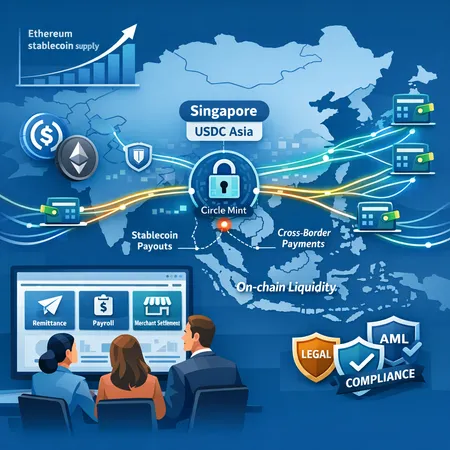
Two recent developments are reshaping the answer. First, Circle launched a Singapore mint and payout offering that lets partners receive compliant USDC payouts across Asia. That change lowers operational friction for firms needing local fiat conversions and regulatory assurance. Second, the aggregate supply of stablecoins on the Ethereum mainnet has reached record levels, increasing on‑chain liquidity for settlement and DeFi primitives. Together, these trends push stablecoins closer to mainstream corporate rails.
Circle Mint Singapore: what it is and why it matters
Circle’s Singapore mint/payout service establishes a local issuance and disbursement point for USDC within the region. According to reporting, Circle Mint Singapore enables partners to receive USDC‑based payouts across Asia with compliance and settlement options tailored to local markets (Blockonomi report).
Operationally, this does three important things for treasury teams:
- Reduces cross‑border friction by enabling regionally anchored USDC flows that can then be converted to local currency through licensed partners.
- Provides clearer compliance pathways — local minting and payout infrastructure is easier to pair with jurisdictional KYC/AML processes and banking integrations.
- Lowers settlement latency compared with traditional correspondent banking, especially for smaller, frequent payouts like payroll or merchant remittances.
For treasuries, that means a new option between legacy fiat rails and purely on‑chain, global USDC flows. It doesn’t eliminate the need for local banking partners, but it changes the shape of the integration: you can route payees to USDC disbursements that are then settled locally or paid out directly if recipients support on‑chain wallets.
Rising Ethereum stablecoin supply: On‑chain liquidity and DeFi implications
On the network side, stablecoin supply on Ethereum has climbed to new highs, increasing the available pool of settlement liquidity on the chain. Analysis highlighting that Ethereum’s stablecoin supply hit an all‑time high underscores a broader point: more USDC (and other stablecoins) on chain means larger nominal liquidity for DeFi markets, settlement rails, and merchant flows (crypto.news analysis).
That abundance of on‑chain USD‑denominated liquidity has several practical consequences:
- Deeper liquidity for settlement: Treasuries can route larger payouts through on‑chain swaps, DEX liquidity, or trusted OTC desks with less slippage. This makes stablecoins viable for higher‑value merchant settlement and batch payrolls.
- Faster reconciliation: On‑chain receipts provide immutable settlement records, reducing reconciliation time compared with multi‑leg bank transfers.
- Composability with DeFi rails: With more stablecoins on chain, it’s easier to program settlement logic — for example, automatic conversion to local stablecoins or routing via layer‑2s to reduce gas costs. This is where DeFi primitives can augment corporate workflows rather than replace them.
Be mindful, though, that higher stablecoin supply can increase competition for block space and push gas fees during congestion. For many treasury teams the solution will be a mix: use Ethereum where liquidity and tooling are strongest, and rely on layer‑2s or alternative chains for high‑frequency, low‑value disbursements.
Regulatory and compliance considerations for enterprise adoption
Moving payouts and settlements onto stablecoin rails changes the compliance checklist. Corporates must treat on‑chain rails as they would banking relationships — possibly even more strictly because the rails are global and near‑instant.
Key compliance areas to evaluate:
- KYC/AML and beneficiary screening: Ensure your payout flow enforces wallet KYC or pairs with a custodial/merchant partner that does. Circle’s regional payout capability helps here by combining local compliance with token issuance.
- Licensing and payments law: Different APAC jurisdictions treat digital asset services differently. Some require money‑transmitter licenses; others focus on merchant acquiring rules. Work with counsel to map obligations per market.
- Sanctions and transaction monitoring: On‑chain identities are pseudonymous; effective sanction screening requires integration with blockchain analytics and real‑time monitoring.
- Reserve attestations and issuer credibility: For USDC, Circle’s public attestations matter — counterparties and auditors will want to see proof that on‑chain USDC is backed as claimed.
- Custody, private key management and insurance: For corporates holding on‑chain balances, enterprise custody solutions or regulated custodians are usually non‑negotiable.
- Tax and accounting treatment: Stablecoin receipts and conversions may create taxable events depending on local rules; ensure your finance team documents cost bases and FX legs.
A pragmatic approach: run a compliance matrix that ties each target country to a clear set of requirements (licenses, KYC level, tax reporting, permitted counterparties). Platforms offering regional issuance — like Circle’s Singapore mint — simplify some of these controls by localizing regulatory touchpoints.
Practical use cases: remittance, payroll, and merchant settlement
Below are three near‑term rollout scenarios, with practical steps and considerations for each.
Remittances and supplier payouts
Why it fits: Cross‑border suppliers often need faster settlement than wire transfers provide, and they frequently operate in jurisdictions with limited fiat liquidity. USDC payouts let payers lock a USD‑equivalent value and let suppliers choose when to convert.
Operational steps:
- Onboard suppliers with KYC, preferred payout wallet type (custodial vs. self‑custody), and FX conversion preferences.
- Use a regional issuance/payout partner to create on‑ramp/off‑ramp options where suppliers prefer fiat.
- Decide routing: direct on‑chain USDC, or USDC → local stablecoin/fiat via a liquidity partner to reduce conversion steps.
Risk notes: Monitor counterparty credit for OTC conversion partners and set caps on single‑transaction settlement size until the rail is proven.
Payroll in multi‑jurisdiction Asia teams
Why it fits: Regular payroll schedules benefit from predictable settlement times and the option to avoid slow correspondent banking when employees accept crypto or can access local on‑ramps.
Operational steps:
- Offer employees an opt‑in for USDC payments, with clear documentation on taxes and conversions.
- Automate payroll generation on chain and pair with custodial providers that can handle withholding and local tax remittance.
- Provide a fiat fallback (bank deposit) where employees cannot receive or convert crypto.
Risk notes: Payroll implies fiduciary duty — always maintain robust reconciliation and ensure payroll gross‑to‑net calculations account for conversion fees and liabilities.
Merchant settlement and marketplace payouts
Why it fits: Marketplaces and merchants want near‑instant settlement without long float periods. USDC rails enable instant settlement and can reduce chargeback windows when integrated with custody partners.
Operational steps:
- Integrate payment APIs that accept stablecoins and offer automatic conversion to merchant fiat where needed.
- Leverage on‑chain receipts as settlement proof; reconcile daily and net positions via custodial partners.
- Use liquidity pools or OTC desks to handle larger merchant conversion volumes and price‑protect via limit orders.
Risk notes: Protect against price and liquidity shocks by setting slippage tolerances and pre‑allocating conversion buffers.
Implementation checklist and operational controls
Before production roll‑out, crypto payments teams should validate these items:
- Legal sign‑off on country‑level compliance matrix.
- Partner due diligence for issuers, custodians, and conversion desks.
- Technical integration tests for wallets, reconciliation APIs, and notification flows.
- Audit trail: immutable on‑chain receipts plus off‑chain records for payroll/tax purposes.
- FX and liquidity playbook: routing rules, slippage limits, and contingency fiat rails.
- Insurance and key‑management policy for any corporate hot wallets.
This is where platforms like Bitlet.app can sit in the ecosystem — offering integration and routing tools while leaving regulatory compliance in the hands of local partners.
Risk management, accounting, and treasury controls
Stablecoins reduce settlement risk but introduce crypto‑specific considerations:
- Operational risk: Private key exposure, smart contract vulnerabilities, and bridge risks require technical controls and third‑party assurance.
- Liquidity risk: Even with growing supply on Ethereum, idiosyncratic liquidity constraints can appear in specific corridors or at certain times. Keep FX buffers and preposition balances in high‑demand on‑chain assets.
- Accounting controls: Define clear policies for recognition, valuation, and hedging of on‑chain positions — and record conversion legs to prevent mismatches between book and tax outcomes.
A layered control model — policy, technical, monitoring — reduces the chance of surprise losses and keeps auditors satisfied.
Choosing the right rails: Ethereum, layer‑2s, and off‑chain issuance
Ethereum remains the principal settlement layer because of deep liquidity for USDC and rich tooling. For treasuries, that means easy access to DEX liquidity, OTC makers, and settlement finality. Reference to Ethereum is not accidental: its network effects matter.
But production deployments often blend rails:
- Use Ethereum mainnet for large, infrequent settlements where liquidity is critical.
- Use layer‑2s or rollups for high‑frequency, low‑value disbursements to control fees.
- Lean on localized issuance and payout services (for example, Circle’s Singapore offering) to simplify fiat conversions and compliance.
As on‑chain stablecoin supply grows, expect more institutional liquidity providers to quote competitive spreads — but also expect occasional gas‑driven cost spikes. Design routing rules that automatically switch between chains and partners when thresholds are met.
Recommendations for treasurers and payments teams
- Start with a narrow pilot (one corridor, one use case such as supplier payouts) and measure cost, speed, and reconciliation complexity.
- Use regional issuance partners to simplify local compliance and payout preferences.
- Build robust monitoring: on‑chain analytics for sanction screening, liquidity dashboards, and automated reconciliation with accounting systems.
- Keep fiat rails as a fallback and plan for gradual expansion once risk controls and partner SLAs are proven.
- Engage legal and tax counsel early — stablecoin rules vary widely across APAC and can change quickly.
Conclusion
The combination of Circle’s Singapore mint/payout capability and rising stablecoin supply on Ethereum is lowering the operational and liquidity barriers to on‑chain settlement in Asia. For corporate treasuries and crypto payments teams, the opportunity is real: faster settlement, clearer on‑chain records, and more flexible routing of USD‑denominated liquidity. But success depends on disciplined compliance, careful partner selection, and operational playbooks that account for on‑chain nuances.
If you’re evaluating a pilot, focus on one corridor, validate the compliance model, and test direct on‑chain receipts against local conversion partners — then scale.
Sources
- Blockonomi — Circle Mint Singapore now offers stablecoin payouts to partners across Asia: https://blockonomi.com/circle-mint-singapore-now-offers-stablecoin-payouts-to-partners-across-asia/
- Crypto.news — Ethereum price outlook as network stablecoin supply hits all‑time high: https://crypto.news/ethereum-price-outlook-as-network-stablecoin-supply-hits-all-time-high/