Cardano Whales vs Midnight: On-Chain Accumulation, Concentration Risk, Portfolio Moves
Summary
Executive snapshot
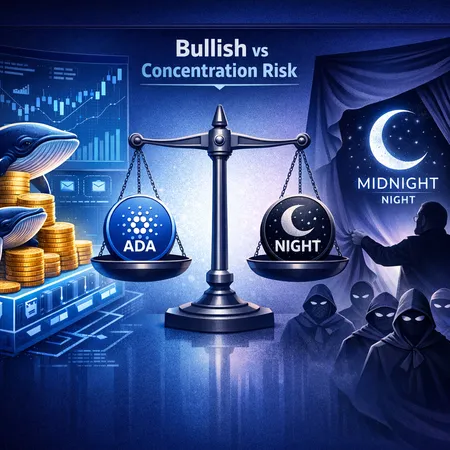
Cardano is back on investors’ radar for two distinct reasons: renewed on‑chain accumulation by large wallets and the launch of Midnight (NIGHT) — a privacy‑focused initiative led by Charles Hoskinson. Chain data and recent reporting suggest whales have been adding to positions, a bullish signal on the surface. But concentration of supply and the added strategic risk of a founder‑led new token complicate a simple “bull” narrative.
For many traders, Cardano remains the primary context for evaluating both the ADA market and the ecosystem bets that follow. This article examines the on‑chain evidence for accumulation, why that pattern is double‑edged, what Midnight is and why skeptics are vocal, and how investors might adjust portfolios accordingly.
On‑chain picture: accumulation, distribution, and what the data says
Two recent reports highlight clear on‑chain behavior: large wallets have increased holdings and accumulation has reached multimonth highs. Reporting from ZyCrypto notes a surge in whale wallets to a four‑month high while Coinpedia frames the move as accumulation at a critical price level for ADA. Both stories draw on on‑chain snapshots that show significant inflows into non‑exchange cold wallets and growth in addresses holding meaningful balances.
At the same time, Cardano’s network shows broad retail participation: the chain reports more than 10 million unique addresses holding ADA in some capacity. That level of retail distribution helps dilute simple narratives that ADA is concentrated solely in a few hands. Yet distribution is not uniform: a relatively small share of top wallets can still control a disproportionate slice of circulating supply, and recent analyses point to renewed concentration by addresses identified as whales.
Concrete on‑chain metrics worth tracking:
- Top‑wallet supply share (e.g., % of circulating ADA held by top 10/100 addresses).
- Exchange reserves (falling exchange balances often correlate with accumulation off‑exchanges).
- Growth in wallets above thresholds (e.g., addresses holding >100k ADA).
- Staking participation and locked supply figures (how much ADA is illiquid via staking/delegation).
ZyCrypto and Coinpedia both suggest these indicators moved meaningfully after February’s bottom in ADA, which helps explain price resilience and the renewed interest of large holders.
Why whale accumulation can be bullish — and why it’s risky
On the bullish side, whales buying ADA can create structural support for price:
- Reduced liquid supply: when large balances move into cold wallets or stake, tradable float tightens.
- Confidence signal: whale accumulation often signals professional participants perceive value, attracting momentum buyers.
- Liquidity sink: sustained accumulation lowers slippage on upward moves and can shorten rallies.
But concentration has downsides:
- Liquidity shocks: if a whale decides to liquidate, a single event can create outsized price moves.
- Price manipulation risk: concentrated holdings make coordinated selling or buy‑walls easier to execute, increasing volatility around key events.
- Governance centralization: on proof‑of‑stake chains, large holders can bias voting and delegation patterns, which has long‑term implications for protocol direction.
The presence of 10M+ ADA holders is reassuring from a distribution view, but the key question for investors is the share controlled by whales. Even with many retail addresses, a small number of whale wallets can still hold enough ADA to move markets.
Midnight and NIGHT: the opportunity and the competitive squeeze
Midnight is a founder‑led project from Charles Hoskinson aimed at bringing privacy and identity‑focused tooling to the Cardano stack, backed by the upcoming NIGHT token. The pitch: enable private accounts and shielded transactions while maintaining interoperability with Cardano’s smart contract layer.
Supporters argue Midnight could fill gaps in Cardano’s stack and attract use cases that value privacy or selective disclosure. If Midnight delivers seamless UX and developer primitives, it could be a material value add for Cardano and create an alternate network effect.
Skeptics — and there are legitimate grounds for caution — raise several points summarized in coverage of Midnight’s launch dynamics: Crowdfund Insider outlines that Midnight may struggle because the Web3 privacy space has matured and entrenched players already occupy parts of that market. Competition is not just from privacy coins like Monero or Zcash but from privacy‑focused L2s and cryptographic primitives (zk‑based solutions, trusted execution environments) that have a head start on tooling and developer adoption.
Key competitive and execution risks:
- Market crowding: there are many privacy solutions; differentiation must be technical and user‑facing.
- Regulatory scrutiny: privacy layers attract compliance and regulatory attention, which can complicate listings and institutional adoption.
- Resource allocation and focus: major founder projects can shift community and developer attention (and liquidity) away from core protocol improvements.
- Tokenomics and distribution: how NIGHT is allocated and how incentives are structured will determine whether Midnight benefits the Cardano ecosystem or primarily enriches early insiders.
Taken together, Midnight’s promise is real but nontrivial to realize. Observers quoted by Crowdfund Insider emphasize that success is neither guaranteed nor immediate; execution and market timing will matter enormously.
How these dynamics intersect: what to watch on‑chain and in governance
The combination of whale accumulation and a new founder‑led token creates a tension: whales adding ADA may be bullish, but if key stakeholders also receive or pivot to NIGHT, that could shift incentives.
Practical on‑chain signals to monitor:
- Exchange balance trends for ADA and NIGHT: rising ADA off‑exchanges + growing NIGHT liquidity can indicate capital rotation.
- Top wallet overlaps: are the same addresses accumulating both ADA and NIGHT? Overlap increases single‑entity exposure.
- Staking and delegation moves: sudden unstaking in favor of Night‑related activity can signal shifting priorities.
- Developer and TVL activity: check smart contract deployments, Github commits, and actual usage metrics for Midnight integrations.
Watching these signals helps distinguish healthy ecosystem growth from concentration or founder‑centric resource flows.
Portfolio implications and practical steps for ADA holders
No one‑size‑fits‑all answer exists, but investors can use a framework that balances conviction in Cardano with the new variables Midnight introduces.
Position sizing and diversification
- Keep ADA exposure consistent with risk tolerance: many prudent crypto investors cap single‑asset exposure (e.g., 3–10% of risk capital) unless they have very high conviction.
- If you hold ADA because of long‑term belief in Cardano’s roadmap, treat NIGHT as a speculative allocation. Early founder tokens often have asymmetric upside — and asymmetric governance or concentration risk.
Staged allocations and rules
- Use staged buying/selling (DCA or tranche exits) rather than lump sums, especially around catalyst events (NIGHT token unlocks, Midnight mainnet milestones).
- Establish stop‑loss or rebalancing rules to limit downside when market structure changes fast due to whale actions.
On‑chain monitoring and alerts
- Track exchange reserves, top‑wallet concentration, and staking participation; set alerts for major on‑chain transfers or sudden liquidity changes.
- Tools and dashboards that surface large transfers and top‑holder movements are useful; some portfolio platforms (including Bitlet.app) let users automate alerts and rebalance triggers.
Governance and voting considerations
- If you’re a long‑term ADA stakeholder, participate in governance and delegation choices. Concentration risk is partly mitigated when a broad base of active delegators engages thoughtfully.
Risk management around Midnight (NIGHT)
- Limit NIGHT position size early — many professional investors keep founder‑token allocations to single‑digit percentages of their crypto portfolios until product‑market fit is proven.
- Avoid overexposure to correlated risk: heavy holdings of both ADA and NIGHT that are likely to move together increase portfolio volatility.
Scenarios to consider
- Bull case: Whales continue responsibly accumulating and Midnight achieves niche adoption without centralizing control — ADA benefits from lower float and broader utility, NIGHT finds a complementary market. Result: gradual appreciation and stronger ecosystem.
- Bear case: Accumulation concentrates power, a large holder(s) liquidate or shift funds to NIGHT, and regulatory or adoption headwinds limit Midnight’s reach. Result: amplified volatility and negative repricing.
- Base case: Mixed outcomes with episodic rallies and pullbacks — ADA stays a major chain with periods of strong interest while Midnight evolves slowly and attracts a subset of use cases.
Bottom line
On‑chain accumulation by whales is a meaningful signal for ADA, but it’s only one piece of a larger puzzle. Distribution across 10M+ addresses is encouraging, yet the share held by top wallets and the potential reallocation of attention and capital to Midnight (NIGHT) are real risks investors must weigh.
For most holders: maintain thoughtful position sizes, use staged allocations, monitor top‑wallet and exchange reserve metrics, and treat NIGHT as speculative until clear adoption signals emerge. That balanced approach captures upside from on‑chain accumulation while guarding against concentration risk and leadership‑driven strategic shifts.