Solana’s New Resilience: How Sandwich Defenses and Jito’s Block Building Change MEV and Trader UX
Summary
Executive overview
Solana’s low-latency design has long been a double-edged sword: it enables high-throughput, cheap transactions but historically made the chain attractive to front-running strategies such as sandwich attacks. Over the last several months the picture has changed. Simple mempool sandwich vectors are materially reduced and Jito — the prominent Solana block builder and MEV infrastructure provider — has been iterating on transaction execution and blockspace allocation to make sandwich-style MEV harder to exploit and more transparent to capture.
This article explains: what sandwich attacks are and why the risk has fallen on Solana; what Jito is doing technically around block building, bundle submission, and execution ordering; how these changes alter fees, front-running, and DEX liquidity; and whether Solana’s architecture can sustain renewed price momentum for SOL. The target reader is a blockchain engineer or DeFi product manager assessing the evolving attack surface and practical implications for traders and liquidity providers.
What a sandwich attack is — and why it mattered on Solana
Anatomy of a sandwich attack
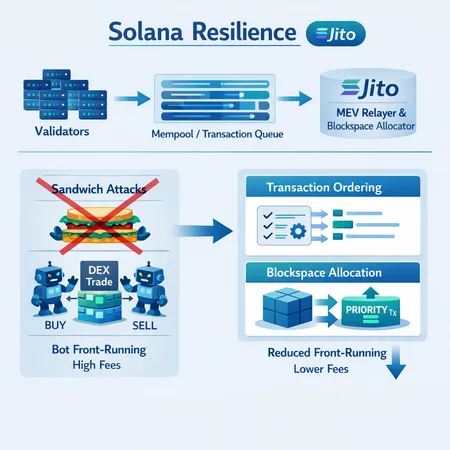
A sandwich attack targets AMM trades with predictable size. The attacker detects a victim trade in the mempool and submits two transactions: a buy just before the victim (front-run) and a sell right after (back-run). The attacker profits from the price movement caused by the victim’s trade while the victim suffers price impact and extra slippage.
Key enablers: fast observation of pending transactions, deterministic transaction ordering by block builders, and low inclusion friction. On high-throughput chains like Solana, small latency windows and cheaply-financed priority fees made these attacks common and painful for retail traders and LPs.
Why that risk has fallen
Several technical and product developments have reduced the simple sandwich surface on Solana. First, there is growing use of private or semi-private submission channels and bundle-based inclusion, which shrinks the time window when a pending transaction is visible to opportunistic searchers. Second, block-builder tooling — led by projects like Jito — provides controlled pathways for searchers and relayers to submit complex bundles that are executed atomically, removing the need to rely on the public mempool. Finally, continuous runtime optimizations and guardian logic at the validator and builder layer make naive front-running attempts less reliably profitable.
As recently reported, the immediate threat from simple sandwich attacks has decreased substantially on Solana: ecosystem observers note a reduction in straightforward sandwich profitability and credit Jito’s tooling and ongoing optimizations for part of that decline (see reporting from Cryptopolitan). Cryptopolitan’s write-up frames this as a combination of improved block production workflows and better searcher protocols.
Jito’s role: block building, bundle submission, and blockspace allocation
What Jito provides at a high level
Jito Labs has built infrastructure that sits between searchers (MEV bots / arbitrageurs) and validators. Instead of letting every individual transaction race the public mempool, searchers can submit bundles or participate in auctions where a block builder constructs an execution sequence that maximizes extractable value while offering a deterministic inclusion guarantee to the validator.
This model changes the incentives and the mechanics of transaction ordering in two important ways. First, it centralizes the ordering decision into builders who can optimize for overall revenue while respecting safety constraints. Second, it gives searchers a private channel to propose sequences, reducing the exposure of single transactions that would otherwise be visible to sandwichers.
Technical mechanics: bundles, solver auctions, and allocation
At a technical level, Jito’s stack allows searchers to send pre-signed transaction bundles (or solver outputs) directly to block builders. Builders then run a solver to select and order those bundles together with ordinary transactions. This is similar in spirit to the “block-building + relay” model used in other ecosystems but adapted to Solana’s pipelined execution and leader schedule.
Blockspace allocation is therefore more auction-driven: high-value bundles win inclusion and can pay a direct compensation to validators or block builders. That re-allocates MEV from opportunistic, possibly predatory actors into structured capture via builders and relays. The direct implication is a reduction in uncoordinated front-running, because profitable sequences are now often executed atomically by the builder rather than as separate transactions through the public mempool.
Jito continues to iterate on latency, bundle acceptance policies, and how priority fees and bribes are surfaced to validators — all of which change the calculus for searcher strategies.
How these changes affect fees, front-running, and DEX liquidity
Fees and effective cost to traders
There are two fee dynamics to track. Base transaction fees are still governed by Solana’s cost structure and are generally low. But when blockspace becomes auctioned via bundles, inclusion fees (or “tips”) can rise during spikes in MEV opportunities. That said, because many MEV flows are now captured by builder relays instead of being extracted via slippage, the effective cost to a retail trader in terms of slippage and execution loss tends to fall.
In short: out-of-pocket gas fees may not fall dramatically, but realized trade cost (price impact + sandwich losses) often improves when naive sandwich vectors are removed.
Front-running, ordering, and UX improvements
When builders execute bundles atomically, the classic front-run/back-run sequence becomes either impossible or less profitable for simple sandwichers. That reduces bad UX for traders: fewer inexplicable slippage events, fewer drowned trades, and better predictable fills. For DEX users, this translates into tighter effective spreads and improved certainty about execution outcomes.
However, there are trade-offs. Centralized builders can become single points of ordering power. If builder selection or relay policy is opaque, searcher behavior may shift to more sophisticated MEV extraction strategies (e.g., cross-block reorg attempts, complex sandwich variants, or multi-leg arbitrages). That’s why transparency and careful builder governance are important mitigations.
Impact on DEX liquidity and LP risk models
Lower incidence of simple sandwiching improves the experience for market takers and reduces short-term impermanent loss for liquidity providers. AMM prices will better reflect underlying arbitrage adjustments executed by coordinated builders, instead of being skewed repeatedly by sandwichers.
For LPs the risk profile changes subtly: fewer micro front-running events reduce short-term volatility and potential fee leakage, but the concentration of MEV capture into builder economics means some rent is paid outside the AMM fee pool. LPs and product teams need to model this shift: expected fee revenue may change depending on whether MEV capture is internalized by validators/builders or continues to be extracted in AMM slippage.
Practical guidance for engineers and product managers
- Mempool strategy: prefer private submissions or builder-compatible bundling when offering trade execution to reduce sandwich exposure. If you run an RPC or wallet backend, support bundle primitives or private relay endpoints.
- Slippage controls: tighten default slippage settings for retail UI while offering advanced users explicit options to participate in bundle-based execution.
- Observability: instrument transaction outcomes (fill price vs. expected, fee paid, latency) to quantify MEV-related slippage over time.
- LP monitoring: add metrics for realized impermanent loss vs. historical benchmarks before/after builder adoption; gauge how much MEV rent leaks outside of the fee pool.
- Compatibility: ensure smart-contract composability and DEX routing can accept atomic bundle inclusion semantics (retries, fallbacks).
For trading platforms like Bitlet.app these operational changes matter: execution pipelines that integrate with builders or offer bundle submission options will yield materially better UX for users in many contexts.
Can Solana’s architecture sustain renewed price momentum for SOL?
On the technical front, Solana’s strengths — low latency, high throughput, and a leader-driven block production pipeline — remain intact while the ecosystem reduces obvious MEV attack vectors. That improves the chain’s security posture for traders and DeFi apps, which is a positive fundamental for adoption.
But price momentum is not driven solely by lower sandwich attacks. Coinpedia’s market note connecting technical resilience to price action observed SOL reclaiming the $85 area during the rally, which underlines how market participants price in protocol-level improvements alongside macro liquidity and speculative flows (see Coinpedia). Coinpedia’s analysis frames recent price action as partly confidence-driven.
Sustained price upside will require continued on-chain activity, developer momentum, DEX volumes, and broad searcher adaptation. If MEV capture simply migrates into opaque builder rents with poor revenue-sharing, some participants could view that as centralizing. Conversely, if builders like Jito continue to evolve transparent, efficient blockspace allocation and share MEV under reasonable governance, the UX improvements could attract more trading volume and composability use-cases — supportive of longer-term valuation.
Risks and open questions
- Sophisticated MEV: reducing naive sandwich vectors shifts searchers to more complex strategies (multi-block or cross-protocol) that may be harder to observe and mitigate.
- Centralization trade-offs: builder/relay concentration can create systemic points of failure or censorship risk if not properly decentralized.
- Fee oscillation: during high MEV episodes, inclusion fees can spike; product teams need robust fallbacks and retry logic.
Monitoring these vectors is essential. Engineers should instrument for non-trivial attack patterns and keep validator/builder telemetry as part of their security dashboard.
Conclusion: a more resilient Solana, with new responsibilities
Solana’s immediate sandwich attack surface has narrowed thanks to private submission channels, bundle-based inclusion, and Jito’s continuous optimizations. That materially improves trader UX — fewer slippage surprises, more predictable fills, and better DEX liquidity behavior — while changing where MEV is captured and how fees behave.
For engineers and product managers, the imperative is to adapt: support bundle paths, tighten slippage defaults where appropriate, and monitor on-chain outcomes to detect emergent attack patterns. Whether these technical advances convert into sustained SOL price momentum depends on adoption, governance of builder markets, and how searchers evolve their tactics.
Solana security and MEV dynamics have entered a new phase: the attack surface is changing, not disappearing, and careful engineering plus transparent builder governance will determine whether the chain reaps long-term product and market benefits.
Sources
- Solana no longer threatened by simple sandwich attacks; Jito continues optimization: https://www.cryptopolitan.com/solana-no-longer-threatened-sandwich-attacks/
- Market note on Solana price rally and reclaiming $85: https://coinpedia.org/price-analysis/solana-price-rally-gains-momentum-can-sol-flip-100-hurdle/
(Internal reference: read more on ecosystem trends and on-chain UX in DeFi.)