XRP's Split Personality: Institutional ETF Flows vs. Spot Price — Can Whales and XRPL Japan Trigger a Real Breakout?
Summary
Executive snapshot
XRP today looks like two markets layered on top of each other. On one layer institutional flows and ETF-like demand are building a bullish narrative; on another, the spot market has lagged and remains fragile, susceptible to short squeezes and liquidity whipsaws. For active crypto investors and event-driven traders, the key question is whether whale accumulation plus the upcoming XRPL Japan events can convert episodic demand into a sustained breakout.
Whale accumulation: what the on-chain data actually shows
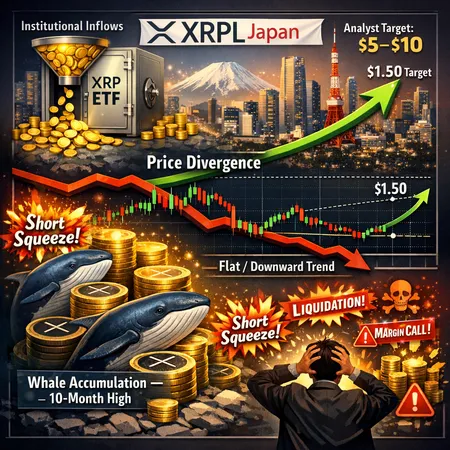
On-chain trackers and market reporters flagged a notable uptick in large XRP transfers and accumulation ahead of XRPL-focused conferences. Reporting indicates that whale accumulation climbed to a 10-month high in the run-up to the XRPL Japan event, suggesting that large holders are using the calendar of on-chain-focused gatherings as an opportunistic accumulation window (Coingape report).
Why this matters: whales shifting coins into accumulation addresses can reduce easily available sell-side liquidity and set the stage for larger moves when matched by new buy-side pressure. But accumulation alone is not the same as price discovery—large holders can sit on inventory, and exchanges still provide the marginal liquidity that sets spot prices.
ETF flows versus spot price: the growing divergence
Several institutional indicators have been positive even as the XRP spot price retreated. Reports show that XRP-focused ETFs or institutional channels have achieved strong performance metrics and inflows in certain periods, a pattern that contradicts the roughly 40% decline in spot over the same horizon (U.Today analysis on ETF performance).
How can ETFs outperform while spot falls? Structural reasons include:
- ETF creation/redemption mechanics and market makers smoothing flows through derivatives and synthetic exposures.
- Institutional demand that sits in off-exchange vehicles or custodial stacks rather than in spot exchange order books.
- Price dissipation caused by retail selling on spot venues while institutions dollar-cost average into managed products.
This split means that institutional interest may not immediately translate into tighter spot liquidity or higher exchange-cleared prices. For traders who watch on-exchange depth, that creates a tricky environment: headlines about ETF inflows can be accurate while the spot market remains vulnerable.
Recent short squeezes and liquidation dynamics — a cautionary note
Event-driven rallies in XRP have recently carried a hidden cost: rapid short squeezes and cascading liquidations. One report quantified about $200M of shorts getting squeezed, and technical indicators like Bollinger Band expansions warned traders against impulsively chasing the bounce (U.Today short-squeeze coverage).
What traders should internalize:
- Short squeezes can create powerful, fast-moving spikes that quickly reverse once liquidity providers step in to lock profits.
- Liquidation cascades widen spreads and often attract predatory liquidity-taking, increasing slippage for late buyers.
- Volatility around events (like XRPL Japan) can be amplified by leverage on margin exchanges.
In short: rallies that feel decisive intraday can still be traps if they are purely squeeze-driven rather than demand-driven. Keep order execution and slippage front of mind.
Technical targets and scenario framing
Near-term: a realistic resistance band for a meaningful move higher sits around $1.50. That level has shown historical friction and is a natural first test if accumulation turns into buy-side pressure.
Medium- to long-term: some analysts frame more ambitious targets in a $5–$10 range, conditional on transformative flows and structural adoption (Coinpedia price scenario). Those outcomes require more than one positive event; they need sustained institutional buying, reduced sell-side liquidity from holders, and clearer macro/regulatory tailwinds.
Probability framing (not trading advice): moving from the spot trough to $1.50 is plausible if whale accumulation persists and event-related demand materializes. Jumping to $5–$10 within months is a lower-probability outcome unless institutional flows remain robust and are accompanied by significant new liquidity or adoption on the XRPL.
Conditions that would support a sustained breakout
- Continued and visible ETF/institutional flows that deposit XRP into custody (not just synthetic exposures).
- A meaningful portion of whale accumulation staying off-exchange (removing circulating supply from liquidity pools).
- Positive XRPL ecosystem developments from the XRPL Japan event that drive adoption news, not just PR.
- Macro stability in crypto markets, with crypto risk-on flows (often led by assets like Bitcoin) supporting altcoin rallies.
How XRPL Japan could catalyze (or disappoint)
The XRPL Japan event is a focal point: it concentrates developers, corporate partners, and regional participants. Good outcomes—new partnerships, live product demos, or exchange listings—could provide narrative fuel and institutional confidence. But events also invite headline-chasing and speculative flows. A strong PR cycle without material product launches can create a short-lived price bump rather than a structural shift.
Japan-specific context matters: Japanese OTC desks and local exchanges can be significant sources of buy-side, but regional flows must exceed global sell pressure to move the spot price sustainably.
Practical trade frameworks for event-aware exposure
For active investors who want XRP exposure without being trapped by event-driven volatility, consider these frameworks:
- Scaled allocation and laddered entries
- Break your target exposure into several tranches. Buy portions before the event, at the event, and on controlled post-event pullbacks to avoid paying peak squeeze prices.
- Size by volatility, not conviction
- Allocate a smaller percentage of portfolio capital to high-volatility event trades. Use position sizing that limits the dollar loss to a pre-defined percentage.
- Use hedges and defined-risk instruments
- Consider buying protective puts or using collar strategies when available. For spot-only investors, short-duration derivatives hedges can reduce downside during the event window.
- Avoid chasing late-day breakouts
- If you observe a strong intraday spike driven by elevated funding rates and liquidation prints, wait for a 4–8 hour consolidation or pullback before adding.
- Have clear exit rules
- Define stop-loss levels and profit-taking bands ahead of time (e.g., trim at $1.50, scale further if price closes and holds above that level on weekly candles).
- Watch liquidity, not headlines
- Track order book depth across major venues; shallow books mean higher slippage and greater chance of being front-run by liquidity takers.
- Event window limits
- Limit the portion of your position exposed to the immediate event window (48–72 hours around XRPL Japan). Reassess after the event using on-chain and flow data.
Bitlet.app users, for instance, may find installment or dollar-cost-averaging tools useful to implement laddered exposures without executing all capital at once.
Bottom line: can whale accumulation + XRPL Japan drive a sustained breakout?
Yes—but with important caveats. Whale accumulation and strong institutional/ETF flows are necessary ingredients for a real breakout, not sufficient ones on their own. The XRPL Japan event can act as a catalyst, but catalysts often reveal the underlying liquidity structure: if buy demand is sustained and inventory stays off-exchange, a path to $1.50 and beyond becomes more credible. If flows are transient or mostly headline-driven, expect sharp, short-lived rallies and risk of reversals.
For event-driven traders, the pragmatic approach is nuanced exposure: size positions to survive volatility, use hedges where appropriate, avoid chasing squeezes, and let structural evidence (continued ETF inflows, custodial deposits, persistent on-chain accumulation) confirm the move before committing heavily to $5–$10 scenarios.
Sources
- Coingape — XRP whales turn more bullish as Ripple execs head to major XRPL Japan event: https://coingape.com/xrp-whales-turn-more-bullish-as-ripple-execs-head-to-major-xrpl-japan-event/
- U.Today — XRP’s strong ETF performance goes against price 40% decline: https://u.today/xrps-strong-etf-performance-goes-against-price-40-decline-41-million?utm_source=snapi
- U.Today — Don’t chase XRP’s price bounce: Bollinger Bands signal after $200 million short squeeze: https://u.today/dont-chase-xrps-price-bounce-bollinger-bands-signal-after-200-million-short-squeeze?utm_source=snapi
- Coinpedia — XRP price prediction: analyst explains why $5–$10 are realistic targets: https://coinpedia.org/news/xrp-price-prediction-analyst-explains-why-5-to-10-are-realistic-targets/