Freezeable vs Freeze‑Proof Stablecoins: Lessons from cirBTC, RLUSD, and Recent Hacks
Summary
Why this debate matters now
The stablecoin landscape is changing fast. Circle’s launch of cirBTC — a token intended to expand Bitcoin utility through a Circle‑issued wrapped product — has forced teams to reexamine custody, compliance, and the role of emergency controls. At the same time, high‑profile protocol hacks and the broader regulatory push for accountability have revived arguments for both freezeable and freeze‑proof approaches. Stablecoin product managers, compliance officers, and governance teams must decide not just how to build tokens, but how to protect users without breaking the asset’s fungibility.
For many traders and treasury managers, Bitcoin remains a benchmark of liquidity; tokenized Bitcoin products like cirBTC aim to bring that liquidity into on‑chain rails. Yet increasingly visible incidents — and vocal technical critiques — show that there is no free lunch between custody, recoverability, and the market’s expectations around fungibility.
cirBTC in context: product positioning and tradeoffs
Circle announced cirBTC to extend Bitcoin’s on‑chain utility by offering a Circle‑issued token backed by BTC custody mechanisms. Coverage highlights that cirBTC is intended to be a bridge between traditional custody and on‑chain programmability, giving institutional counterparties a familiar custody model while enabling DeFi use cases (coverage here).
That positioning carries three explicit tradeoffs:
- Custodial convenience vs. permissionless guarantees. A custodied cirBTC can be integrated into existing custody and AML/KYC frameworks, but that means issuer controls and legal obligations are part of the trust model.
- Recoverability vs. permanent immutability. Issuers with freeze capabilities can respond to hacks and court orders; a truly freeze‑proof design cannot. The market prices both risks differently.
- Regulatory clarity vs. raw censorship‑resistance. Compliance advantages can unlock exchange listings and institutional adoption, yet those same controls risk counterparty concerns about censorship or confiscation.
Understanding these tradeoffs is essential: product teams must decide whether the primary customer is the exchange and regulator (who prefer custody and controls) or permissionless users (who value censorship resistance).
The technical critique: why some experts doubt freeze‑proof designs
A recent industry debate frames the technical limits of freeze‑proof systems. Ripple’s CTO Emeritus publicly pushed back against claims that stablecoins can be both practical and truly freeze‑proof, arguing that operational realities and legal obligations force compromises (see the discussion summarized by Coinpedia) Ripple CTO Emeritus critique.
Two core points emerge from that critique:
- Operational recoveries require control hooks. When a protocol or custody provider faces a theft (or an accidental mint/burn), having no technical ability to intervene often means losses are permanent and users have no remediation channel. This is a material risk for mainstream adoption.
- Interplay with legal frameworks. Courts, regulators, and counterparties can demand asset freezes or forfeiture. A design that resists all forms of freeze may simply be infeasible for organizations operating across jurisdictions.
The net takeaway: “freeze‑proof” as a marketing term can mislead stakeholders about practical recoverability and insurer willingness to underwrite risks.
Custodial realities and recent hacks: why governance matters
Recent incidents — technical exploits, private key compromises, and bridge hacks — illustrate the stakes. When funds move off into attacker addresses, users and exchanges cry out for remedies. Issuers who can’t or won’t act often face liquidity drains, delistings, or even legal action.
Custodial stablecoins like USDC operate inside an ecosystem of legal entity control, insurer conversations, and regulated counterparties. That affords them routes to cooperate with law enforcement and exchanges. Conversely, token designs that refuse any form of freeze may retain a narrow subset of users but will also limit institutional adoption.
Market participants notice. Token listings, tradable pairs, and exchange support reflect how issuers balance control and market access. RLUSD, for example, has secured listings and pairs against tokenized gold and other assets on several venues — a sign that exchanges will list products when the issuer’s operational and legal frameworks are clear (RLUSD listing example).
At the same time, investor reaction to Circle’s strategic moves shows how markets price governance choices: CRCL stock failed to recover in the short term after news and market speculation about Circle’s wrapped Bitcoin plans and broader risk profile (market reaction coverage). That’s a reminder: governance design affects valuations as much as technical execution.
Token freezes and fungibility: the central tension
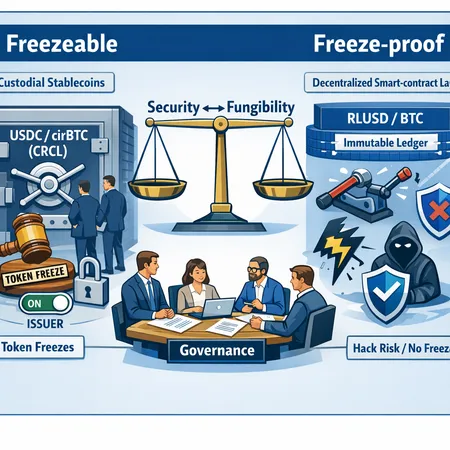
Token freezes are a blunt instrument. When an issuer freezes addresses or pauses contracts, affected tokens temporarily lose fungibility — some holders cannot transact while others can. This raises market fragmentation risks and user trust issues.
Key nuanced points:
- Temporary, well‑articulated freezes can prevent systemic contagion (e.g., stopping the onward distribution of stolen funds) and enable remediation or insurance payouts.
- Permanent or opaque freezing policies undermine fungibility and create economic winners/losers among holders, harming market liquidity.
- Transparency and predictability matter more than the binary existence of a freeze power. Markets tolerate short, well‑documented emergency powers better than surprise or discretionary interventions.
Recommended governance patterns for product teams
Product and compliance teams don’t need to choose extremes. Here are pragmatic governance and emergency‑control patterns that preserve fungibility while enabling credible response paths.
1) Pre‑committed, public emergency policy
Publish a clear Emergency Action Framework (EAF) that defines who can trigger freezes, under what binary conditions (hacks, court orders, severe bugs), and the required evidence. Make this policy immutable or changeable only through a transparent governance process.
2) Layered controls with time delays
Instead of a single on/off kill switch, use multi‑layered controls:
- Short delays (e.g., 24–72 hours) on protocol pauses to allow community review.
- Multi‑sig approval thresholds tied to independent entities (custodian, auditor, legal counsel).
- Automated alerts and public dashboards that announce pending actions and reasons.
3) Minimum‑effective intervention principle
Design freeze powers to be as narrow as possible: freeze specific addresses or token flows rather than entire contract ceilings. Where possible, rely on reversible ledger entries (mirror accounts, reversible settlement) rather than deleting tokens.
4) Cryptographic and on‑chain audit trails
Every emergency action should produce signed, on‑chain evidence of who authorized it and why. This preserves accountability and helps markets decide whether to trust the issuer going forward.
5) Independent oversight and legal clarity
Create an independent recovery committee that includes external auditors, legal counsel, and a subset of recognized industry participants. Document the legal basis for freezes and publish memoranda that can be reviewed by exchanges and custodians.
6) User opt‑in tiers and product design
Offer product tiers: a fully custodial version with recovery options for institutional clients, and a lesser‑trusted, more censorship‑resistant variant for users who accept more risk. Clear labeling reduces surprises and preserves fungibility within each tier.
7) Insurance and remediation mechanisms
Work with insurers and build dedicated recovery funds. If a freeze enables remediation (e.g., reverting a theft), having capital and legal frameworks ready will make the market view freezes as protective rather than predatory.
Practical checklist for launches (quick reference)
- Publish an Emergency Action Framework before mainnet launch.
- Require multi‑party approval with public logs for any freeze or pause.
- Implement address‑level freezes where possible; avoid global halts.
- Maintain a documented recovery fund and insurer relationships.
- Offer clear product tiers (custodial vs. censorship‑resistant) and label them.
- Run tabletop exercises with exchanges and auditors, and publish after‑action reports.
These steps reduce surprises, help exchanges assess listing risks, and provide investors with the transparency they need — which is exactly what markets priced in with RLUSD listings and CRCL moves.
Designing for markets: the liquidity and listing angle
Exchanges and market makers evaluate not just code but counterparty risk. Transparent governance often wins listings and pairs: RLUSD’s recent exchange integrations showed that clear issuer behavior and tradable pair support can unlock liquidity (RLUSD listing coverage). Meanwhile, CRCL’s muted reaction after Circle’s cirBTC announcement demonstrates how investor sentiment can penalize perceived governance or execution risks (CRCL coverage).
If your goal is institutional adoption, accept that some custodial controls are a feature, not a bug — provided they are transparently governed.
Closing: a pragmatic middle path
The binary framing — freezeable bad, freeze‑proof good — is unhelpful. The real work for product and governance teams is to build policies and systems that:
- Make interventions predictable and accountable;
- Minimize impacts on fungibility through narrow, time‑bounded measures;
- Provide remediation and insurance options that protect users after incidents;
- And communicate clearly to exchanges, auditors, and regulators.
Circle’s cirBTC, Ripple’s technical critique, RLUSD’s market integrations, and the CRCL reaction together show that the industry is converging on a pragmatic model: controls exist, but they must be governed transparently and narrowly. That balance — not ideological purity — will determine which stablecoin products achieve broad market utility.
Bitlet.app product and compliance teams routinely see these tradeoffs in client conversations: the best token designs are those that bake both technical robustness and governance clarity into their architecture.
Sources
- https://coinpedia.org/news/ripple-cto-says-freeze-proof-stablecoins-cant-work-as-circle-misses-285m-drift-hack/
- https://cryptonews.com/news/circle-launches-cirbtc-token-bitcoin-utility/
- https://coinpaper.com/15975/crcl-stock-fails-to-recover-despite-circle-wrapped-bitcoin-launch-plans?utm_source=snapi
- https://u.today/ripple-usd-stablecoin-secures-rare-listing-against-tokenized-gold-by-tether-and-paxos?utm_source=snapi