Stablecoins Under Scrutiny: What Circle and Tether Mean for Trust and Liquidity
Summary
Executive snapshot
Stablecoins are no longer an abstract plumbing risk discussed only in white papers. Recent events tied to Circle’s handling of suspect USDC transfers and Tether’s high‑stakes fundraising plan have focused attention on the real operational and compliance questions behind USDC and USDT. For compliance officers, risk managers and treasury teams, this means rethinking counterparty exposure limits, settlement expectations and the role forensic tracing plays in recovery strategies.
In the sections below I reconstruct the key incidents, explain why decisions to freeze (or not) matter, and offer pragmatic controls to manage liquidity and legal risk in an era where stablecoins account for much of crypto’s deployable liquidity.
The events: what happened and why they matter
ZachXBT’s $420M allegation — timing and the claim
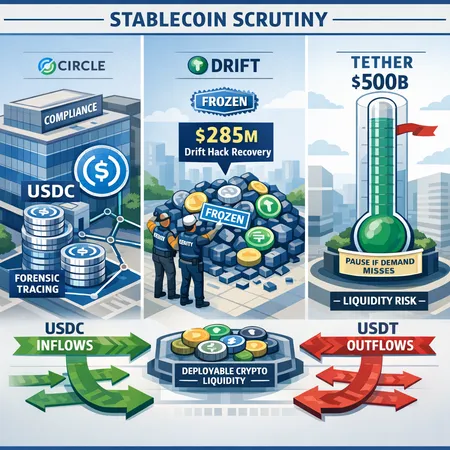
Analyst ZachXBT flagged a sequence of suspect USDC transfers totalling roughly $420 million and asserted that Circle did not freeze those funds in time. Coverage of the allegation (summarized by ApeD and expanded by Crypto.News) reconstructs transactions across multiple chains and points to delays or gaps between detection, public disclosure and enforcement action.
If accurate, the allegation is not merely a technical footnote. It goes to the heart of how quickly a fiat‑backed issuer can act on suspicious activity, the legal constraints they face across jurisdictions, and the operational coupling between on‑chain forensic dashboards and off‑chain compliance teams.
The Drift incident: refusal to freeze $285M and the downstream effects
Circle’s earlier decision not to freeze roughly $285M in stolen USDC tied to the DRIFT protocol hack drew public scrutiny and produced a different kind of lesson: sometimes not freezing enables traceability and negotiation. Blockonomi’s analysis of Circle’s position in the Drift case lays out why refusal to freeze can be a deliberate, evidence‑driven choice designed to preserve the chain of transfers and increase chances of recovery or civil enforcement later (see analysis at Blockonomi).
That decision influenced how the Drift recovery and eventual settlements played out: it lengthened the forensic window, raised bargaining leverage with intermediaries and, in some views, improved the prospects for full restitution by allowing investigators to follow funds instead of interrupting flows abruptly.
Tether’s $500B fundraising move and the market concentration question
Meanwhile, Tether announced an aggressive capital plan with a headline valuation target of $500 billion and a fundraising cadence that includes a caveat to pause if investor demand falls short. Reporting by CoinPedia and Crypto.News highlights how this move both signals enormous ambition and raises questions about concentration: a successful capital raise at scale would increase Tether’s balance sheet clout and, conversely, a pause could reduce confidence in USDT growth assumptions.
For market structure, large shifts in either direction matter: USDT is the dominant stablecoin by on‑chain volume and market depth in many trading pairs. If Tether’s plans change supply expectations, counterparties who use USDT as principal liquidity can face renewed settlement and counterparty risks.
Compliance and enforcement: freeze, trace, or negotiate?
Deciding whether to freeze suspect stablecoin balances is rarely binary. The sequence looks like this in practice: detection → legal review → enforcement decision → public communication. Each step has constraints.
- Detection depends on on‑chain forensic tools and timely alerts. Active monitoring reduces decision latency but cannot eliminate legal friction. Platforms must pair tooling with well‑rehearsed playbooks.
- Legal review is often cross‑jurisdictional. Freezing a fiat‑backed tethered token implicates custodial obligations, access to fiat reserves, and potential conflicts with local law enforcement requests.
- Enforcement decisions must weigh immediate asset immobilization versus the potential loss of forensic evidence and traceability. As the Drift example shows, leaving flows open can be the right call if it increases the odds of constructive recovery.
From a compliance perspective, the ZachXBT allegation raises three uncomfortable but essential questions: how fast can issuers act, what internal controls exist to escalate suspicious patterns, and how transparent are the rules of engagement? Institutions need written, measurable SLAs for issuer response times and public‑facing transparency about freezing policies to set realistic settlement expectations.
Forensic tracing: capability, limits, and expectations
Forensic tracing is a core mitigant to theft and fraud, but it is not a panacea. Modern blockchain analytics are powerful — they can cluster addresses, identify mixing patterns and link to centralized on‑ramps — but the value of tracing depends on cooperation from custodians, exchanges and fiat gateways.
The Drift situation illustrated a trade‑off: uninterrupted flows can create a richer chain of custody for tracing, increasing the prospect of recovery through civil claims or negotiated returns. Conversely, failing to act quickly in scenarios involving fast‑moving laundering rails can facilitate exits. That means treasuries must not assume every illicit transfer is instantly reversible.
For risk teams: insist on documented forensic capabilities from counterparties. Ask for example playbooks, detection timelines and references to past recovery outcomes. Those answers should inform counterparty limits and settlement contingency plans.
Liquidity risk: how large USDC inflows/outflows change deployable liquidity
Stablecoins are a primary source of deployable liquidity in crypto markets. Sudden and large inflows into USDC or outflows from it can change the liquidity available for trading, lending and market making.
Consider two scenarios:
- Rapid USDC outflows (e.g., redemptions or issuer freezes): market‑making desks that use USDC to post bids could find inventory constrained, bid‑ask spreads widen, and margin requirements spike. This creates an access shock for protocols and liquidity takers.
- Rapid USDC inflows (e.g., large minting or concentration of supplies on exchanges): short‑term liquidity may increase, but it can also drive leverage, amplify speculative rails, and concentrate settlement risk on a few custodial entities.
Tether’s fundraising and potential issuance expansion matter because USDT remains deeply embedded in venue and trading pipelines. If Tether pauses issuance or the market reweights to USDC amid trust questions, treasuries will see a rotation in where liquidity sits and who ultimately provides it. That rotation can increase slippage and counterparty exposure during stress events.
Practical playbook for compliance officers, risk managers and treasury teams
Counterparty concentration limits: set hard limits on stablecoin exposure by issuer and by on‑chain wallet clusters. Treat USDC and USDT exposures as distinct counterparty relationships, not fungible liquidity.
SLA and escalation expectations: demand written SLAs for suspicious activity response from stablecoin issuers and primary custodians. Include expected detection → decision → action windows in onboarding contracts.
Forensic capability audits: require counterparties to disclose analytics partners and provide anonymized past case studies showing detection and recovery outcomes. This makes forensic tracing an auditable vendor capability.
Settlement contingency plans: create playbooks for “partial freezes” and market‑making disruptions. Prearrange fallback liquidity lines (e.g., bank fiat corridors or diversified stablecoins) and test them in tabletop exercises.
Operational rehearsals: simulate scenarios where a major stablecoin issuer delays action or where large USDC outflows occur. Measure execution time to switch rails and the P&L impact of widened spreads.
Legal readiness: ensure cross‑border subpoena and enforcement strategies are mapped. Understand which jurisdictions the issuer’s fiat reserves sit in and how local courts have treated token freezes historically.
Price and funding stress tests: include stablecoin runs in liquidity stress tests. Model bid‑ask widening, routing latency and the cost of converting on‑chain stablecoins back to fiat under constrained conditions.
How market structure might change
If trust in USDC erodes materially, expect three market responses: a short‑term migration to USDT and algorithmic alternatives, a regulatory push for stronger issuer transparency, and an acceleration of centralized custody solutions that promise indemnities. Conversely, if transparency improves and freezing decisions become more predictable, institutional adoption will likely deepen — but that requires robust, industry‑standard response norms.
Tether’s fundraising ambition underscores another dynamic: concentration risk. A single issuer with outsized balance‑sheet scale can add efficiency in normal times but becomes a single point of failure during stress. Institutional counterparties should price that optionality explicitly.
Final thoughts and recommended next steps
Stablecoins are both a technological convenience and a governance challenge. The recent ZachXBT allegations and the history of the Drift hack are reminders that issuers operate in difficult trade‑offs between freezing to block theft and allowing continuity to improve traceability. Tether’s capital plans further complicate the picture by changing concentration and issuance expectations.
For compliance officers and treasury teams: rewrite your stablecoin playbook now. Treat USDC and USDT as distinct counterparties, demand documented SLAs and forensic proofs, and build operational fallbacks to convert or hedge stablecoin holdings quickly. Simple exposure limits, combined with regular red‑team tabletop exercises and forensic audits, will materially reduce surprise in future incidents.
Platforms and service providers — including liquidity aggregators and wallets such as Bitlet.app — will need to operationalize these expectations to remain useful to institutional clients.
Sources
- ZachXBT claim and coverage: ApeD summary of ZachXBT’s $420M allegation and Crypto.News expanded coverage.
- Drift protocol analysis and rationale for not freezing: Blockonomi on Circle’s decision in the Drift hack.
- Tether fundraising plans and pause caveat: CoinPedia report on Tether’s $500B valuation fundraising and Crypto.News coverage of the pause if demand misses.
For further reading on how stablecoin liquidity interacts with trading venues and protocols, see discussions on DeFi market depth and why, for many traders, Bitcoin remains a useful hedging reference point.