Why Stablecoins Could Be Crypto's 'ChatGPT Moment' — Banks, Regulation and Payments Rails
Summary
Intro — a moment, not a fad
The phrase "ChatGPT moment" implies a sudden, visceral change in how people, business and institutions perceive a technology. For crypto, a similar inflection point may be playing out around stablecoins. Brad Garlinghouse, CEO of Ripple, has argued that stablecoins are the gateway for enterprise adoption—an on‑ramp that translates crypto-native rails into bankable, balance‑sheet friendly instruments. That framing matters because it reframes stablecoins from speculative tokens into utility infrastructure: programmable money that can settle payments across corporate, banking and public-sector rails.
This article unpacks why that analogy is useful, why banks are racing in, what signals like Tether's KPMG audit mean for institutionalization, and how cleared stablecoin rails, bank custody and policy debates (including congressional hearings mentioning Ripple) will shape outcomes. The goal is practical: help policy analysts, payments executives and institutional strategists evaluate whether stablecoins are ready for mainstream finance and what to do next.
Why stablecoins could be crypto’s 'ChatGPT moment'
A technology reaches a "moment" when it becomes materially easier for institutions to adopt it and when a new set of use cases suddenly look pragmatic rather than speculative. Stablecoins meet several of those criteria: they offer price stability pegged to fiat, near‑instant settlement, programmable features for composable workflows, and the potential to bypass slow legacy settlement cycles.
Brad Garlinghouse has been explicit: stablecoins lower the friction for enterprises to use crypto for payments and liquidity management rather than treating on‑chain assets as purely speculative holdings. His public comments have also nudged major banks and technology vendors to treat stablecoins as a serious product category rather than an experiment (source). That gravitas—coming from a firm actively involved in cross‑border payments—helps shift boardroom conversations from “if” to “how.”
Banks are racing in — strategic incentives and friction points
Why are banks accelerating stablecoin projects? Three pragmatic incentives drive the rush:
- Settlement efficiency and float reduction: tokenized fiat and stablecoin settlement can compress intraday credit exposures and shorten payment cycles. For institutions, that reduces capital tied up in nostro/vostro arrangements.
- Product differentiation: custodial services, token issuance, and enterprise-grade wallets are new revenue lines for banks if they can operate within regulatory constraints.
- Competitive dynamics: technology firms and non‑bank players are building rails and liquidity pools that could disintermediate traditional payment flows if incumbents do not respond.
These incentives coexist with major friction points: custody risk, operational resilience, prudential capital treatment, AML/KYC alignment, and unclear legal status of tokenized bank liabilities. For many banks, offering stablecoin custody or issuing tokenized deposits means reconciling bank governance and operational risk frameworks with on‑chain primitives.
Institutionalization in action: Tether hires KPMG
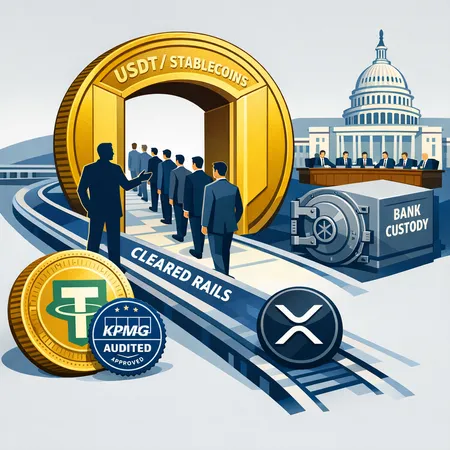
A concrete signal of institutional maturation is Tether (USDT) hiring KPMG to perform a Big‑Four full audit of its reserves. That move is more than optics. For institutional counterparties, auditors from recognized global firms reduce collateral and counterparty model uncertainty. An independent Big‑Four audit helps satisfy several stakeholder groups simultaneously: corporate treasuries conducting due diligence, custody partners assessing exposures, and regulators tracking reserve backing claims. Zycrypto reported on Tether’s engagement with KPMG and framed it as a step toward regulatory readiness and U.S. expansion (source).
Nonetheless, an audit does not erase all questions. Key issues remain: audit scope and frequency, the timeliness of attestations versus the 24/7 nature of on‑chain flows, and whether audited reserves translate into regulatory capital or liquidity relief for counterparties. Still, the KPMG engagement is a marker: one of the large, fast‑moving stablecoins is actively engaging with traditional gatekeepers to lower institutional friction.
Cleared stablecoin rails, bank custody and the policy pivot
Where do cleared rails and bank custody enter the design? There are at least two architectural paths institutions favor:
- Custodial + interbank rails: banks custody tokenized fiat on behalf of clients and rely on existing central bank or correspondent networks for finality and settlement netting. This path minimizes legal novelty by keeping deposits within regulated balance sheets while offering tokenized rails for speed.
- Permissioned cleared rails: industry consortia or regulated entities operate cleared, deterministic settlement rails for tokenized fiat—essentially interoperable private ledgers or hybrid systems that bridge public and private chains.
Both approaches require policy clarity. U.S. congressional attention to payments rail reform—with Ripple named in discussions around modernizing the $93 trillion ACH network—signals that lawmakers are considering both incumbents and crypto firms as participants in a retooled settlement architecture (source). That moment highlights three policy levers:
- Legal characterization of tokenized deposits and stablecoins (bank liabilities vs. private liabilities).
- Prudential rules for custody operations and segregation of client assets.
- AML/CTF and consumer protection standards tailored to 24/7 settlement.
If policymakers create clear templates for settlement finality and custody—while allowing banks to act as regulated on‑and‑off ramps—then cleared stablecoin rails can be integrated without forcing banks to accept open‑ended crypto exposures.
Ripple, XRP and the politics of rails
Ripple’s advocacy for tokenized rails and its CEO’s public framing have put the company in the middle of the policy conversation. Congressional hearings that mentioned Ripple reflect a broader debate: should reform prioritize incumbents (upgrading ACH/CBDC experiments) or allow specialized token infrastructure to compete? The answer matters for market structure. A model that privileges regulated banks operating tokenized deposits will favor incumbents; a more open model could allow fintechs and crypto-native firms to run settlement networks under regulatory oversight.
Either way, the distinction between the token (e.g., XRP) and the use of tokenization as an operational tool is crucial for policymakers and payments executives to understand. The UX of instant settlement will be judged more by counterparty risk and legal finality than by whether a particular token is used under the hood.
Risks, unresolved questions and guardrails
Stablecoins can accelerate enterprise adoption—but only if several risks are managed credibly:
- Liquidity and reserve transparency: Audits and attestation regimes (like the Tether/KPMG move) help, but audit cadence, forensic depth, and continuous monitoring are still open governance questions.
- Systemic exposure: Large stablecoin runs could transmit shocks across payment systems if banks or funds hold meaningful positions.
- Interoperability and fragmentation: Multiple competing rails without common settlement finality risk operational complexity for corporates that need cross‑border solutions.
- Legal clarity: Without statute or clear precedent, legal disputes about custody, finality and insolvency could deter large banks from sizeable commitments.
Regulators and industry consortia should prioritize rules that reduce these risks while preserving innovation: standardized reserve attestations, defined custody responsibilities, interoperable settlement messaging standards, and clear protocol for cross‑border dispute resolution.
Practical recommendations for policymakers and payments executives
For policymakers
- Establish a clear legal taxonomy for tokenized deposits and privately issued stablecoins. Define when an instrument is a bank liability, a regulated stablecoin, or a private token.
- Create minimum audit and reserve transparency standards (frequency, scope, public summaries) that address real‑time monitoring needs of institutional counterparties.
- Pilot cleared rails with participating banks and regulated entities to test finality, liquidity management and cross‑border messaging before broad adoption.
For payments executives and institutional strategists
- Treat stablecoins as an operational design question: evaluate custody models, reconciliation processes and liquidity lines, not just token economics.
- Engage auditors and regulators early. Tether’s KPMG engagement shows the market premium for firms that can demonstrate audited reserves and robust governance.
- Build bilateral and multilateral settlements playbooks that assume multiple rails will coexist; prioritize modular integrations that permit routing across on‑chain and traditional rails.
Platforms like Bitlet.app are watching how these developments influence P2P and treasury products; vendors must balance interoperability with compliance to win institutional customers.
Conclusion — readiness, not inevitability
Calling stablecoins crypto’s 'ChatGPT moment' is useful shorthand: it reflects a sudden, institutional tipping point where technology plausibility, business incentives and regulatory conversations align. But a moment is not inevitability. Institutional adoption depends on credible audits, custody frameworks, cleared settlement rails and legal clarity. Recent moves—Garlinghouse’s framing, congressional hearings mentioning Ripple, and Tether hiring KPMG—suggest the debate is moving from fringe to mainstream. The next 12–24 months will test whether that momentum converts into durable, regulated infrastructure or simply into more pilots.
For policy analysts, payments executives and institutional strategists, the task is to separate hype from practical readiness: insist on rigorous transparency, pragmatic legal frameworks, and pilots that stress‑test liquidity and finality. If those pieces fall into place, stablecoins could indeed become the bridge that brings enterprise finance onto tokenized rails.