Can Solana’s Enterprise Privacy Framework and $136M Inflows Convince Institutions?
Summary
Why enterprise privacy matters for blockchain evaluators
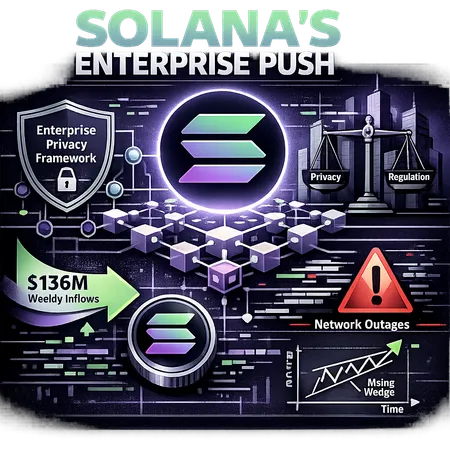
For institutional projects, privacy is rarely about secrecy for secrecy’s sake. Enterprises need confidential transaction flows, predictable auditability, and strong access controls so that sensitive business data (payment amounts, counterparty identity, or business logic) doesn’t leak to competitors while still satisfying regulators and auditors. The Solana Foundation’s new enterprise privacy framework deliberately reframes privacy as configurable — a set of tools and patterns enterprises can toggle to fit compliance and commercial needs rather than an all-or-nothing promise of anonymity. You can read the Foundation’s announcement in more detail in this coverage of the rollout.
This configurable approach is significant because it signals a pragmatic posture: enterprises commonly demand privacy mechanisms that integrate with existing KYC, AML, and reporting workflows. A privacy model that permits selective disclosure, cryptographic audit trails, and off-chain controls is more attractive than privacy that removes auditability entirely.
What the Solana enterprise privacy framework aims to do
The high-level intent behind the framework is to make privacy an enterprise-grade feature set — not an afterthought. In practical terms, the framework is positioned to:
- Make privacy configurable at different layers (transaction fields, program state, and off-chain data links).
- Support operational models where authorized parties can audit or disclose information under governance controls.
- Lower barriers for enterprise pilots by documenting patterns for compliance, custody, and key management.
By packaging privacy as a set of selectable patterns, the Foundation is trying to thread the needle between confidentiality and regulatory visibility. That matters for enterprises exploring on-chain settlement, tokenized assets, or private data-sharing networks; it’s far easier to pilot a solution if the privacy layer can be made audit-friendly for compliance teams.
Sources: the Foundation’s announcement is summarized in this write-up covering the enterprise privacy framework.
The $136M weekly inflow: signal or noise?
Short-form headline: Solana accumulated roughly $136M in weekly inflows recently, which on the surface is a powerful vote of capital interest. That figure (covered in market reporting) shows there is demand — but “demand” can mean different things to an enterprise evaluator or portfolio manager.
Key questions when interpreting inflows:
- Are these inflows from retail allocation rotations or from deeper institutional pockets (treasury allocations, custody onboarding, staking programs)?
- How much of the capital is transient trading liquidity versus locked value (staked SOL, tokenized exposure held by institutional coffers)?
- Do inflows coincide with tangible enterprise activity (pilot launches, partner integrations, or custody enablement)?
On the bullish side, large inflows can improve network liquidity, reduce spreads for large trades, and make it easier for institutions to enter and exit positions. They also attract service providers — custody, OTC desks, and staking providers — that institutions need.
On the cautionary side, inflows can be speculative, momentum-driven, or tied to macro narratives. The same market reports that highlight the $136M figure also flag a technical pattern — a rising-wedge — which traders read as a possible reversal signal. That means capital can build into price near a technical inflection, only to be repriced quickly if momentum stalls.
For portfolio managers, the durable signal would be rising institutional custody balances, higher staking participation by long-term holders, and visible enterprise pilots — not solely weekly inflow snapshots.
Technical and UX hurdles that institutions can’t ignore
Solana offers performance advantages: high throughput and low gas friction are attractive to enterprises building high-frequency micro-payments, NFT-based loyalty systems, tokenized markets, and real-time reconciliations. But several technical and user-experience issues remain core risk factors for institutional adoption:
- Historical outages and availability concerns. Solana has experienced network halts in the past that interrupted transaction finality. For an enterprise paying vendors, settling payroll, or running financial rails, even short outages represent operational and reputational risk.
- Validator and centralization dynamics. Optimal performance currently favors validators with robust hardware and networking — that raises questions about decentralization and single-point operational dependencies, both of which matter to compliance teams and to the resilience assumptions of enterprise deployments.
- Developer and UX friction. While many developers praise Solana’s speed, building reliable systems still requires mature toolchains, observability, and standardized patterns for security and compliance — areas that are actively evolving but not yet uniform across the ecosystem.
- Near-term market technicals. The recent market commentary calling out a rising-wedge in SOL price action is relevant because technical breakouts or breakdowns impact capital availability for new initiatives. If price corrects sharply, some pilot budgets and treasury allocations may slow.
These issues are not fatal, but they force enterprises and allocators to ask for higher SLAs, stronger incident response agreements, and clearer upgrade roadmaps before committing production workloads.
How privacy features interact with compliance and auditability
A major advantage of a configurable privacy framework is that it can be designed around enterprise compliance needs: selective disclosure, auditor view-keys, and time-limited access can allow businesses to keep commercially sensitive fields private while still meeting regulatory reporting.
Practical compliance patterns enabled by sensible privacy primitives include:
- Permissioned view keys or escrowed disclosure for regulators and auditors.
- Off-chain attestations combined with on-chain proofs (for example, zk-proofs that attest to compliance properties without revealing raw data).
- Role-based access control integrated with enterprise identity providers for traceable disclosure logs.
However, privacy features can also attract regulatory scrutiny if they are perceived as enabling illicit activity. The difference is in implementation: privacy that is configurable and gateable for authorized disclosure aligns more with institutional risk profiles than black-box anonymity.
Real-world enterprise pilots and where privacy helps
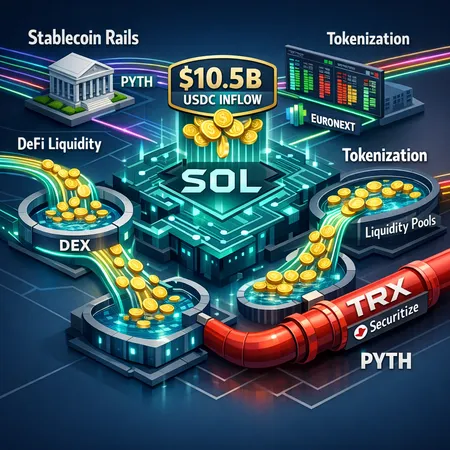
Actual enterprise adoption tends to begin with narrow, well-scoped pilots. On Solana, early enterprise use-cases are clustered around: high-volume stablecoin rails (e.g., USDC issuance and rails on Solana), payment primitives (Solana Pay-style rails and merchant integrations), and tokenized asset pilots. These are not speculative experiments — many are production-feasible once enterprise concerns around custody, compliance, and availability are addressed.
Privacy tools are particularly useful in three classes of enterprise projects:
- Inter-company settlement: companies want to reconcile without revealing counterparty volumes publicly.
- Tokenized securities or private markets: issuers need to protect investor identity or transaction economics while maintaining regulatory audit trails.
- Healthcare and identity workloads: sensitive data can be linked to on-chain proofs without exposing PHI directly on a public ledger.
In each case, configurable privacy lets an organization dial confidentiality up or down depending on the counterparty, the jurisdiction, and contractual obligations.
Balancing the triangle: privacy, capital, and chain stability
Institutional adoption requires three things simultaneously: credible privacy controls, reliable uptime and performance, and sustainable capital depth. Solana has made credible progress on the first two fronts conceptually — a framework and meaningful capital flows — but the practical test is execution.
- Privacy without auditability will spook compliance teams.
- Capital without uptime undermines enterprise SLAs and ruins vendor trust.
- Stability improvements without clear privacy patterns still leave some regulated industries on the sidelines.
The good news is the Solana Foundation’s approach explicitly acknowledges this balancing act: privacy is configurable to avoid the “privacy versus auditability” binary. The investor signal of $136M in inflows suggests the market is paying attention, but infrastructure teams must turn that attention into operational guarantees.
How enterprise blockchain evaluators and portfolio managers should proceed
If you are evaluating Solana for an institutional project or a portfolio allocation, consider a checklist approach:
- Technical resilience: request historical uptime metrics, incident post-mortems, and validator decentralization data.
- Privacy capability: get a clear specification of the privacy primitives, how selective disclosure works, and how auditors can access needed records.
- Capital quality: dig beyond headline inflow numbers to custodial balances, staking patterns, and whether institutional custodians are offering SOL services.
- Operational contracts: require SLAs, integration support, and clear upgrade/rollback procedures for production deployments.
- Regulatory & legal signoff: assess how configurable privacy maps to your jurisdiction’s AML/KYC and data-protection rules.
Platform vendors and service providers — custody firms, auditors, and OTC desks — will be the glue between Solana’s tech and enterprise risk teams. Watch for growing support from institutional custodians; their entrance typically signals a step-change in durable institutional capacity.
Platforms like Bitlet.app and others that track on-chain metrics can help teams monitor inflows, staking rates, and network health as part of ongoing diligence.
Bottom line: a conditional yes, but execution matters
Solana’s enterprise privacy framework and a notable weekly capital inflow are meaningful developments. They move the needle on institutional considerations by addressing both the privacy and liquidity dimensions of adoption. But these signals are conditional — privacy must be accompanied by robust auditability provisions, and capital must prove durable rather than purely momentum-driven.
For enterprise evaluators and portfolio managers, the decision to adopt or allocate should hinge on: (1) demonstrable uptime and incident-resilience commitments, (2) verifiable privacy controls that map to compliance needs, and (3) evidence that capital inflows are translating into lasting infrastructure, custody, and service-provider support. If Solana continues to operationalize its framework while improving network stability, its institutional prospects will materially improve; until then, many risk teams will view Solana as a promising but still maturing candidate.
Sources
- Solana Foundation unveils enterprise privacy framework: Solana Foundation Unveils Enterprise Privacy Framework for Institutional Adoption
- SOL accumulates $136M in weekly inflows (and technical note): Solana (SOL) Accumulates $136M in Weekly Inflows Despite Rising Wedge Warning
For broader context on privacy, institutional adoption patterns, and on-chain health metrics, evaluate on-chain dashboards and auditor reports before committing production workloads.