Can Solana’s SDP Drive Enterprise Adoption—and Lift SOL Price?
Summary
Executive summary
Solana’s new Solana Developer Platform (SDP) is an explicit bet that lowering integration friction for regulated firms will accelerate enterprise adoption of Solana. For product managers and institutional dev teams, SDP promises pre-built APIs, SDKs, and compliance hooks that can shorten pilots and satisfy governance and audit requirements. Whether this translates into stronger on-chain activity and a durable bullish narrative for SOL depends on which workloads land first, how firms deploy (public mainnet vs permissioned stacks), and the macro liquidity backdrop.
For many institutional readers, Solana will feel like the fastest chain that nevertheless needs better enterprise rails. SDP is a practical response: faster onboarding, clearer compliance signals, and developer tooling aimed at regulated financial institutions.
What SDP actually delivers for compliant financial product development
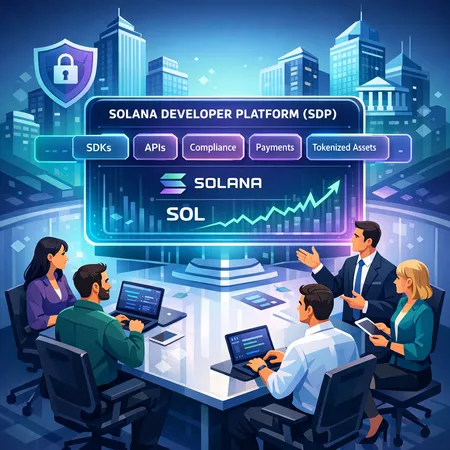
The public announcement frames SDP as an API-driven platform aimed specifically at enterprises and financial institutions. The core value proposition is familiar: deliver abstraction layers that handle security, identity, and compliance so enterprise teams can focus on product logic rather than chain plumbing (Solana Foundation announcement).
Key SDP features that matter to institutional dev teams:
- Institutional SDKs and APIs: Standardized client libraries and REST/gRPC endpoints for account provisioning, token minting, and transaction lifecycle management. This reduces integration risk and dev time.
- Compliance hooks: Built-in KYC/KYB and audit trails, or at least well-defined extension points to integrate custody and compliance providers—critical for banks and licensed fintechs.
- Permissioning and access controls: Options for role-based controls, whitelisting, and rate limits so issuers can meet operational controls without building everything from scratch.
- Operational tooling: Monitoring dashboards, replayable logs, and simulation environments that mimic production throughput—important when SLAs matter.
- Enterprise-grade SLAs and support: Commercial support and enterprise SLAs for onboarding and incident response.
Taken together, these features aim to convert proof-of-concept work into production pilots faster. That matters to product managers who must justify regulatory and engineering timelines to compliance and security teams.
Which enterprise use cases will land first?
Not every enterprise blockchain use case is equally likely. The most probable early adopters are those that prioritize throughput, low latency, and mature token standards.
Payments and stablecoin rails
Payments—especially cross-border payouts, payroll rails, and B2B settlement—are the most natural first wave. These use cases benefit from Solana’s high throughput and low per-transaction cost, and they map cleanly to regulatory models since many firms already operate stablecoin rails and licensed fiat gateways.
Enterprises prefer deterministic performance for settlement windows; SDP’s operational tooling and compliance hooks reduce risk and accelerate integration with custodians and fiat on-ramps.
Tokenized assets and asset servicing
Tokenized securities, tokenized funds, and asset servicing workflows (corporate actions, dividends, custody reconciliation) are a close second. These are attractive because the business case can come from cost savings and faster settlement—areas where on-chain tokenization can be measured in fees saved and capital efficiencies.
However, tokenized assets also trigger the strictest regulatory scrutiny. SDP’s compliance interfaces will be decisive: tokenization pilots succeed only if issuer, custodian, and transfer agent requirements are satisfied.
AI-ready apps and alternative data use
The SDP announcement explicitly mentions AI readiness. Solana’s speed is attractive for real-time inference, streaming data marketplaces, and composable AI services where chain-attached data and state matter. These are more experimental but could flourish inside enterprises that want low-latency on-chain coordination for models or data marketplaces.
In short, payments and tokenized assets are first; AI-ready apps follow as enterprise confidence grows.
How institutional SDKs and APIs change developer economics on Solana
Developer economics is about time-to-market, maintenance cost, and ongoing operational expense. Institutional SDKs and APIs change those levers in several ways:
- Lower integration cost: Pre-built SDKs reduce bespoke engineering, cutting months off enterprise timelines. That lowers the marginal cost of each pilot and increases the number of experiments an org will run.
- Reduced compliance overhead: Standardized compliance patterns reduce legal friction. When auditors and compliance teams recognize familiar controls, sign-off becomes easier—again lowering non-technical cost.
- Friction toward a service model: Commercial APIs often introduce recurring costs (licensing, support tiers). That shifts some economic value from engineering teams (custom solutions) to platform providers and may centralize a portion of revenue capture.
- Platform lock-in vs. composability: Well-designed SDKs can remain composable; poorly designed ones can lock teams into vendor-specific patterns. Institutional buyers will weigh this carefully because migration costs for financial systems are high.
- Operational overhead trade-off: If enterprises run on public mainnet, they will consume blockspace (fees) and contribute to on-chain activity. If instead they deploy permissioned or consortium layers that only sync selectively to mainnet, developer economics favor predictable costs but reduce direct fee capture for SOL.
For product managers, the key calculation is whether faster pilots and predictable support compensate for any platform fees or lock-in risk.
Will SDP moves justify a medium-term bullish thesis on SOL price and support levels?
Short answer: SDP improves Solana’s narrative and raises the probability of sustained enterprise activity, but it is not by itself sufficient to guarantee a medium-term rally in SOL. The market impact depends on three chained outcomes:
- Enterprise demand translates to public mainnet volume — enterprises must choose public deployment (or public settlement rails) instead of fully permissioned stacks.
- Sustained fee capture — higher on-chain activity must produce enough recurring fees and protocol utility to matter to token economics.
- Macro and liquidity context — broader crypto capital flows and macro risk appetite remain supportive.
Technically, the charts show that SOL has been defending key support zones, and short-term sentiment has improved relative to BTC, but macro liquidity and risk-on flows still dominate price action (Coinpaper analysis on weekly support; see also short-term market notes on SOL strength versus BTC in industry commentary) (CryptoTicker market commentary).
If SDP accelerates real payments and tokenization pilots that run on the public mainnet, the result could be measurable: higher transactions-per-second, more SPL token issuance, greater demand for validator services, and more fee sinks through increased settlement activity. That would be constructive for SOL’s medium-term support levels.
But there are counterweights. Enterprises may prefer permissioned or hybrid deployments that keep settlement off-chain or on private clusters with only periodic netting to mainnet. That reduces the direct on-chain benefit and dilutes the effect on SOL price. Additionally, even if activity moves to public mainnet, fee economics on Solana are still orders of magnitude lower than on congested chains; high-volume enterprise activity may not translate into materially higher fee revenue unless protocols introduce fee-model changes or additional value-capture mechanisms.
Taken together, SDP shifts probabilities in favor of a bullish outcome, but it does not eliminate the tail risks. A prudent medium-term thesis would treat SDP as an incremental positive that must be confirmed by measurable adoption signals over the next 12–24 months.
Practical checklist for product managers and institutional dev teams
If you are evaluating SDP for a regulated product, consider this pragmatic checklist:
- Compliance fit: Can SDP integrate with your KYC, AML, and custody partners without custom work?
- Deployment model: Will you run on public mainnet, a permissioned cluster, or a hybrid model? What does that mean for settlement finality and audit trails?
- Cost model: What are expected run costs (fees, SDK licensing, support) and how do they compare to your existing rails?
- Vendor lock-in: How portable is your stack if you later migrate to another chain or a permissioned ledger?
- Monitoring and SLAs: Can you get the operational guarantees your business requires (uptime, incident response)?
Teams that answer these questions positively will find SDP materially reduces time-to-market. Teams that need absolute control over every compliance touchpoint may still prefer bespoke stacks.
Product teams that already use fiat rails or installment and P2P features (for example, partners in the Bitlet.app ecosystem) will watch whether SDP shortens settlement loops or reduces reconciliation overhead.
Risks and timeline
Realistic timelines: Expect pilots and small-scale production launches in 6–12 months if integration is straightforward; larger bank-grade deployments can take 12–24 months given regulatory sign-offs, audit cycles, and third-party integrations.
Key risks:
- Regulatory clampdowns or unclear guidance that slows approvals.
- Enterprises choosing permissioned-only deployments, limiting public mainnet impact.
- Market liquidity and macro conditions that mute any on-chain volume to token-price correlation.
Conclusion
SDP is a meaningful product-market fit move by the Solana Foundation: it addresses the chief engineering and compliance objections that have slowed enterprise pilots. For product managers and institutional dev teams, the platform lowers integration and regulatory friction and makes payments and tokenization much more plausible near-term projects.
For SOL price, SDP tilts the odds toward a constructive narrative but is not a guarantee. The medium-term bullish case requires sustained, measurable migration of enterprise activity onto public mainnet and favorable macro liquidity. Watch for early signals—live payment rails, tokenized asset issuances, and regular enterprise transaction volume—as the clearest evidence SDP is shifting on-chain economics in a way that should support SOL.
Sources
- Solana Foundation announcement: Solana Foundation launches new AI-ready developer platform for global financial institutions
- Market/technical context on SOL support: Solana price prediction: weekly support still intact
- Short-term market commentary on SOL vs BTC: CryptoTicker market notes