What Circle-Led $36M for Tazapay Signals: Regulated Rails, Stablecoins and XRP in Cross-Border Payments
Summary
Executive overview
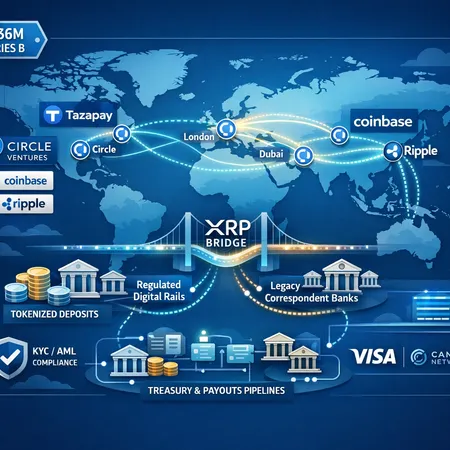
The Circle-led $36M Series B extension into Tazapay marks more than a growth capital event: it’s a directional bet that regulated crypto rails—built around fiat-backed stablecoins, compliant custody, and payments APIs—can displace or materially augment legacy correspondent banking for many cross-border use cases. The syndicate (which includes Coinbase and Ripple) brings three types of value: stablecoin liquidity, access to on‑and‑off ramps, and a regulatory posture that tilts toward compliance-first productization. For fintech product and payments strategists, this is a signal to re-evaluate treasury, payouts, and liquidity strategies with tokenized rails in mind.
Deal details and investor motives
The primary reporting on the transaction outlines a $36M extension to Tazapay’s Series B led by Circle Ventures, with participation from Coinbase and Ripple, among others primary report. Tazapay is a cross-border payouts and collections platform focused on marketplaces and merchants; the financing is explicitly aimed at scaling regulated rails and expanding payout corridors.
Why these investors? A few motives align:
- Liquidity and distribution: Circle can supply or integrate stablecoins (e.g., USDC) as settlement legs; Coinbase provides exchange and custody integrations; Ripple contributes payments experience and corridor relationships.
- Regulatory signaling: Having regulated, well-known backers reduces friction with banks and enterprise customers who demand compliance guarantees.
- Product expansion: The round accelerates product roadmaps—treasury integrations, tokenized deposits, and programmable payouts—where these investors already see demand.
Taken together, the deal is as much about market credibility and operational partnerships as it is about capital.
Technical and compliance requirements to scale globally
Scaling regulated rails is not just a software problem; it’s an operational and legal engineering challenge. Building global, compliant cross-border flows that use stablecoins or tokenized deposits requires addressing multiple layers in tandem.
Licensing, KYC/AML and local partnerships
Enterprises need either domestic licenses or trusted local partners that can accept and remit fiat. Expect a mix of Money Transmitter licensing, payment institution approvals, and bespoke regional registrations depending on corridor. Strict KYC/AML, sanctions screening and transaction monitoring systems are table stakes; these must integrate with on-chain instrumentation to correlate chain addresses with legal entities.
Custody, tokenized deposits and regulatory capital
Tokenized deposits (on-chain representations of bank balances or regulated stablecoins) demand custody and segregation rules that satisfy regulators. Firms expanding into this space will have to prove settlement finality, reconciliations, and consumer protection in the event of insolvency—areas that historically favored banks.
A recent precedent: regulated payment firms are upgrading licenses to expand virtual-asset services, underscoring the trend of compliance-oriented growth and the feasibility of building these capabilities under a regulated umbrella license upgrade example.
Liquidity provisioning and FX management
Cross-border payouts require pre-funded liquidity in destination currencies or instant FX conversion layers. Stablecoins simplify intra-rail movement but still require reliable conversion to local fiat—either through licensed partners, regulated exchanges, or on-chain liquidity pools with adequate depth.
Architecturally, platforms will combine order books, automated market maker (AMM) liquidity, and custodial FX holdings with smart contract rails to reduce latency and reduce cost relative to multi-hop correspondent paths.
Settlement guarantees and operational resiliency
Enterprise customers expect guaranteed settlement windows and predictable reconciliation. That means building monitoring, dispute resolution, and liquidity backstops (credit lines, pooled liquidity) that mimic bank guarantees while leveraging faster chain settlement.
Why stablecoins and regulated rails can compete with correspondent banking
Legacy correspondent banking is reliable but slow and expensive for many use cases—especially low-ticket B2B payouts, marketplace merchant remittances, and treasury optimization across many corridors. Stablecoins and regulated rails offer advantages:
- Speed: On-chain settlement can be near-instant compared with multi-day correspondent routing.
- Cost: Fewer intermediaries reduce fees if on/off ramps are efficient.
- Programmability: Smart contracts enable automated payouts, reconciliation hooks, and composable treasury workflows.
But the competitive edge depends on integration—where regulated rails with strong compliance controls and trusted on/off ramps win enterprise customers. This is why Circle, Coinbase and Ripple backing Tazapay is important: they provide both the liquidity and the credibility to bridge on-chain efficiency with off-chain compliance.
Institutional initiatives mirror the same logic. For example, Visa joining the Canton Network as a super validator illustrates how major payments firms are architecting for on‑chain, regulated settlement layers and not ignoring tokenized rails Visa on Canton. That alignment between incumbents and crypto-native players accelerates the path to production-grade rails.
Likely product roadmaps: treasury, payouts, tokenized deposits
Based on investor profiles and market demand, expect the following near-term product priorities from regulated-rail providers:
- Treasury primitives: APIs for multi-currency balance management, single-view liquidity, and automated FX conversion using stablecoins as an internal settlement leg.
- Payout orchestration: SDKs and APIs for batch and real-time payouts to bank accounts, cards, and wallets—combined with automated reconciliation and dispute workflows.
- Tokenized deposits: On-chain representations of regulated cash (or fully-backed stablecoins) to enable programmable flows, instant settlement guarantees, and transparent proof-of-reserves.
- White-label merchant rails and marketplace integrations: Turnkey solutions for marketplaces that need cross-border merchant remittances and fee splits.
These product lines are complementary—treasury primitives reduce working capital needs, tokenized deposits lower settlement time, and payout orchestration delivers the final mile.
Interplay with Ripple’s commercial strategy and XRP as a bridge asset
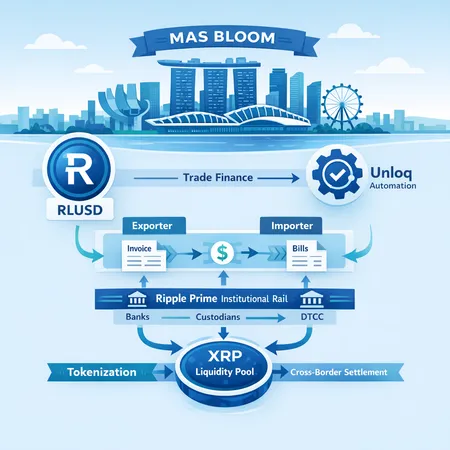
Ripple’s participation in this financing should be read through two lenses: distribution and corridor optimization. Ripple has been actively expanding commercial ties in Asia and beyond—recent collaborations in Singapore are part of that push and indicate a focus on regional corridor activation Ripple Asia push.
XRP's potential role is as a low-cost, fast bridge asset when fiat liquidity is thin or when market prices make direct FX expensive. But two practical points matter:
- Adoption depends on corridor liquidity and counterparty acceptance. If enterprises and payout providers prefer fully regulated stablecoins or tokenized deposits, XRP may be used sparingly—perhaps as a backup liquidity leg or in corridors where XRP liquidity is deeper.
- Regulatory clarity and commercial incentives: XRP’s role grows if Ripple can bilaterally place liquidity and commercial relationships that make it cheaper or faster than alternatives.
So the investment is symbiotic: Ripple helps open corridors, and platforms like Tazapay can embed XRP as one of several settlement options—alongside USDC or tokenized deposits—depending on client needs.
Near-term market and regulatory risks
No transition is frictionless. Key near-term risks to product and market rollout include:
- Regulatory scrutiny of stablecoins: Jurisdictions moving to tightly regulate redeemability, reserves and issuer responsibilities could raise costs or require local issuance models.
- Bank de-risking and correspondent responses: Banks may restrict relationships or raise fees for participants perceived as crypto-native, forcing more reliance on non-bank partners or licensed custodians.
- Liquidity fragmentation: Multiple stablecoins, tokenized deposits and bridging assets risk fragmenting liquidity and increasing slippage unless interoperability/multi-rail routing is implemented.
- Operational and legal risk: Reconciliation mismatches, custody incidents or sanctions-compliance failures would quickly erode enterprise trust.
A recent regulatory/compliance precedent shows how firms are seeking license upgrades to expand virtual-asset trading under regulated frameworks, a pattern that will likely continue as firms try to mitigate these risks license precedent.
Strategic takeaways for fintech product and payments strategists
- Reassess treasury architecture: Design treasury stacks to natively support on-chain settlement legs (stablecoins, tokenized deposits) while preserving bank rails for fiat finality.
- Prioritize modular on/off ramp partnerships: Build or select partners that can localize compliance and liquidity in key corridors quickly.
- Expect multi-rail routing logic: Competitive platforms will route payments across stablecoins, tokenized deposits and bridge assets (including XRP where practical) to optimize cost and speed.
- Watch incumbent moves: Visa and other merchants moving onto chains means integration points will expand; map how these initiatives (e.g., Canton) affect corridor topology Visa on Canton.
- Consider commercial partnerships strategically: Investors like Circle, Coinbase and Ripple offer more than capital—access to liquidity, exchange rails and corridor relationships that reduce time-to-market for enterprise products. Platforms that move early to integrate regulated rails can gain a first-mover advantage.
For a working example of how consumer and P2P layers can connect to these rails, platforms such as Bitlet.app illustrate the integration of crypto installment, earn and P2P exchange services into broader payments stacks.
Conclusion
The Circle-led $36M extension into Tazapay is a tangible vote of confidence for regulated, stablecoin-capable rails as the next wave in cross-border payments. Execution hinges on rigorous compliance, deep liquidity, and practical partnerships that bridge on-chain speed with off-chain legal finality. For Ripple, the deal complements a commercial push that can increase real-world utility for XRP where liquidity and regulation permit. Payments strategists should treat this moment as both an opportunity and a warning: the rails are becoming available, but the winners will be those who marry operational discipline with smart multi-rail engineering.
Sources
- https://crypto.news/circle-coinbase-and-ripple-back-tazapays-36m-raise/
- https://cryip.co/visa-joins-canton-network-as-super-validator-for-on-chain-payments?utm_source=snapi
- https://www.tokenpost.com/news/business/19313
- https://blockonomi.com/alchemy-pay-and-htf-securities-obtain-sfc-type-1-license-upgrade-for-virtual-asset-trading/